- Animals
- ›Arthropods
- ›Hexapods
- ›Insects
- ›Winged and Once-winged Insects
- ›Ants, Bees, Wasps, and Sawflies
- ›Narrow-waisted Wasps, Ants, and Bees
- ›Ants, Bees, and Stinging Wasps
- ›Vespoid Wasps
- ›Hornets, Paper Wasps, Potter Wasps, and Allies
- ›Paper Wasps
- ›Honey Wasps and Allies
- ›Polybia
- ›Pedothoeca
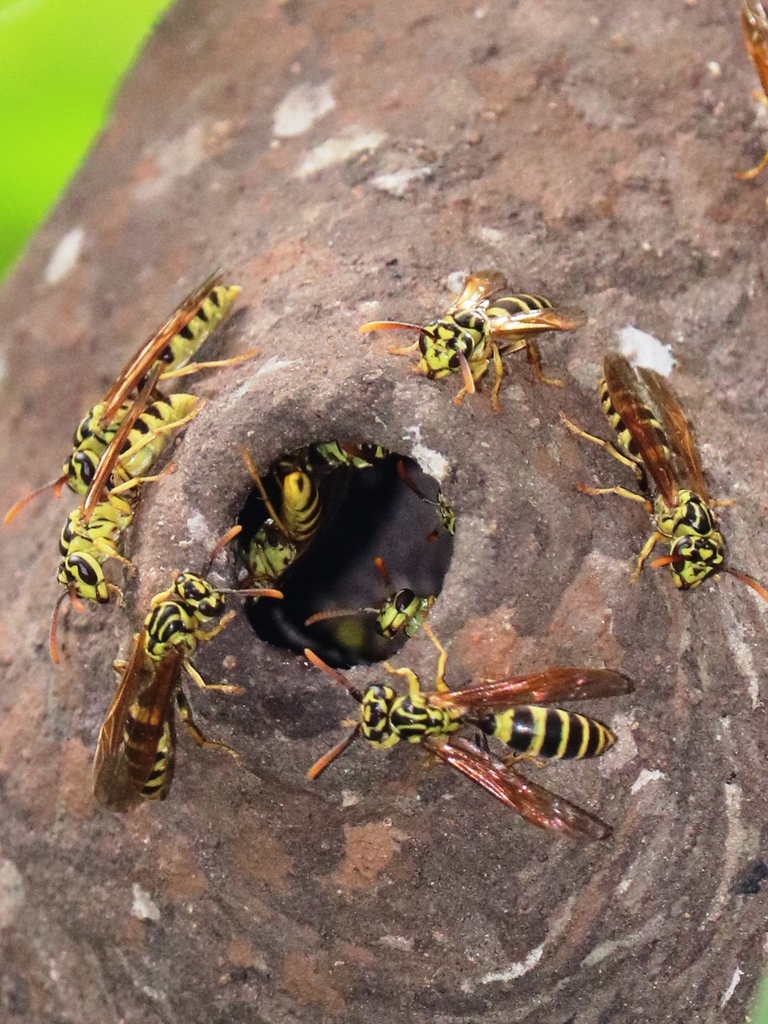
Polybia emaciata
Polybia emaciata is a Neotropical swarm founding wasp that is mainly found in South America. This eusocial species has a unique colony structure in which multiple queens are present. Workers and queens are not morphologically distinct, but the high amount of relatedness maintained in the colony ensures that workers police each other. Polybia emaciata relies on a diet of liquid nectars which is supplemented with prey insects, particularly flies. It is well known for being one of only three wasp species in the genus Polybia that uses mud as the primary material for building its nest. Polybia emaciata is one of the least aggressive wasp species in the genus Polybia, and is known for its distinctive defensive behavior.
From the article Polybia emaciata on Wikipedia (CC BY-SA), quoted section by section
Description
Polybia emaciata shares many morphological characteristics with Polybia singularis, another neotropical wasp species. The main differentiating aspect of this species is not its physical appearance but its nesting structure, which is famous for its closed pear shape and single circular opening at the bottom.
Workers. A unique characteristic of Polybia emaciata is that there are no distinct morphological differences between workers and queens. This causes caste totipotency, which means that any female could have the potential to become a queen. Small factors like head size have been identified as minor differences but the difference in head size is almost negligible. Worker head size is about 1.3 times bigger than queen head size.
Queens. Polybia emaciata is polygynous, which means that multiple queens will simultaneously occupy the same nest. However, not all of the queens end up reproducing and mating with males. As the number of males in a colony increases, the number of queens decreases. Queen number is highest when it is not time to reproduce, but as reproduction approaches the number of queens decreases.
Males. Males found in Polybia emaciata nests are usually very young, which suggests that they are just coming into adulthood when they mate and then eventually leave the nest. …
Wikipedia: “Description and identification”
Range & habitat
Polybia emaciata mainly occupies South America in tropical climates, where fruit and predation is abundant. They are found in many South American countries such as Colombia, Venezuela, Brazil, and Argentina. Nests are built mainly around pastures and fruit crops on the branches of plants and trees. This is because their nests are energetically costly and it is best for them to build them where there are plenty of resources. Polybia emaciata is a fairly common species and has been used abundantly in the study of eusocial wasps.
Wikipedia: “Habitat”
What it does
While Polybia emaciata are much less aggressive as a group than other species in their genus, they are natural predators and are capable of fighting. When faced with danger, they use signaling techniques like wing waving and leg raising to warn others of their capabilities.
Wikipedia: “Potential predator behavior”
Listen
Looking for field recordings…
Where it lives
Recorded sightings
—
geo-referenced records in GBIF, from museums, herbaria and field observers.
Drag the globe to turn it. Dots are where records exist, not a range map; darker means more records.
In the stacks
Searching the stacks…
Every page naming Polybia emaciata in the Biodiversity Heritage Library →
This page is assembled live from iNaturalist, GBIF, Wikipedia, the Source Library and the Internet Archive. It is not yet part of the hand-edited codex. iNaturalist taxon 266269.