- Animals
- ›Arthropods
- ›Hexapods
- ›Insects
- ›Winged and Once-winged Insects
- ›Beetles
- ›Water, Rove, Scarab, Long-horned, Leaf, and Snout Beetles
- ›Cucujiform Beetles
- ›Cucujoidea
- ›Pleasing Fungus Beetles
- ›Erotylinae
- ›Tritomini
- ›Mycotretus
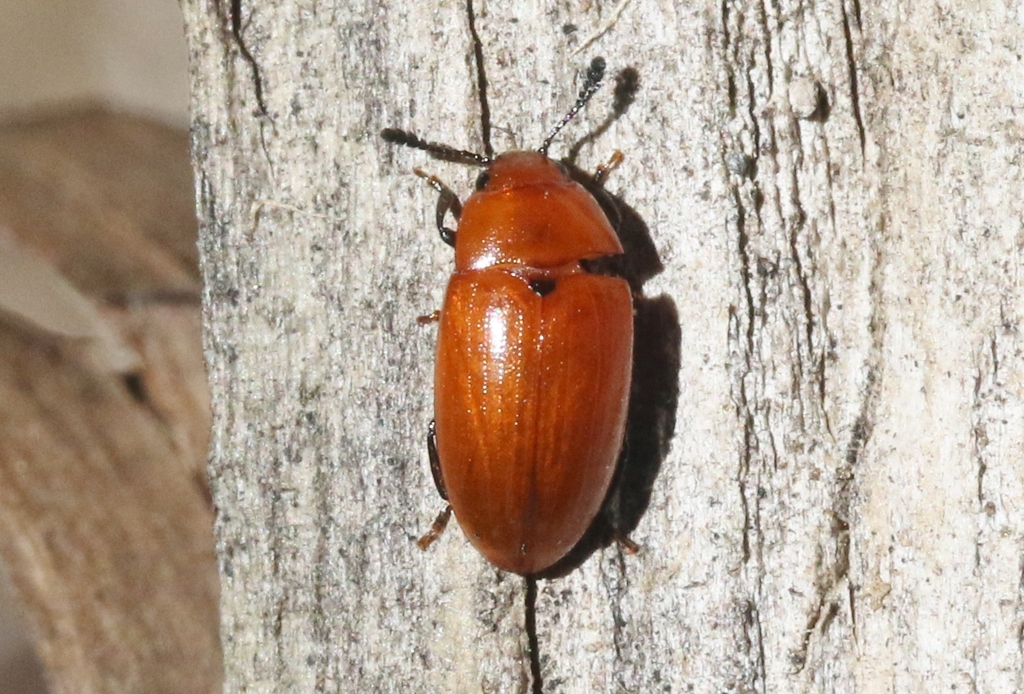
Mycotretus nigromanicatus
Mycotretus nigromanicatus is an enigmatic small reddish pleasing fungus beetle species in family Erotylidae, occurring in Central and North America. Among its family, the genus Mycotretus is placed in subfamily Tritominae, or – in taxonomic arrangements that prefer a more comprehensive subfamily Erotylinae – in tribe Tritomini of the Erotylinae.
Among its Mycotretus relatives, this species strongly resembles M.bistrigatus in body shape and the hue of its reddish color. It is possible these two are closely related species or even color morphs or subspecies of a single species, in which case M.nigromanicatus would be subsumed into M.bistrigatus. Also, in its overall appearance and specific anatomical details, it is strikingly similar to some unusual beetles traditionally separated in genus Haematochiton. Little is known about M.nigromanicatus, which is a major obstacle in resolving the taxonomic status of Mycotretus in general and Haematochiton in particular.
From the article Mycotretus nigromanicatus on Wikipedia (CC BY-SA), quoted section by section
Description
Mycotretus nigromanicatus is a small beetle, slightly more than 0.2 in long and around 0.1 in wide on average (around 5-5.5 mm long, 2.5 mm wide) as adults. Their body is elliptical, without conspicuous hairs, smoothly rounded on all sides, and fairly flat-backed. The antennae, scutellum and legs (except for the coxae) are black in color. Otherwise, M.nigromanicatus is bright orange-red all over. The holotype specimen is strikingly lighter than others, more of a brownish orange-yellow. Most likely, this specimen was caught soon after the adult's eclosion from the pupa, before its exoskeleton could fully harden and achieve its full hardness and color.
Head The head seems to lack file-like structures for stridulation, and has no constriction between the rather small compound eyes. The individual ommatidia are also small; this genus is probably diurnal or crepuscular, but generally does not seem to rely on eyesight much. All over the head there are small shallow punctures, separated by about 2.5 times their diameter, but more densely-set at the base of the top of the head. The epistome is unmargined, due to the ocular striae at most barely reaching the antenna insertion points, and ends in an almost straight edge with a slight concave indentation. …
Range & habitat
This beetle has been reported from a few sites in the southwestern USA and east-central Mexico. The type specimen ANSP 10701 was caught on July 19, 1919 by Witmer Stone in Pinery Canyon of the Chiricahua Mountains, Cochise County, Arizona, close to the Mexican border at an altitude of about 6,000 ft (c.1,800 m) AMSL. Stone had a curatorial job at the Academy of Natural Sciences of Philadelphia at that time, and probably came across the beetle on one of the many field excursions he did with the ANSP team. While he was fairly knowledgeable about beetles, he did generally not know them down to species level, his main interest being birds, whose almost 50,000 ANSP specimens he was reviewing at that time. Thus, the beetle specimen went into the museum's insect collection with no in-depth assessment, and was only recognized as a new species when Wilford Boyle reviewed it after almost 40 years. Another specimen in the USNM was from Huatusco, Veracruz, near the Gulf of Mexico coast. It was found on January 14, 1949 and is also annotated "El Paso 57823", perhaps the collector's reference. A third specimen was collected by Vincent Vesterby on August 8, 1963, in the Madera Canyon of the Santa Rita Mountains in Arizona, the altitude not specified but almost certainly between 4,500 and 6,500 ft (1,300-2,000 m) or a bit higher. …
Wikipedia: “Distribution and ecology”
Listen
Looking for field recordings…
Where it lives
Recorded sightings
—
geo-referenced records in GBIF, from museums, herbaria and field observers.
Drag the globe to turn it. Dots are where records exist, not a range map; darker means more records.
In the stacks
Searching the stacks…
Every page naming Mycotretus nigromanicatus in the Biodiversity Heritage Library →
This page is assembled live from iNaturalist, GBIF, Wikipedia, the Source Library and the Internet Archive. It is not yet part of the hand-edited codex. iNaturalist taxon 267369.