- Animals
- ›Arthropods
- ›Hexapods
- ›Insects
- ›Winged and Once-winged Insects
- ›Beetles
- ›Water, Rove, Scarab, Long-horned, Leaf, and Snout Beetles
- ›Cucujiform Beetles
- ›Cucujoidea
- ›Pleasing Fungus Beetles
- ›Erotylinae
- ›Tritomini
- ›Triplax
- ›Triplax thoracica
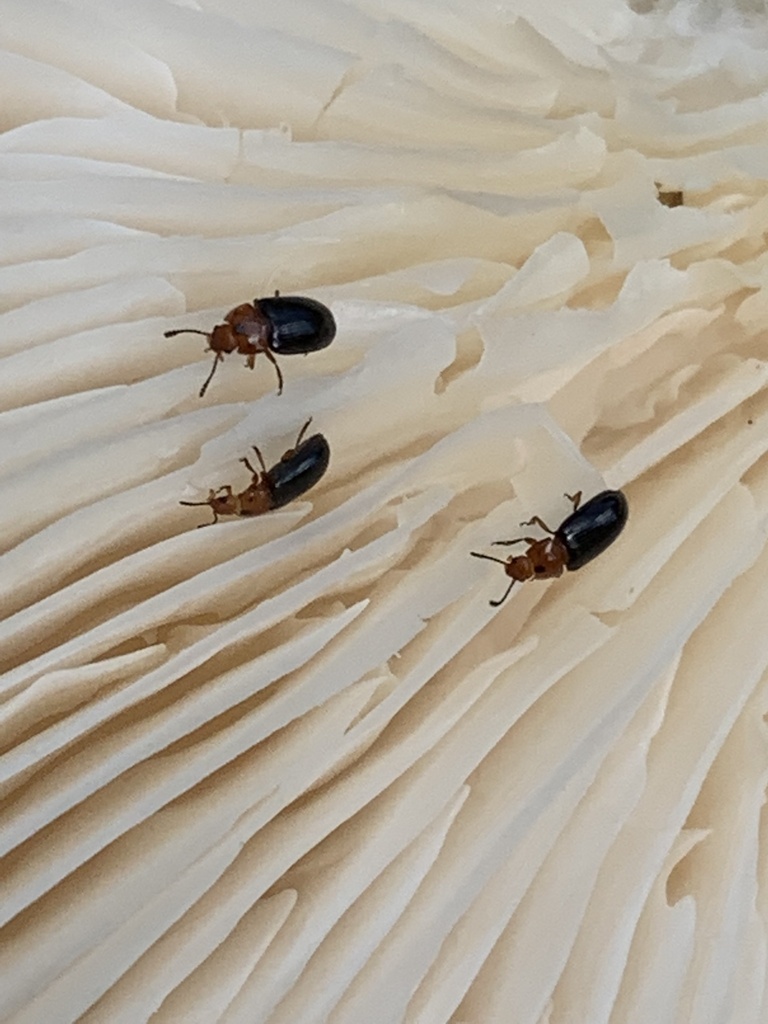
Triplax mesosternalis
Triplax mesosternalis is a North American species of small pleasing fungus beetle (family Erotylidae). It is placed in subfamily Tritominae (formerly Triplacinae), or – in taxonomic arrangements that prefer a more comprehensive subfamily Erotylinae – in tribe Tritomini of the Erotylinae.
This species is possibly one of the "breast-plated" pleasing fungus beetles of the Triplax thoracica cryptic species complex. This large group, other than T.thoracica and perhaps T.mesosternalis, also includes T.californica, T.cuneata, T.dissimulator, T.errans, T.flavicollis, T.frosti, T.lacensis, T.microgaster, T.puncticeps and T.wehrlei.
From the article Triplax mesosternalis on Wikipedia (CC BY-SA), quoted section by section
Description
Adults of this beetle are about 3.3-5.2 mm long and 1.5-2.4 mm wide. Their elongated body has smoothly curving sides; it is slightly shiny and mostly bare, with conspicuous hair only on the abdomen. Like in many of their relatives, head and prothorax are reddish-orange, while the elytra are black. The tell-tale mark of this species is a round black spot between the middle of the pronotum and its forward edge. Usually, there are also two much smaller rund black spots on the pronotum, on each side halfway between the center and the outer edge; these are often tiny, however, and entirely absent in some individuals. As usual for the members of the "breast-plated" species complex, T.mesosternalis has orange legs (although the hindleg coxae are blackish in this species) and antenna bases, and lacks a conspicuous margin to the forehead sides, which also form a well-rounded obtuse angle towards the mouth. The underside is orange up to the mesothorax, which is orange in the center and on the forward half of the sides; the rear part of the mesothorax sides is brown to black, and the metathorax and abdomen are black. The "stalk" of the antennae is reddish-brown, and the "club" forming the antenna tips is black. Unlike most Triplax species, T.mesosternalis is more easily identified with a simple magnifying glass without resorting to microscopic details of its anatomy. …
Range & habitat
The lectotype, an adult of unknown sex, was only established more than half a century after this species' description. It was originally part of a 5-cotype series (Brooklyn Museum collection 42600 at the USNM) that was collected at Palmerlee in Cochise County, Arizona (mis-spelled "Palmerly" on the specimen label), probably in late 1904 or early 1905. Palmerlee – known as "Reef" before 1904, and after 1911 as "Garces" – is an abandoned mining settlement in Miller Canyon, Huachuca Mountains, at the site of the present-day Miller Canyon Recreation Area and trailhead on the northeastern slopes of Miller Peak, at almost 6,000 ft (1,800 m) AMSL. Apart from Arizona, this species has been reported from New Mexico, Colorado, and Kansas. From Mexico few reliable data exist, but a specimen was identified from Chiapas State, less than 250 km from Mexico's southeastern border, suggesting T.mesosternalis is widespread across the country but probably not common or easily found, and might even range further eastwards. Its distribution seems to run along the eastern foothills of the Rocky Mountains. In Arizona, it occurs from the east at least to Prescott; in New Mexico it ranges from the west at least to Cloudcroft, Las Vegas, and Ponil Canyon in Colfax County northwest of Cimarron. …
Wikipedia: “Distribution and ecology”
Listen
Looking for field recordings…
Where it lives
Recorded sightings
—
geo-referenced records in GBIF, from museums, herbaria and field observers.
Drag the globe to turn it. Dots are where records exist, not a range map; darker means more records.
In the stacks
Searching the stacks…
Every page naming Triplax mesosternalis in the Biodiversity Heritage Library →
This page is assembled live from iNaturalist, GBIF, Wikipedia, the Source Library and the Internet Archive. It is not yet part of the hand-edited codex. iNaturalist taxon 267375.