- Animals
- ›Arthropods
- ›Hexapods
- ›Insects
- ›Winged and Once-winged Insects
- ›Ants, Bees, Wasps, and Sawflies
- ›Narrow-waisted Wasps, Ants, and Bees
- ›Ants, Bees, and Stinging Wasps
- ›Bees and Apoid Wasps
- ›Bees
- ›Mason, Leafcutter, Carder, and Resin Bees
- ›Megachilinae
- ›Megachilini
- ›Megachile
- ›Chelostomoides
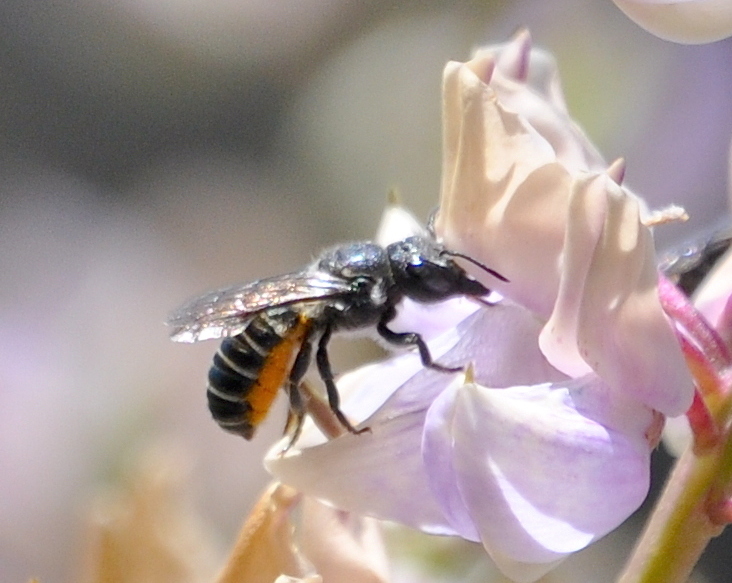
Megachile angelarum
Megachile angelarum is a species of bee in the Megachilidae family.
From the article Megachile angelarum on Wikipedia (CC BY-SA), quoted section by section
Description
Morphological Features: Metasoma: The female M. angelarum can be recognized by its parallel-sided metasoma (abdomen). Mandibles: Unlike some other bees, M. angelarum has mandibles that lack cutting edges. Apical White Fasciae: The complete apical white fasciae on tergites T1 to T5 (visible segments of the abdomen) are characteristic of this species. Distinctive Traits: Abdominal Scopa: Look for an abdominal scopa (a specialized brush of hairs) on the underside of the abdomen. Grooves on T2-T4: Deep grooves on tergites T2 to T4 are another identifying feature. Lip on T6: The last visible segment (T6) in a female has a distinct turned-up lip at the very end of the bee. Comparison with Similar Species: M. angelarum most closely resembles Megachile campanulae. However, females of M. campanulae lack the apical white fascia on T5. Morphologically, they most resemble Megachile campanulae.
Wikipedia: “Morphology and identification”
Range & habitat
Distribution: Megachile angelarum occurs in the following regions: Southern British Columbia, Canada California, Arizona, and New Mexico in the United States Baja California, Mexico Ascher and Pickering (2014) also map its presence from southern British Columbia south to Tijuana, Mexico, with most records in California. Habitat: These bees inhabit various natural landscapes within their range. They can be found in diverse habitats such as forests, grasslands, and urban areas. Their nesting sites include cavities in wood, plant stems, and other suitable sheltered locations.
Wikipedia: “Distribution and habitat”
What it does
Nesting Behavior: Megachile angelarum is a cavity-nesting bee. It collects resin and gum to build its nest. While it looks similar to a leafcutting bee, it does not actually cut leaves or petals like other leafcutters. Solitary Behavior: As a solitary bee, Megachile angelarum constructs its nest independently. Unlike social bees, it does not rely on a colony structure for tasks like brood rearing. Pollination Role: These native bees are essential pollinators, contributing to the reproduction of various plant species. Their solitary lifestyle allows them to focus on individual nesting and foraging activities.
Wikipedia: “Life cycle and behavior”
Listen
Looking for field recordings…
Where it lives
Recorded sightings
—
geo-referenced records in GBIF, from museums, herbaria and field observers.
Drag the globe to turn it. Dots are where records exist, not a range map; darker means more records.
In the stacks
Searching the stacks…
Every page naming Megachile angelarum in the Biodiversity Heritage Library →
This page is assembled live from iNaturalist, GBIF, Wikipedia, the Source Library and the Internet Archive. It is not yet part of the hand-edited codex. iNaturalist taxon 271430.