- Plants
- ›Vascular Plants
- ›flowering plants
- ›Dicots
- ›beeches, oaks, walnuts, and allies
- ›beech family
- ›Quercus
- ›Quercus
- ›Lobatae
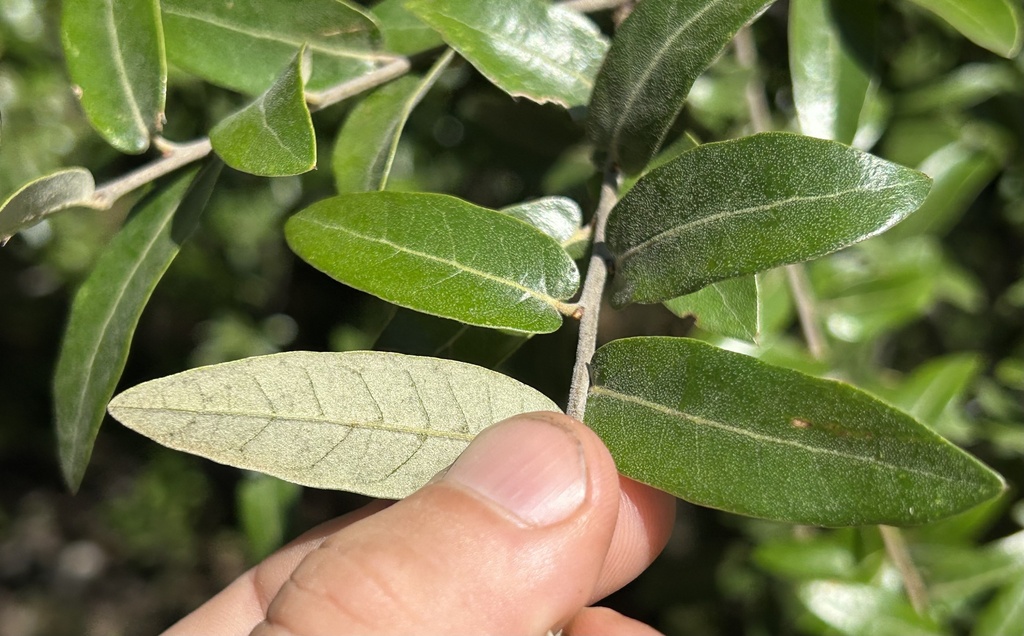
Quercus durifolia
Quercus durifolia, commonly known as encino colorado, is a species of oak tree native to Mexico.
From the article Quercus durifolia on Wikipedia (CC BY-SA), quoted section by section
Description
Quercus durifolia is a small evergreen tree that typically reaches 6 to 9 metres (20 to 30 feet) in height, occasionally growing to 15 meters. Leaves are lanceolate or ovate, glossy and dark-green on the top and tomentose on the underside. The bark is dark gray to black, smooth when young and becoming rough and fissured with age.
Range & habitat
It is native to the Sierra Madre Occidental, from northwestern Chihuahua to Aguascalientes and northern Jalisco, with a southeastern outlier in the mountains of Guanajuato. It is most common on the drier eastern slopes of the Sierra, where it is generally found in open pine–oak woodland with Pinus leiophylla var. chihuahuensis and Pinus engelmannii, at the transition between lower-elevation oak and pine–oak woodlands and higher-elevation pine forests, from 1,700 to 2,300 m (5,600 to 7,500 ft) in elevation. It is generally found on gently sloping sites with deep soils, and can form pure stands on relatively flat sites with favorable soils. Other associated plants include Quercus arizonica, Pinus cooperi, Arbutus xalapensis, Fraxinus gooddingii, and Juniperus deppeana.
Wikipedia: “Distribution and habitat”
What it does
The acorn woodpecker (Melanerpes formicivorus) disperses its acorns in northwestern Mexico.
== References ==
Wikipedia: “Ecology”
Where it lives
Recorded sightings
—
geo-referenced records in GBIF, from museums, herbaria and field observers.
Drag the globe to turn it. Dots are where records exist, not a range map; darker means more records.
In the stacks
Searching the stacks…
Every page naming Quercus durifolia in the Biodiversity Heritage Library →
This page is assembled live from iNaturalist, GBIF, Wikipedia, the Source Library and the Internet Archive. It is not yet part of the hand-edited codex. iNaturalist taxon 275507.