- Plants
- ›Vascular Plants
- ›flowering plants
- ›monocots
- ›gingers, bananas, and allies
- ›Spiral Gingers and Allies
- ›Costus
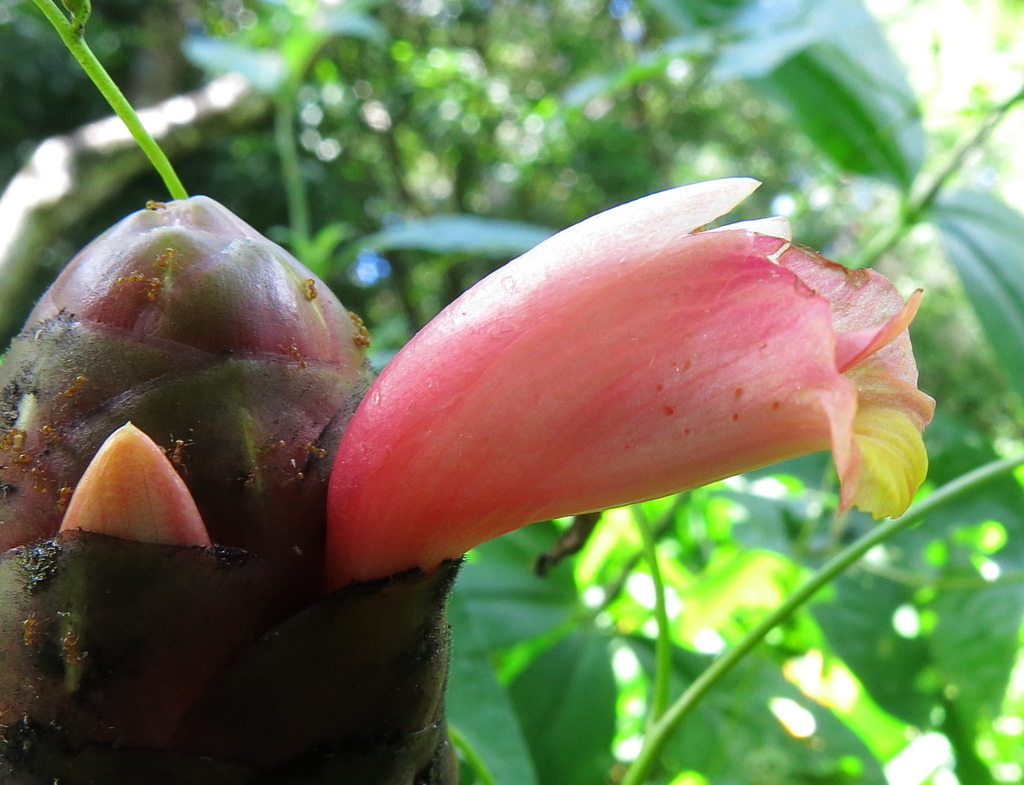
Indian Head Ginger
Costus spicatus
Costus spicatus, also known as spiked spiralflag ginger or Indian head ginger, is a species of herbaceous plant in the Costaceae family (also sometimes placed in Zingiberaceae). Common names in the Antilles include cumani, gengibre cimarron, gengibrillo, canne d’eau, and la canne de rivière.
From the article Costus spicatus on Wikipedia (CC BY-SA), quoted section by section
Description
Costus spicatus leaves grow to a length of approximately 1 ft (30 cm) and a width of approximately 4 in (10 cm). It produces a short red cone, from which red-orange flowers emerge one at a time. In botanical literature, Costus woodsonii has often been misidentified as Costus spicatus. Costus spicatus is also similar in appearance to Costus scaber and Costus spiralis.
Range & habitat
Costus spicatus is native to some islands of the Caribbean (including Dominica, Guadeloupe, Hispaniola, Martinique, and Puerto Rico). There has been some confusion about the native range of Costus spicatus. Kew Botanical Gardens lists it as native to Mexico. It has been described as exotic or native to Cuba. Costus spicatus is possibly invasive in lower montane rainforests on Saint Lucia, where botanist Roger Graveson considers it to be an escaped exotic.
Wikipedia: “Distribution”
What it does
Costus spicatus can develop a symbiotic partnership with certain species of ants (often only a single species of ant will be compatible). The ants are provided with a food source (nectar in C. spicatus flowers) as well as a place to construct a nest. In turn, the ants protect developing seeds from herbivorous insects.
Wikipedia: “Ecology”
How it is grown
Costus spicatus will grow in full sun if it is kept moist. It reaches a maximum height of about 6 to 7 feet (1.8 to 2.1 m).
Wikipedia: “Cultivation”
Where it lives
Recorded sightings
—
geo-referenced records in GBIF, from museums, herbaria and field observers.
Drag the globe to turn it. Dots are where records exist, not a range map; darker means more records.
In the stacks
Searching the stacks…
Every page naming Costus spicatus in the Biodiversity Heritage Library →
This page is assembled live from iNaturalist, GBIF, Wikipedia, the Source Library and the Internet Archive. It is not yet part of the hand-edited codex. iNaturalist taxon 276567.