- Plants
- ›Vascular Plants
- ›flowering plants
- ›Dicots
- ›pinks, cactuses, and allies
- ›knotweed family
- ›Polygonoideae
- ›Polygoneae
- ›Reynoutriinae
- ›Muehlenbeckia
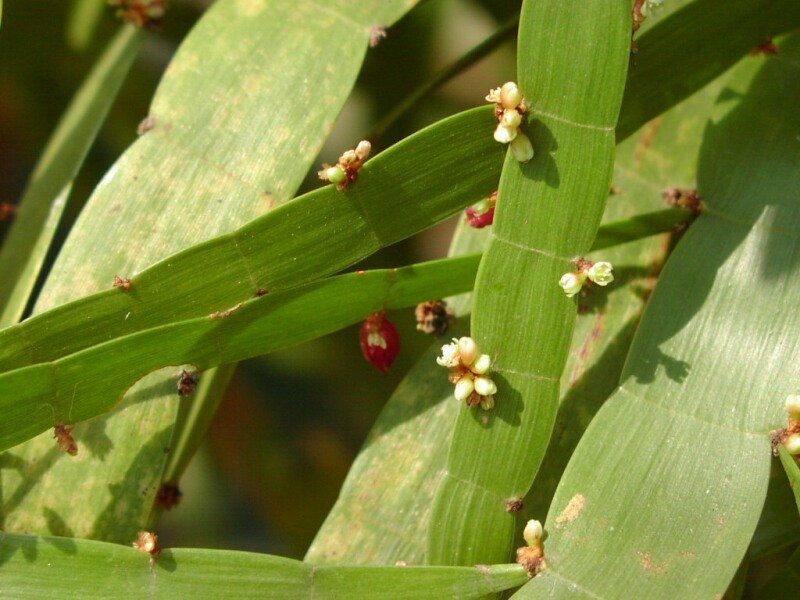
tapeworm plant
Muehlenbeckia platyclada
Muehlenbeckia platyclada (synonym Homalocladium platycladum), known as centipede plant, tapeworm plant or ribbonbush, is a species of plant in the knotweed family from New Guinea and the Solomon Islands. It is also naturalized in other tropical regions, including Puerto Rico, India, Bolivia, Madagascar, Nicaragua and Pakistan.
From the article Muehlenbeckia platyclada on Wikipedia (CC BY-SA), quoted section by section
Description
Evergreen shrub with flattened, jointed, green stems and arrow-shaped leaves. This shrub has both spreading and climbing tendencies. Flowers are short-lived and compact. Grows in well-drained soil that is moist in full sun. It also grows well in sandy loam to clayey soil with pH 5.5 to 6. Will tolerate some shade, heat and humidity. It grows 2 to 4 ft. high and 1.5 to 3 ft. wide. Leaves dark green, elongated, flattened, alternately arranged on a flat stem. Flowers tiny, white to light pink. Blooms from early to late spring.
== References ==
Where it lives
Recorded sightings
—
geo-referenced records in GBIF, from museums, herbaria and field observers.
Drag the globe to turn it. Dots are where records exist, not a range map; darker means more records.
In the stacks
Searching the stacks…
Every page naming Muehlenbeckia platyclada in the Biodiversity Heritage Library →
This page is assembled live from iNaturalist, GBIF, Wikipedia, the Source Library and the Internet Archive. It is not yet part of the hand-edited codex. iNaturalist taxon 278467.