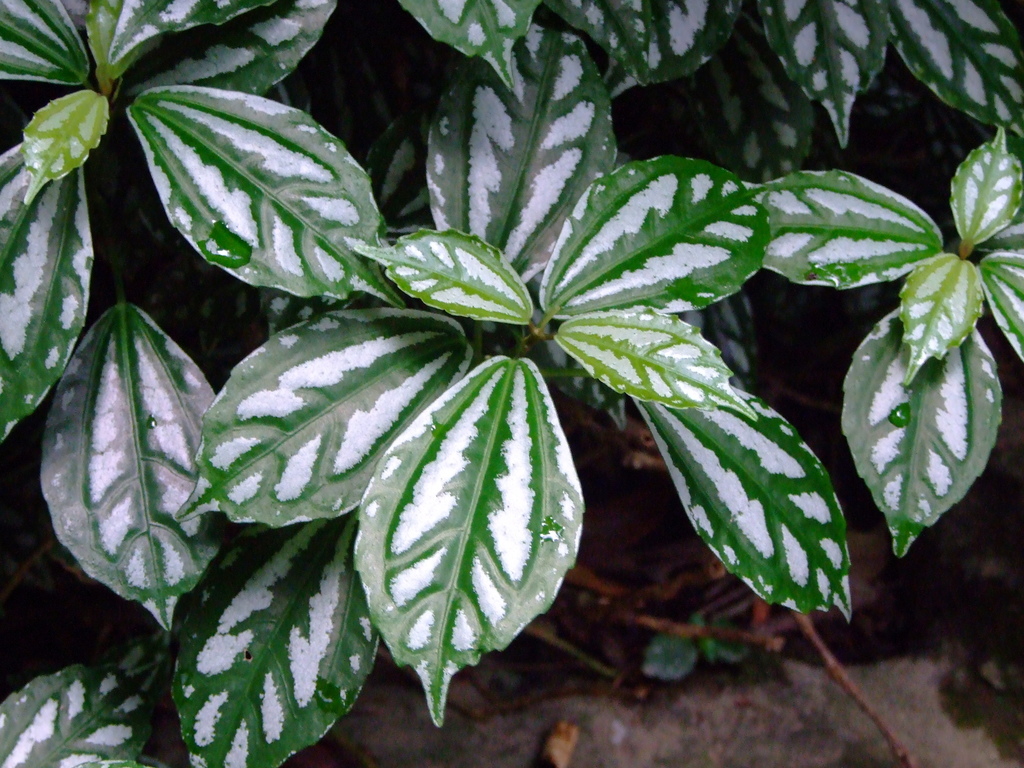
Aluminium Plant
Pilea cadierei
Pilea cadierei (or the aluminium plant or watermelon pilea) is a species of flowering plant in the nettle family, Urticaceae. The species is endemic to the southern Chinese provinces of Guizhou and Yunnan, as well as Vietnam. The specific epithet cadierei refers to the 20th-century botanist R.P. Cadière. P. cadierei has earned the Royal Horticultural Society's Award of Garden Merit for its hardiness and reliability as a houseplant. In warmer countries, usually within USDA zones 8–12, the plant may be grown outside year-round as a perennial, either in-ground or contained, and pruned about 50% during the autumn (or whenever blooming concludes).
From the article Pilea cadierei on Wikipedia (CC BY-SA), quoted section by section
Description
The aluminum pilea is an evergreen perennial, growing up to 60 cm (24 in) tall and featuring dark-green, oval leaves, with slightly “textured” or “serrated” edges, and with each leaf having four raised silvery patches (hence the name "aluminium plant"). The plant forms subterranean rhizomes to colonize an area. The independent and upright stems are somewhat succulent and may grow woody over time at the base. The stems are mostly featureless, though (along with the stipules, petioles and blades) they have a fine coating of spindle-shaped cystoliths. The constantly opposing arrangement of the stems and leaves are divided into petiole and leaf blade. The bald petioles are all almost the same length, usually in the range of 7 to 15 millimeters. The simple, dark-green, parchment-like, almost uniformly shaped leaf blades are obovate, with a length of 2.5 to 6 centimeters and a width of 1.5 to 3 centimeters. They have a broad, wedge-shaped or almost rounded blade base and a spiky tip. There are three main nerves that are visible along at least 3⁄4 of their length and there are three side nerves on each side. The leaf margins are hardly recognizable to weakly serrated or bitten out. On the upper side of the leaf there are two subdivided white furrows and this results in some silvery raised areas (hence the English designations "aluminum" or "watermelon plant"). …
How it is grown
With a minimum temperature of 15 °C (59 °F), P. cadierei is cultivated as a houseplant in temperate regions due to its decorative leaves and easy vegetative propagation through cuttings. This plant is non-toxic to cats, dogs, and horses, and so is safe to have around pets.
Wikipedia: “Cultivation”
Where it lives
Recorded sightings
—
geo-referenced records in GBIF, from museums, herbaria and field observers.
Drag the globe to turn it. Dots are where records exist, not a range map; darker means more records.
In the stacks
Searching the stacks…
Every page naming Pilea cadierei in the Biodiversity Heritage Library →
This page is assembled live from iNaturalist, GBIF, Wikipedia, the Source Library and the Internet Archive. It is not yet part of the hand-edited codex. iNaturalist taxon 278679.