- Plants
- ›Vascular Plants
- ›flowering plants
- ›Dicots
- ›sandalwoods, mistletoes, and allies
- ›sandalwood family
- ›viscaceous mistletoes
- ›Phoradendron
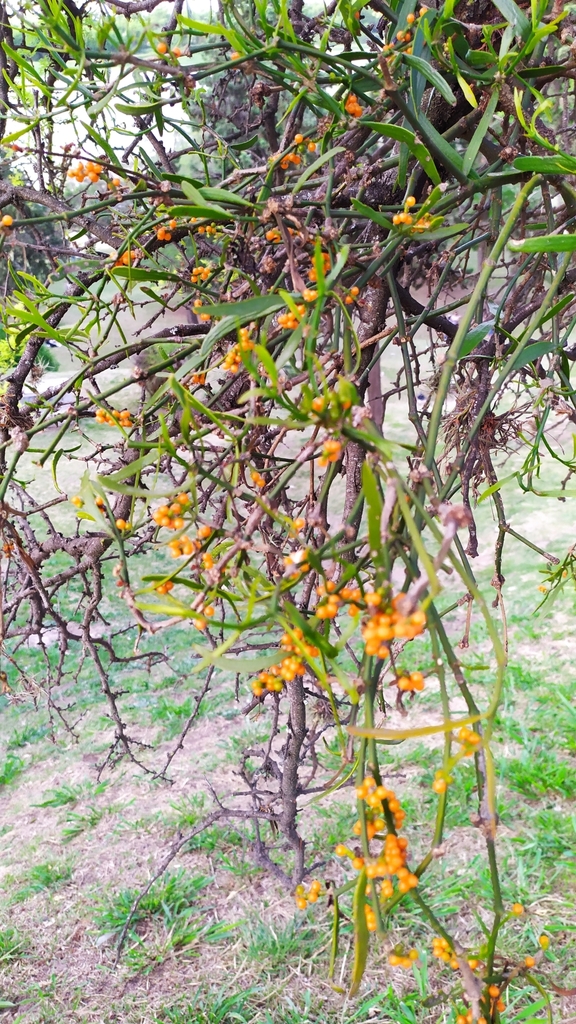
Quacimmila de Canario
Phoradendron quadrangulare
Phoradendron quadrangulare, with no commonly accepted English name other than mistletoe, which is shared with many other similar species, is an evergreen shrub partly parasitic on branches of woody plants; it belongs to the Family Santalaceae.
From the article Phoradendron quadrangulare on Wikipedia (CC BY-SA), quoted section by section
Description
Phoradendron quadrangulare is easy to recognize as a mistletoe because it's a compactly growing shrub on tree branches. Among the approximately 270 accepted Phoradendron species, though a few other mistletoe species share the feature, its main field mark is that, except for the older ones, the stems are quadrangular in cross-section. The species is morphologically variable across its distribution area, with delicate to more robust plants, depending on the habitat. Here are some notable distinguishing features:
Plants are monoecious -- with male and female flowers on the same individual. The plant body is hairless. Stem sections between where leaves arise, the internodes, are longish, up to 8 cm (3 in) long. Where stems branch, there are collar-like green items called cataphylls. Leaves either lack petioles or have them only up to 4 mm (0.16 in) long; blades are variable in shape, up to 6.5 cm (2.6 in) long and 2.5 cm (0.98 in) wide. Inflorescences are up to 4 cm (1.6 in) long with 2 to 5 segments, and 3 or 4 flowers per segment. Male flowers are infrequent and distributed irregularly. Berry-type fruits are spherical or nearly so, about 3 mm (0.12 in) in diameter, orangish or yellowish, smooth and hairless.
Range & habitat
Phoradendron quadrangulare is native to Mexico, the Caribbean, south through Central America and as far south in South America as Argentina and Paraguay.
Wikipedia: “Distribution”
What it does
In Brazil it's been asserted that Phoradendron quadrangulare seeds are almost exclusively dispersed by Euphonia bird species, which defecate seeds in clumps on host branches. A study in Costa Rica of Phoradendron quadrangulare on Guazuma ulmifolia documented that the larger the host tree, the more likely it was to host the mistletoe. Phoradendron quadrangulare is one of several Phoradendron species recognized as a hyperparasite -- a parasite whose host also is a parasite, sometimes the host belonging to the same genus.
Wikipedia: “Ecology”
In medicine
In Mexico, Phoradendron quadrangulare has been used as an antiviral treatment against Herpes zoster. Ground leaves are applied to the affected area, and above that a whole leaf is held in place by a bandage. Also it's used as an analgesic for muscular pain. In Argentina, Phoradendron quadrangulare has been regarded as a treatment for cancer. Chemical analysis finds that compounds in the plant show antioxidant activity which can be explained by the presence of flavonoids and other active molecules. Among the Mayan people of Mexico's Yucatan Peninsula, Phoradendron quadrangulare leaves have been documented used in combination with leaves of Talinum paniculatum and Phyllanthus amarus to treat a severe toothache. Below, it's shown how leaves from the three sources were mashed into a paste using a mortar and pestle, homemade with a whittled stick and the cut-off bottom of a 1-liter Coca-Cola bottle:
Wikipedia: “Use in traditional medicine”
In human culture
The genus name Phoradendron is based on the Greek phor, meaning "thief", and dendron, for "tree", alluding to the taxon's parasitism. The species name quadrangularis is New Latin based on the Latin quadrangulum, meaning "quadrangle", and the suffix -aris, serving as the suffix "-ar" in English, thus "quadrangular", referring to the taxon's quadrangular young stems.
Wikipedia: “Etymology”
Where it lives
Recorded sightings
—
geo-referenced records in GBIF, from museums, herbaria and field observers.
Drag the globe to turn it. Dots are where records exist, not a range map; darker means more records.
In the stacks
Searching the stacks…
Every page naming Phoradendron quadrangulare in the Biodiversity Heritage Library →
This page is assembled live from iNaturalist, GBIF, Wikipedia, the Source Library and the Internet Archive. It is not yet part of the hand-edited codex. iNaturalist taxon 278756.