- Plants
- ›Vascular Plants
- ›flowering plants
- ›Dicots
- ›saxifrages, stonecrops, and allies
- ›stonecrop family
- ›Sempervivoideae
- ›Sedeae
- ›Dudleya
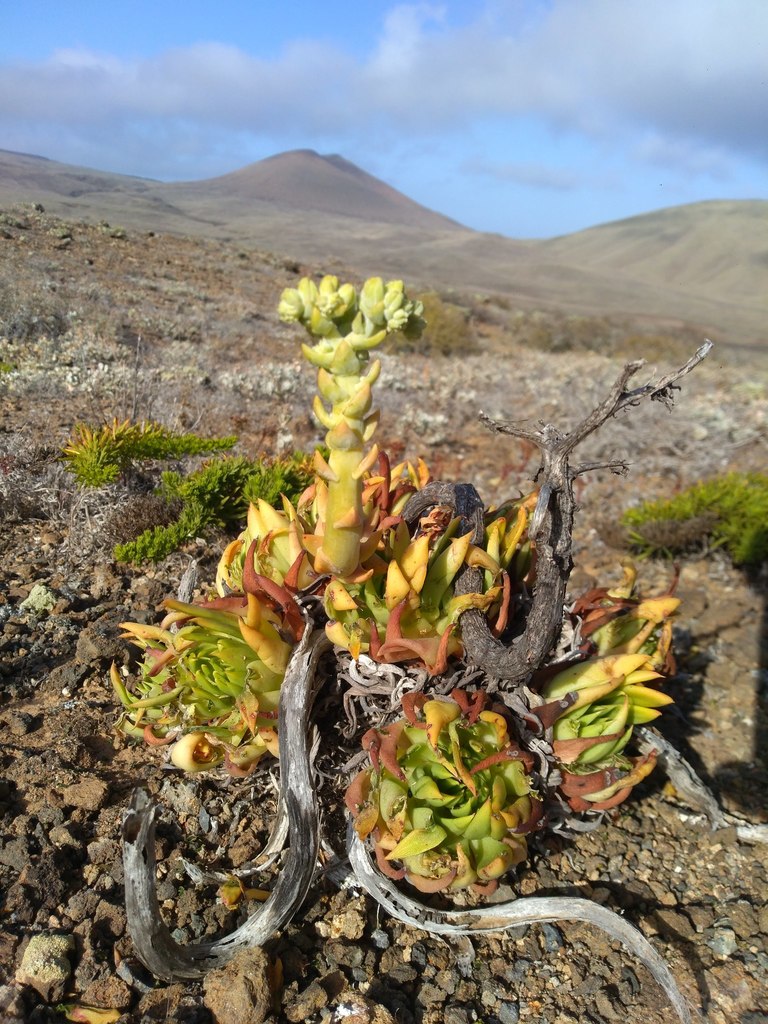
Guadalupe Liveforever
Dudleya guadalupensis
Dudleya guadalupensis is a very rare species of succulent perennial plant in the family Crassulaceae commonly known as the Guadalupe liveforever. It is a rosette-forming leaf succulent, with foliage that is variously colored light green, green, and a waxy white. It is characterized by dense leaves that fold over the center in dormancy, a curving, sinuous flower stalk, and white, cup-shaped flowers. It is endemic to the rocks and islets off of Guadalupe Island, an isolated volcanic island in the Pacific Ocean located 241 kilometers off of the coast of Baja California.
From the article Dudleya guadalupensis on Wikipedia (CC BY-SA), quoted section by section
Description
A densely-leaved species of Dudleya, with the outer foliage folding over the center, giving the rosettes a rounded appearance. It has a curved flower stalk and white flowers that form a cup or "V" shape.
Morphology. Like most other Dudleya, this plant is a rosette-forming leaf succulent which grows rosettes on the tips of a stem, with the stem also referred to as a caudex. In this species, the caudex is 1.5 to 3.5 cm (0.59 to 1.38 in) thick, and elongates up to 15 cm (5.9 in) or more long, the caudex branching to form rounded clumps up to 50 cm (20 in) wide, of up to 80 or more rosettes. The rosettes are almost globe-shaped, 3–15 cm (1.2–5.9 in) wide, of 24–40 leaves, with the leaves colored a pale green, green, or white with epicuticular wax. The leaves are shaped oblong to oblanceolate, the leaf margins rounded, and the tip apiculate to acuminate. Each leaf is typically 2.5–6.5 cm (0.98–2.56 in) long, 8–13 mm (0.31–0.51 in) wide, 2–3 mm (0.079–0.118 in) thick, and 4–8 mm (0.16–0.31 in) at the base.
The floral stems of this species are characterized by an unusual sinuous habit, in that they curve downward at first, and then curve up. The floral stems are glaucous, 20–30 cm (7.9–11.8 in) long and 4–7 mm (0.16–0.28 in) thick. The floral stem is bare of bracts in the lower 5 cm (2.0 in), but above that has 15–35 bracts. …
Range & habitat
Dudleya guadalupensis is native to Guadalupe Island and the surrounding islets. The type specimen originates from Islote Afuera (Outer Islet), collected by Reid Moran. On Islote Afuera, the plants are common from the inner slope of the crater to the upper valley. The plants there have uniformly light green foliage. On Islote Negro, plants have both green and farinose foliage, with the rosettes being less clustered and more solitary. The species is present on Islote Adentro (Islote Toro). Plants have also been spotted on Middle Rock and other islets off of the island.
Wikipedia: “Distribution and habitat”
How it is grown
Most of the examples of plants alleged to be this species in cultivation may be mislabeled. Noted Dudleya collector Paul Thomson observed that many of the plants in cultivation bear little resemble to actual D. guadalupensis plants. Reid Moran also notes that plants in the nursery trade labeled as D. guadalupensis are in fact D. greenei, a species native to the Channel Islands of California with a different chromosome count. Moran found that none of the collectors of the cultivated specimens could verify that the source was from Guadalupe Island.
Wikipedia: “Cultivation”
In human culture
In 1892, Dr. Francescho Franceschi, a horticulturist from Santa Barbara, visited Guadalupe Island. He published an account of the trip and the plants he found, and among them, he reported a "Cotyledon sp." on a rock by a trail not far from the landing. No other expeditions found or mentioned Dudleya until 1948, when Reid Moran and George Lindsay visited the island. The island had been decimated by feral goats that had been introduced by European sailors, which caused significant damage to the flora and left many plants only extant in areas where the goats could not reach. On the far northern portion of the island, where the Guadalupe pine grows, Moran and Lindsay found a clump of Dudleya growing on a north-facing cliff around 3,500 ft (1,100 m) above the sea, out of reach of the goats. Moran noted this plant's similarity to the Dudleya caespitosa found on the Californian coast, and the species on the northern end of Guadalupe would later be recognized as Dudleya virens subsp. extima. The second population of Dudleya was discovered by Moran and Lindsay on Islote Afuera, a small islet off the southern coast of Guadalupe. The small islet is a volcanic cone with sheer vertical cliffs surrounded by tidal currents, but on the north side of the crater there is a small cove and a scalable slope. …
Wikipedia: “Taxonomic history”
Where it lives
Recorded sightings
—
geo-referenced records in GBIF, from museums, herbaria and field observers.
Drag the globe to turn it. Dots are where records exist, not a range map; darker means more records.
In the stacks
Searching the stacks…
Every page naming Dudleya guadalupensis in the Biodiversity Heritage Library →
This page is assembled live from iNaturalist, GBIF, Wikipedia, the Source Library and the Internet Archive. It is not yet part of the hand-edited codex. iNaturalist taxon 282735.