- Plants
- ›Vascular Plants
- ›flowering plants
- ›Dicots
- ›begonias, gourds, and allies
- ›gourd family
- ›Benincaseae
- ›Benincasa
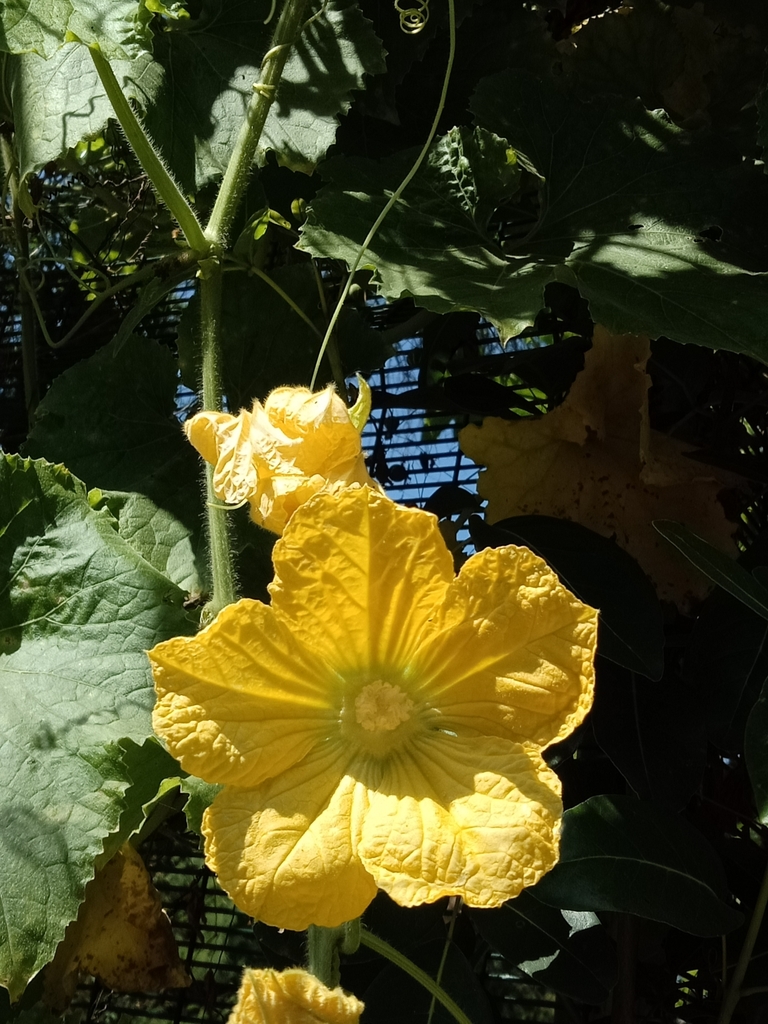
Winter Melon
Benincasa hispida
Benincasa hispida, the wax gourd, also called ash gourd, white gourd, winter gourd, winter melon, tallow gourd, ash pumpkin, dongah or Chinese preserving melon, is a species of gourd.
The wax gourd is native to South and Southeast Asia. It is grown, especially in Asia, for its very large fruit, eaten as a vegetable when mature. One variety of the plant, called chi qua (Benincasa hispida var. chieh-qua), is commonly used in Asian cuisine.
From the article Wax gourd on Wikipedia (CC BY-SA), quoted section by section
Description
The plant grows thick vines with coarse, hairy stems. It has large, rough leaves between 10–30 centimetres (4–12 in) long. In early summer from June to September, golden yellow flowers form in the leaf axils. After they are pollinated, they bear obloid fruit 50–60 cm (20–24 in) long and 10–25 cm wide. They typically weigh 5–10 kg, with weights of up to 34.5 kg recorded. The young fruit are covered with soft fuzzy hairs which eventually disappear and develop a waxy coating that gives the fruit a shelf life of up to a year. The fruit has thick flesh that is sweet, crisp and juicy; it has white or yellow seeds.
Range & habitat
The wax gourd is native to South and Southeast Asia. It is widely grown throughout Asia, including Java and Japan, the places where it is thought to have originated.
Wikipedia: “Distribution and habitat”
At the table
The fruit, seeds, buds and young leaves can be eaten cooked, resembling pumpkin or zucchini. The gourd can be stored for many months, much like winter squash.
Ash gourds of the Indian subcontinent have a white coating with a rough texture (hence the name ash gourd). Southeast Asian varieties have a smooth waxy texture. It is one of the few vegetables available during winter in areas of deciduous vegetation. In India, the wax gourd is viewed as having medicinal properties in the Ayurvedic system of medicine. It is also viewed as having significance in spiritual traditions of India and Yoga, where it is identified as a great source of prana.
In Cambodia, it is known as tralach (Khmer: ត្រឡាច), and used in soup and stews in Cambodian cuisine. It is commonly used to make samlor tralach, which is winter gourd and pork soup, or stuffed pork in the gourd. In Chinese cuisine, the gourds are used in stir fries or combined with pork or pork/beef bones to make winter gourd soup, often served in the scooped out gourd, carved by scraping off the waxy coating. It is also chopped and candied as wintermelon candy (dōng guā táng), commonly eaten at New Year festivals, or as filling for Sweetheart cake (lǎopó bǐng). …
Wikipedia: “Culinary”
How it is grown
It is grown in well-drained loam and sandy soils in warm, mild climates, and will not tolerate frosts. It is grown in riverbeds or furrows, and needs constant irrigation during the growing season.
Wikipedia: “Cultivation”
In human culture
The name "winter melon" that is sometimes given to this plant is based on the Chinese name dōngguā (冬瓜); however, the character 瓜 (guā) can also mean "gourd" or "squash". It is likely that the name "melon" is given because this gourd is sometimes candied or made into a sweet tea. The name "wax gourd" comes from the wax coating in the fruit's skin.
Wikipedia: “Etymology”
Where it lives
Recorded sightings
—
geo-referenced records in GBIF, from museums, herbaria and field observers.
Drag the globe to turn it. Dots are where records exist, not a range map; darker means more records.
In the old herbals & bestiaries


In the stacks
Searching the stacks…
Every page naming Benincasa hispida in the Biodiversity Heritage Library →
This page is assembled live from iNaturalist, GBIF, Wikipedia, the Source Library and the Internet Archive. It is not yet part of the hand-edited codex. iNaturalist taxon 283076.