- Plants
- ›Vascular Plants
- ›flowering plants
- ›Dicots
- ›Gentians, Dogbanes, Madders, and Allies
- ›Dogbane Family
- ›Apocynoideae
- ›Echiteae
- ›Echitinae
- ›Echites
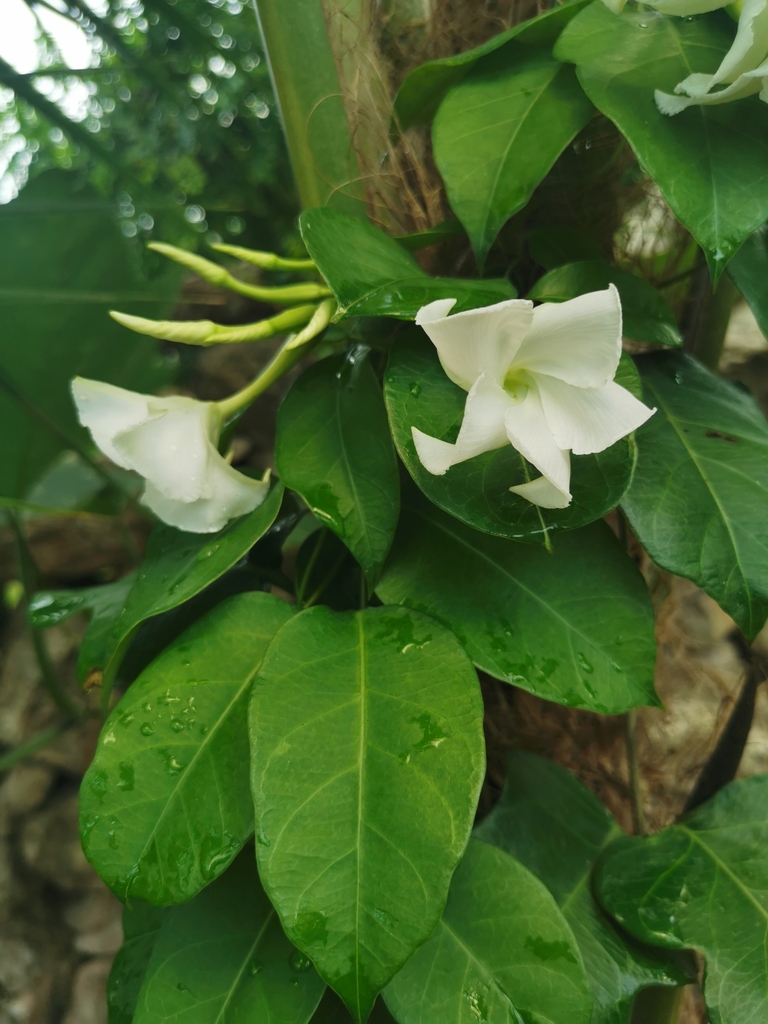
Echites yucatanensis
Echites yucatanensis, with no commonly accepted English name, is a neotropical climbing species of flowering plant belonging to the family Apocynaceae.
From the article Echites yucatanensis on Wikipedia (CC BY-SA), quoted section by section
Description
Echites yucatanensis displays these key features:
Climbing stems usually are woody at their bases but herbaceous at their tips. Leaves have egg-shaped to violin-shaped blades up to 12 cm (4.7 in) long and 7 cm (2.8 in) wide and are of modestly thick, almost leathery texture. Blade tips are pointed. Inflorescences arise on peduncles up to 3 cm (1.2 in) long, are produced along stem lengths, and comprise 3-10 flowers. Flower sepals are narrowly triangular and up to 7 mm (0.28 in) long. The white corollas consist of a narrow tube that abruptly expands in a flat-spreading top part (salverform), up to 10.2 cm long. Stamens are inserted at the tube's middle. There are two ovaries, fused at their styles, and nectaries surrounding the ovaries' bases are fused into cups whose rims may be notched by varying degrees. Follicle-type fruits are up to 29 cm (11 in) long. Seeds up to 22 mm (0.87 in) long are topped by tufts of hairs up to 3 cm (1.2 in) long.
Range & habitat
Based on leaf shape, corolla tube length, nectary configuration, and accepting Echites turriger as a species distinct from Echites yucatanensis, sometimes Echites yucatanensis is regarded as endemic just to Mexico's Yucatan Peninsula.
Wikipedia: “An alternative distribution concept”
In medicine
In Mexico's Yucatan Peninsula Echites yucatanensis is used for bites of venomous snakes, specifically for the terciopelo or cuatro narices, Bothrops asper, and the rattlesnake Crotalus tzabcan. The plant's uncooked underground parts are macerated and combined with lemon juice and ice. Mayan healers in Yucatan also use extracts of the plant for healing wounds and treating warts.
== References ==
Wikipedia: “In traditional medicine”
In human culture
The genus name Echites is based on the Greek echis, which means "viper", and ites, meaning "of the nature of", alluding to the twining habit and deleterious quality of the genus's species. The species name yucatanensis refers to Mexico's Yucatan Peninsula. In 1930 when Standley described the species, the specimens he had available all were from the Peninsula.
Wikipedia: “Etymology”
Where it lives
Recorded sightings
—
geo-referenced records in GBIF, from museums, herbaria and field observers.
Drag the globe to turn it. Dots are where records exist, not a range map; darker means more records.
In the stacks
Searching the stacks…
Every page naming Echites yucatanensis in the Biodiversity Heritage Library →
This page is assembled live from iNaturalist, GBIF, Wikipedia, the Source Library and the Internet Archive. It is not yet part of the hand-edited codex. iNaturalist taxon 284307.