- Plants
- ›Vascular Plants
- ›flowering plants
- ›Dicots
- ›myrtles, evening primroses, and allies
- ›lythrum family
- ›Pehria
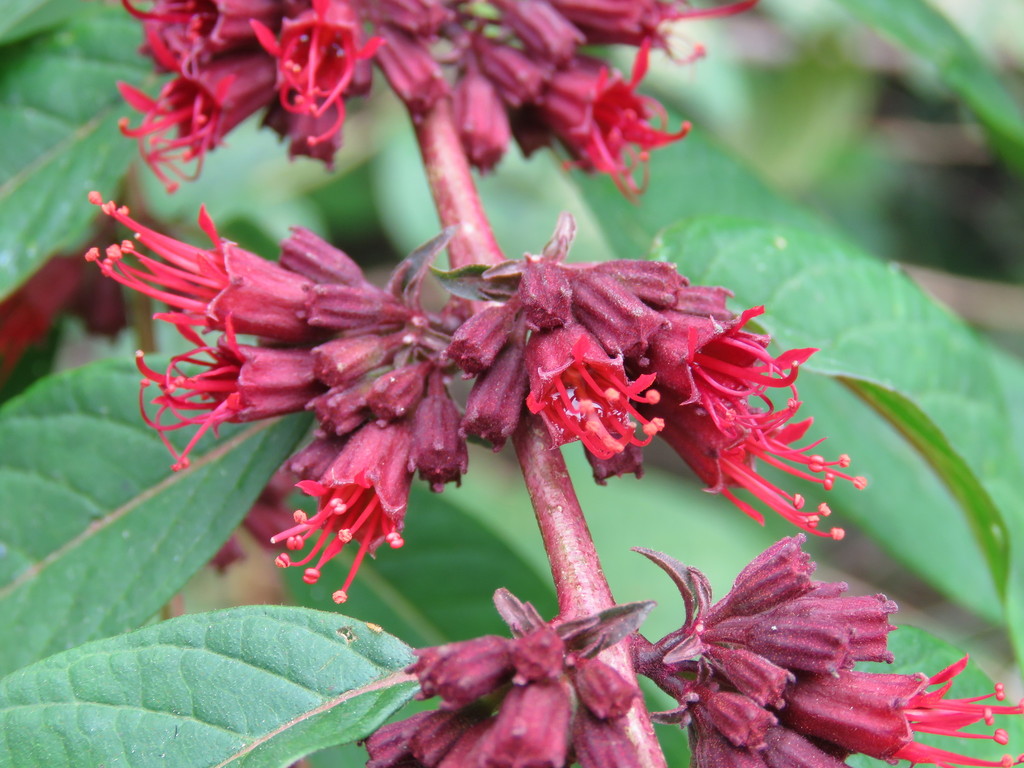
Pehria compacta
Pehria is a monotypic genus of plant in family Lythraceae. It has one known synonym, Grislea Loefl.. The genus just contains one known species, Pehria compacta (Rusby) Sprague
Its native range stretches from Central America down to Venezuela. It is found in Colombia, Honduras and Nicaragua.
From the article Pehria compacta on Wikipedia (CC BY-SA), quoted section by section
Description
They are shrubs or small trees, reaching up to 1.5–6 m (5–20 ft) tall. The leaves, the flowers and young stems are tinged with wine-red. They are puberulent (covered with minute soft erect hairs), with conspicuous glandular, globose, orange or black spots. The leaves have petioles (stalks) which are 3–10 mm (0.1–0.4 in) long. The blades are narrowly elliptical, oblong or lanceolate, 5–14 cm (2–6 in) long and 1–5 cm (0.4–2.0 in) wide. The apex (end of the leaf) is acuminate and the base is narrowly attenuated (narrows gradually). The inflorescences appear in axillary, cymose, compound, lax racemes, which are placed at the ends of the branches. The flowers have four red, petals which are dotted-glandular. The fruit (or seed capsule) is elongated, dry, dehiscent (breaks open at maturity to release contents), wrapped in the persistent floral tube, with 1 mm (0.04 in) long seeds.
Range & habitat
It is found in pastures, grasslands, at the edge of forests and on the banks of roads and rivers, at elevations of 100–1,500 m (300–4,900 ft) above sea level. Birds have been observed in Venezuela eating the fruit of the plant.
== References ==
Wikipedia: “Habitat”
Where it lives
Recorded sightings
—
geo-referenced records in GBIF, from museums, herbaria and field observers.
Drag the globe to turn it. Dots are where records exist, not a range map; darker means more records.
In the stacks
Searching the stacks…
Every page naming Pehria compacta in the Biodiversity Heritage Library →
This page is assembled live from iNaturalist, GBIF, Wikipedia, the Source Library and the Internet Archive. It is not yet part of the hand-edited codex. iNaturalist taxon 285408.