- Plants
- ›Vascular Plants
- ›flowering plants
- ›Dicots
- ›Waterlilies, Fanworts, and Allies
- ›Waterlily Family
- ›Nymphaea
- ›Hydrocallis
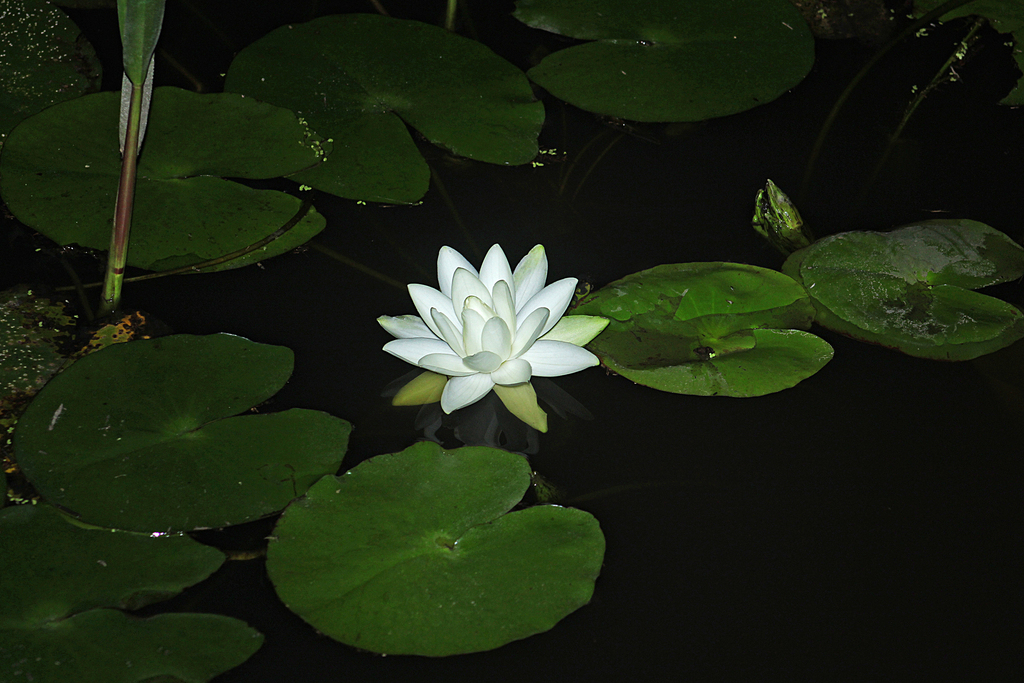
Nymphaea prolifera
Nymphaea prolifera is a species of waterlily naturally found from Mexico (specifically Veracruz and Tabasco) to Brazil and northeastern Argentina. Additionally, it has been reported to occur in Uruguay.
From the article Nymphaea prolifera on Wikipedia (CC BY-SA), quoted section by section
Range & habitat
In Mexico, Nymphaea prolifera was collected in temporarily flooded meadows at the roadside, at depths of 30 to 60 cm. The populations appear shortly after the onset of the rainy season. Its habitat within the Pantanal consists of flooded clay fields. It is also found in swamps, temporary ponds, pastures.
Wikipedia: “Habitat”
What it does
Fruits and seeds are only produced on very rare occasions. Instead, the main form of reproduction relies on the sterile, tubiferous flowers as a form of vegetative reproduction. Due to those vegetative propagules, it can persist through periods of decay. The tubers readily separate and it is common to see numerous floating tubers in the water. They drift briefly in the water, until they establish roots to anchor themselves in the mud. When the water level declines, the tubers are likely embedded within the substrate.
Wikipedia: “Reproduction”
In human culture
The specific epithet prolifera references its distinctive trait of proliferous asexual reproduction.
Wikipedia: “Etymology”
Where it lives
Recorded sightings
—
geo-referenced records in GBIF, from museums, herbaria and field observers.
Drag the globe to turn it. Dots are where records exist, not a range map; darker means more records.
In the stacks
Searching the stacks…
Every page naming Nymphaea prolifera in the Biodiversity Heritage Library →
This page is assembled live from iNaturalist, GBIF, Wikipedia, the Source Library and the Internet Archive. It is not yet part of the hand-edited codex. iNaturalist taxon 285787.