- Plants
- ›Vascular Plants
- ›flowering plants
- ›Dicots
- ›Mints, Plantains, Olives, and Allies
- ›Unicorn Plant Family
- ›Martynia
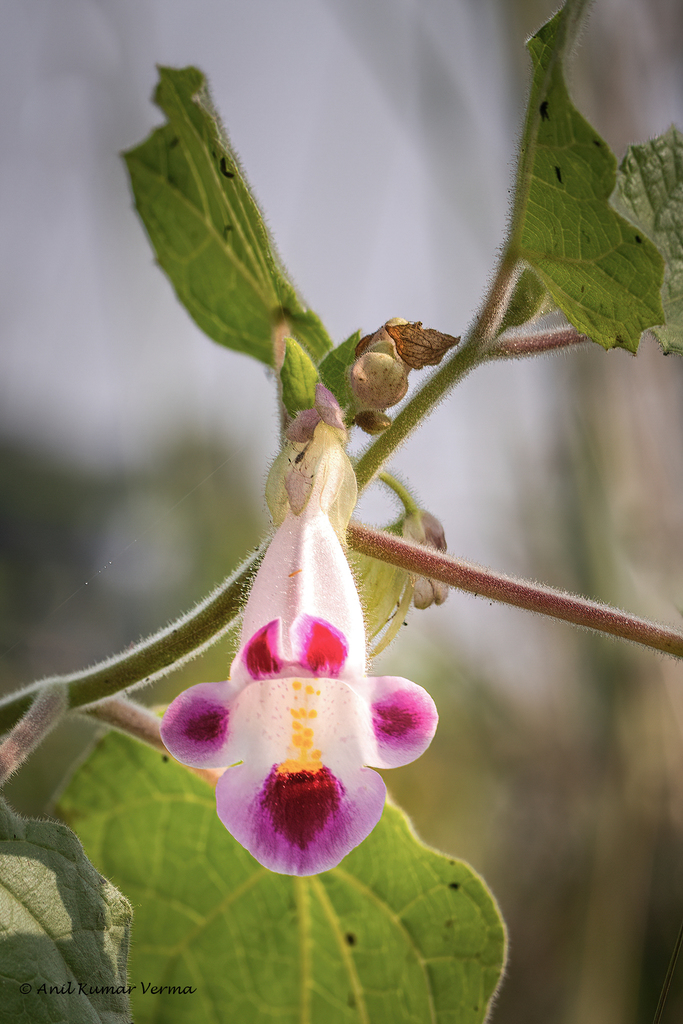
Cat's Claw
Martynia annua
Martynia is a monotypic genus in the Martyniaceae family consisting of a single species, Martynia annua L., which is commonly known as cat's claw, tiger's claw, iceplant. or Devil's claw. However, the name 'iceplant' may also refer to members of the unrelated plant family Aizoaceae.
It is native to Mexico, Central America and the Caribbean, and has been introduced throughout the tropics. It is now quite common in rural areas of India.
From the article Martynia on Wikipedia (CC BY-SA), quoted section by section
Description
Martynia is an erect, somewhat shrubby annual plant about 1 metre (3.3 ft) tall, covered with glandular hairs, and has ovate, mucilaginous leaves 8–20 centimetres (3.1–7.9 in) wide and 6–19 centimetres (2.4–7.5 in) long. The leaves are opposite, and have red petioles. They resemble sticky rhubarb. Its flowers are pale pink and tubular, and have nectar guides and purple spots. Fruits become blackened when ripe and have hooked spines at the tip, lending their name "cat's claw" or "tiger's claw". They stick to animal fur and eventually the seeds fall out as the fruit gets crushed by the animal's feet.
Range & habitat
Martynia is widely naturalized across subtropical and tropical world regions, particularly in Central America and the Indian subcontinent. It is typically found in uncultivated fields and arable lands from plains to 1,500 metres (4,900 ft).
Wikipedia: “Distribution”
At the table
The plant is used for making beads and other native ornaments. It has been applied for numerous supposed treatments in Ayurveda and Siddha folk medicine.
Wikipedia: “Uses”
Where it lives
Recorded sightings
—
geo-referenced records in GBIF, from museums, herbaria and field observers.
Drag the globe to turn it. Dots are where records exist, not a range map; darker means more records.
In the old herbals & bestiaries


In the stacks
Searching the stacks…
Every page naming Martynia annua in the Biodiversity Heritage Library →
This page is assembled live from iNaturalist, GBIF, Wikipedia, the Source Library and the Internet Archive. It is not yet part of the hand-edited codex. iNaturalist taxon 285847.