- Plants
- ›Vascular Plants
- ›flowering plants
- ›Dicots
- ›Mallows, Rock Roses, and Allies
- ›Mallow and Hibiscus Family
- ›Byttnerioideae
- ›Theobroma
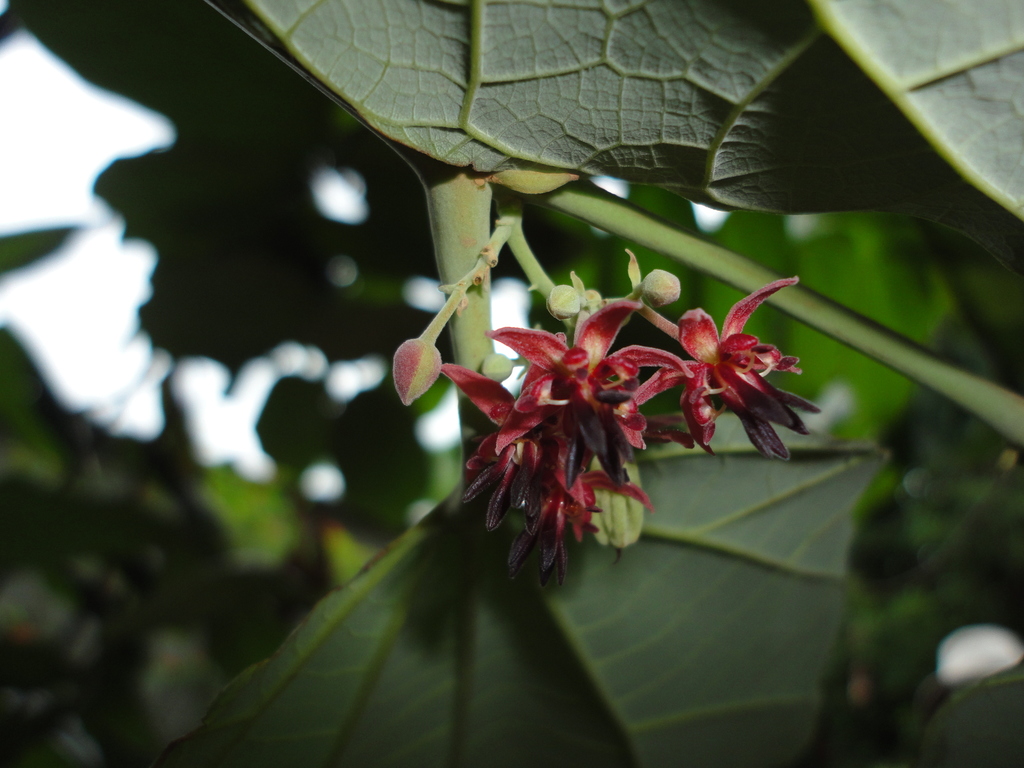
Mocambo tree
Theobroma bicolor
Theobroma bicolor, known commonly as the Mocambo tree, jaguar tree, balamte, or pataxte, among various other common names, is a tree in the genus Theobroma (family Malvaceae), which also contains the better-known Theobroma cacao (cocoa tree). It is known from Central and South America, including stretches of the Amazon rainforest in Brazil, Colombia, Ecuador, and Peru.
From the article Theobroma bicolor on Wikipedia (CC BY-SA), quoted section by section
Description
Theobroma bicolor can reach a height of 3–8 metres in open fields, although in the understories of forests it can grow to 25–30 metres. It is a slow-growing tree and grows best in loose, unconsolidated soils. It is adapted to survive flooding at a minimal level, but can sometimes last in deeper floods. In the central Amazon region, the tree produces fruit from March to November, and flowers from July to September. Similar to its close relative, the cacao tree, the mocambo tree's seeds are edible, high in calories, and rich in protein and fiber. The seeds are also high in omega 9 and contain caffeine.
How it is grown
Theobroma bicolor was historically cultivated by the Aztecs alongside T. cacao for production of chocolate, although when chocolate was introduced to the Spaniards, they considered the product of T. bicolor to be of a lower quality. Its seeds can also be eaten fried or in soups, and the seed pods when emptied are used as planters and containers. The pulp which surrounds the seeds can be eaten fresh, and has a sweet, mild taste. When the fruit is ripe, it naturally detaches from the tree branches and falls to the ground; the general method of harvesting is collecting the fallen fruit. The Maya placed a high value on the buttery foam crowning beverages of cacao and maize, according to descriptions from the time of the Conquista, and it appears that a thick, stable foam can be produced using fruits of T. bicolor as source of cacao, but not with T. cacao fruits.
Wikipedia: “Cultivation and use”
Where it lives
Recorded sightings
—
geo-referenced records in GBIF, from museums, herbaria and field observers.
Drag the globe to turn it. Dots are where records exist, not a range map; darker means more records.
In the stacks
Searching the stacks…
Every page naming Theobroma bicolor in the Biodiversity Heritage Library →
This page is assembled live from iNaturalist, GBIF, Wikipedia, the Source Library and the Internet Archive. It is not yet part of the hand-edited codex. iNaturalist taxon 286418.