- Plants
- ›Vascular Plants
- ›flowering plants
- ›Dicots
- ›Heathers, Balsams, Primroses, and Allies
- ›Pentaphylacaceae
- ›Ternstroemia
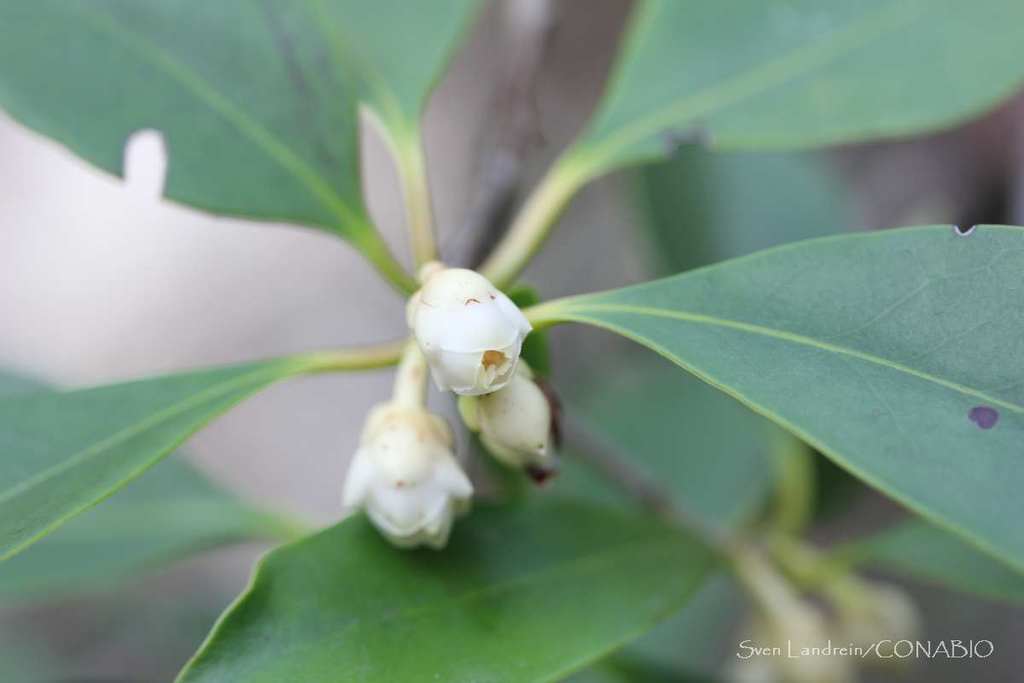
Ternstroemia sylvatica
Ternstroemia sylvatica, with no English name other than ternstroemia used for all Ternstroemia species, is a small tree in mountainous parts of Mexico. Currently it belongs to the small Pentaphylax Family, the Pentaphylacaceae.
From the article Ternstroemia sylvatica on Wikipedia (CC BY-SA), quoted section by section
Description
Ternstroemia sylvatica differs from other Ternstroemia species within its distribution area by its leaves being widest at their middle and flower peduncles being less than 1.6 cm (5⁄8 in) long. Beyond that, it displays the following notable features:
It can grow up to 15 m (49 ft) high, though normally it's half that. Branch stems are grayish. Somewhat leathery, evergreen, hairless leaves with undivided blades arise singly on stems and crowded at the tips of branches. Petioles are up to 1.6 cm (5⁄8 in) long, and blades are up to 10 cm (4 in) long and up to 3.4 cm (1+1⁄4 in) wide. Secondary veins are hardly visible. Flowers on thick peduncles less than 1.6 cm (5⁄8 in) long arise where leaves attach to stems, either singly or in small clusters. Two rounded bracteoles about 2 mm (1⁄8 in) long at first glance look like large calyx lobes, but the actual calyx consists of 5 rounded, leathery lobes up to 7 mm (1⁄4 in) long of unequal sizes; these conspicuously persist on the developing fruit. Corollas consist of 5 rounded, white petals up to 6.5 mm (1⁄4 in) long. Numerous stamens occupy the flowers' centers. Fruits up to 2 cm (3⁄4 in) long are cone to egg shaped, with leathery skin. NOTE: Published information on mature fruits at the seed dispersal stage of Ternstroemia sylvatica is scant. The Flora of China reports that fruits of some Ternstroemia species may split irregularly "... …
Range & habitat
Ternstroemia sylvatica is endemic just eastern Mexico, mainly in mountains of the Eastern Sierra Madre, the eastern Trans-Mexican Volcanic Belt, and relatively few populations in the northern part of the Southern Sierra Madre. Within this area, Ternstroemia sylvatica occurs in discontinuous patches separated by biogeographic features, the most conspicuous being the high limestone mountains known as La Gran Sierra Plegada, which separates the northernmost population of El Cielo from populations of the Sierra Gorda in northern Querétaro, and the Moctezuma River basin, separating Sierra Gorda populations from the southern Moctezuma River ones.
Wikipedia: “Distribution”
What it does
In central Mexico, Ternstroemia sylvatica is very common within its habitats. A study of cloud forests in northeastern Mexico found Ternstroemia sylvatica to be among the most important woody plants, with an Importance Value Index of over 10%. Throughout the distribution area of Ternstroemia sylvatica flowers and fruits are collected for medicinal purposes. Apparently no studies have evaluated how such extraction may affect the long-term survival of natural populations.
Wikipedia: “Ecology”
In medicine
In Mexico, Ternstroemia sylvatica is used in traditional medicine for treating sleep and anxiety disorders. Three flowers are soaked in a cup of water, and a cup is drunk three times daily. In the state of Veracruz, leaves are mashed and used to make alcoholic cataplasms for treating inflammations and rheumatic processes. A study confirmed that Ternstroemia sylvatica is an iimporant anti-inflammatory and analgesic plant.
Toxic effects. On mice, clinical effects of extracts of Ternstroemia sylvatica indicate that extracts of the fruits show toxicity activity.
Wikipedia: “Traditional medicine”
In human culture
The genus name Ternstroemia honors Christopher Tärnström, a Swedish botanist who died in 1746. The species name sylvatica is a Latin adjecive meaning "pertaining to the forest, of or belonging to the forest, growing wild."
Wikipedia: “Etymology”
Where it lives
Recorded sightings
—
geo-referenced records in GBIF, from museums, herbaria and field observers.
Drag the globe to turn it. Dots are where records exist, not a range map; darker means more records.
In the stacks
Searching the stacks…
Every page naming Ternstroemia sylvatica in the Biodiversity Heritage Library →
This page is assembled live from iNaturalist, GBIF, Wikipedia, the Source Library and the Internet Archive. It is not yet part of the hand-edited codex. iNaturalist taxon 286446.