- Plants
- ›Vascular Plants
- ›flowering plants
- ›Dicots
- ›Sunflowers, Bellflowers, Fanflowers, and Allies
- ›Sunflowers, Daisies, Asters, and Allies
- ›Asteroideae
- ›Sunflowers and Allies
- ›Helianthinae
- ›Sclerocarpus
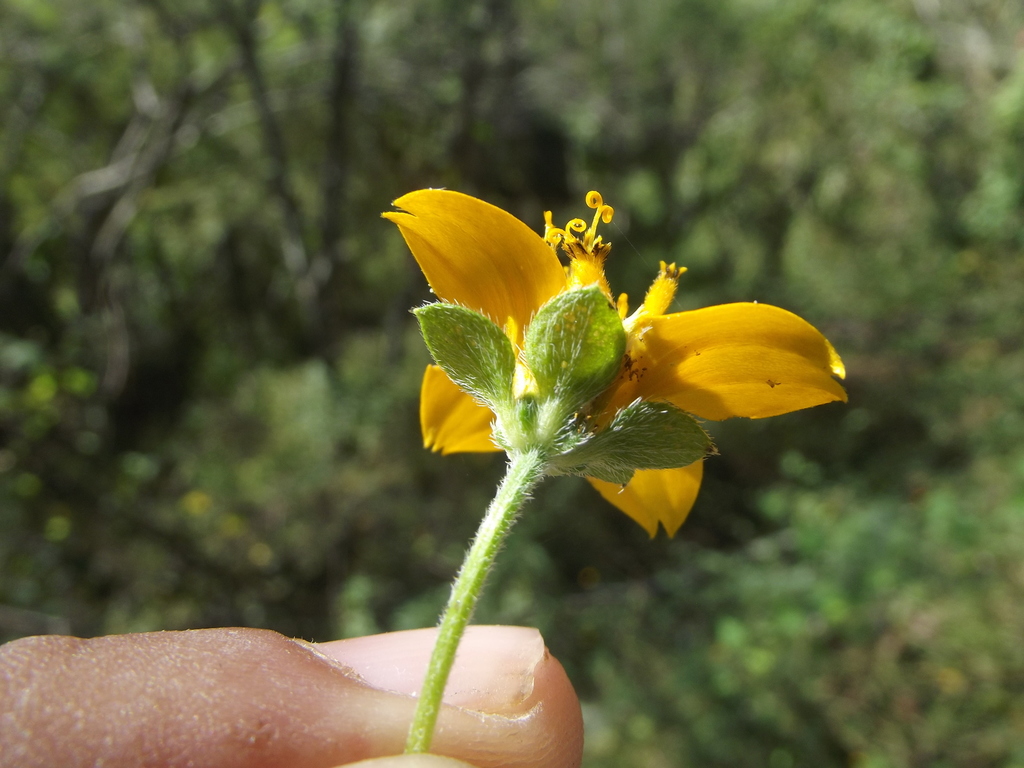
Tropical Bonebract
Sclerocarpus divaricatus
Sclerocarpus divaricatus, sometimes called tropical bonebract, is an attractive species of the Neotropics belonging to the family Asteraceae
From the article Sclerocarpus divaricatus on Wikipedia (CC BY-SA), quoted section by section
Description
Sclerocarpus divaricatus is an erect, spreading herbaceous plant up to 1.5 m (5 ft) tall. Here are features helping to distinguish it from many other similar members of the family:
Leaves with slender petioles reaching up to 9 centimetres (3.5 in) long may arise opposite one another at the base but otherwise alternate on the stems; blades are somewhat egg-shaped with toothed margins, and their rough-hairy surfaces are 3-nerved from near their bases. Flowering heads are solitary atop slender peduncles which are densely hairy at their tips and reach up to 6 cm (2.4 in) long. Each head consists of several yellow, sterile, petal-like ray florets along its margins, with an "eye" consisting of numerous fertile, yellow disk florets with dark anthers. Each disk-floret ovary is enfolded with a hairy bract, the "palea", which is slightly longer than the ovary, and which enlarges with the ovary and hardens with age. The ray florets' petal-like flat part, the ligule, is held well above the ovaries and subtending involucral bracts on a slender tube. Involucral bracts below the florets, numbering 4 or 5, form a green, bowl-like structure. One-seeded, more or less spherical, cypsela-type fruits enlarge to about 2 mm (0.08 in) across; they bear no pappuses atop them, but the enlarged, hairy paleae form crown-like items.
Range & habitat
Sclerocarpus divaricatus is distributed from Mexico south through Central America into Colombia and Venezuela in South America.
Wikipedia: “Distribution”
What it does
In Mexico's Yucatan Peninsula, when a forest is destroyed and plants begin revegetating the soil, Sclerocarpus divaricatus has been listed among the ten first colonizing species to become established. Also in the Yucatan Peninsula, Sclerocarpus divaricatus has been documented as one of six species identified as feed sources for bee colonies during the flowering onset period when flowers are scarce. In fact, in the Yucatan Peninsula the species may provide both flowers and fruits every month of the year.
Wikipedia: “Ecology”
In medicine
In Colombia, a decoction of the whole plant taken twice or more daily is used to treat malaria. In El Salvador, where it is known as Calacate, it has been used to bring down fevers. In the Sierra de Chiconquiaco, Veracrúz, México, Sclerocarpus divaricatus is used to treat diarrhea.
Wikipedia: “Traditional medicine”
In human culture
In Mexico's Yucatan Peninsula where apiculture long has been practiced by the Mayan people, Sclerocarpus divaricatus is seen as important for bees.
Wikipedia: “Apiculture”
Where it lives
Recorded sightings
—
geo-referenced records in GBIF, from museums, herbaria and field observers.
Drag the globe to turn it. Dots are where records exist, not a range map; darker means more records.
In the stacks
Searching the stacks…
Every page naming Sclerocarpus divaricatus in the Biodiversity Heritage Library →
This page is assembled live from iNaturalist, GBIF, Wikipedia, the Source Library and the Internet Archive. It is not yet part of the hand-edited codex. iNaturalist taxon 288661.