- Plants
- ›Vascular Plants
- ›flowering plants
- ›Dicots
- ›Sunflowers, Bellflowers, Fanflowers, and Allies
- ›Sunflowers, Daisies, Asters, and Allies
- ›Asteroideae
- ›Perityleae
- ›Peritylinae
- ›Eutetras
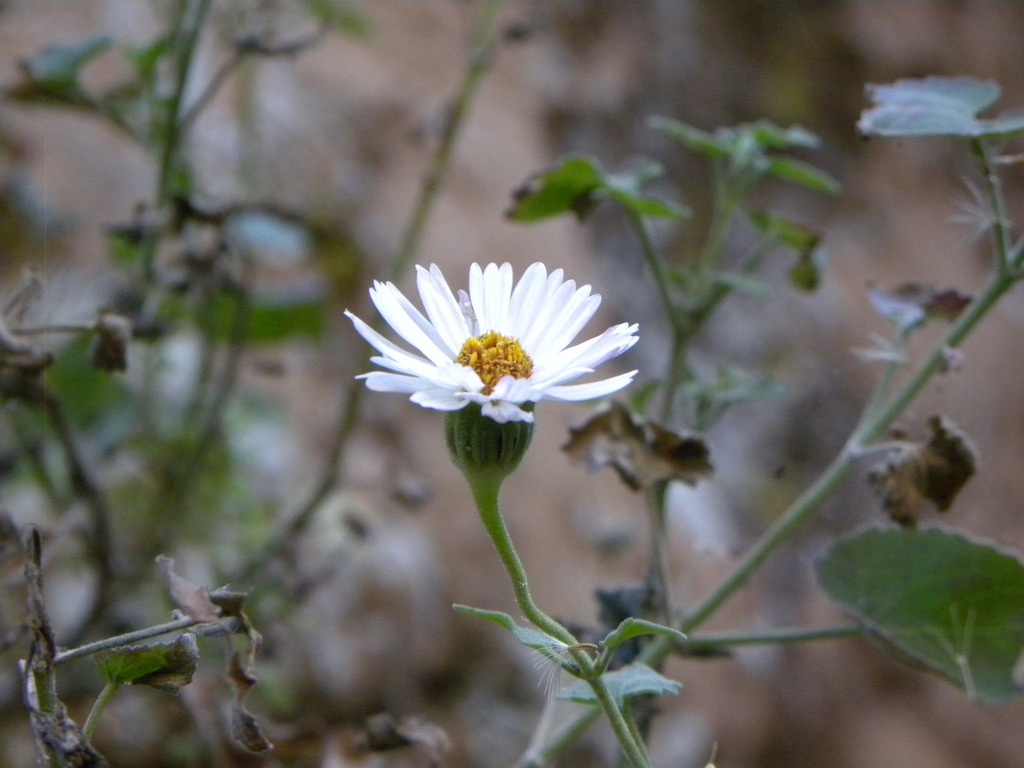
Eutetras pringlei
Eutetras pringlei, with no English name, is a species of flowering plant belonging to the huge Aster, Composite, Daisy or Sunflower family the Asteraceae.
From the article Eutetras pringlei on Wikipedia (CC BY-SA), quoted section by section
Description
With its flowering head consisting of white ray florets surrounding an "eye" of yellow disk florets, Eutetras pringlei is similar to hundreds of other daisy-like members of the Aster Family. However, here is a list of features which, altogether, define the relatively small New World tribe to which Eutetras pringlei belongs, the "rock daisy" tribe, the Perityleae:
Flowering heads consist of white, petal-like ray florets surrounding a cluster of yellow disk florets with cylindrical corollas. Plants produce more than one flowering head. Green, scale-like bracts forming a bowl-like involucre below the flowering heads are arranged in a single series beside one another and are not fused where their margins meet. One-seeded, cypsela-type fruits are topped with two (sometimes 1-4) erect bristles along with, usually but not always, a low "crown" of fused scales. No papery, scale-like bracts (paleae) separate cypselae from one another. Stalks, or peduncles, holding the flower heads don't "bleed" white latex when injured. The cypselae are black.
Within the rock daisy tribe, the Perityleae, the genus Eutetras mainly is distinguished from other genera by its one-seeded cypselae-type fruits, and the pappuses atop them, a close look seen at the left. Note that the cypselae have four sides with hairless faces, while the very prominent, somewhat ribbed margins are hairy. …
Range & habitat
Eutetras pringlei is endemic to a small region in the central Mexican highlands, in portions of the states of Guanajuato, Hidalgo, Querétaro, México, San Luis Potosí and Veracruz.
Wikipedia: “Distribution”
In human culture
In the genus name Eutetras the Eu is a combining form occurring chiefly in Greek words meaning "good, well". In taxonomic names, often it is used in the sense of "true, genuine". The -tetras is New Latin from the Greek tettares meaning "four". Thus with Eutetras, something is "truly four". Apparently this refers to the prominently four-angled, four-sided, cypsela-type fruits produced by species in the genus, a feature which much impressed the genus's author. The species name pringlei honors C.G. Pringle, whose collection #8813, taken near Acámbaro, Guanajuato, Mexico on October 6, 1904, served as the type specimen when J.M. Greenman formally described the species in 1907.
Wikipedia: “Etymology”
Where it lives
Recorded sightings
—
geo-referenced records in GBIF, from museums, herbaria and field observers.
Drag the globe to turn it. Dots are where records exist, not a range map; darker means more records.
In the stacks
Searching the stacks…
Every page naming Eutetras pringlei in the Biodiversity Heritage Library →
This page is assembled live from iNaturalist, GBIF, Wikipedia, the Source Library and the Internet Archive. It is not yet part of the hand-edited codex. iNaturalist taxon 289450.