- Plants
- ›Vascular Plants
- ›flowering plants
- ›Dicots
- ›Gentians, Dogbanes, Madders, and Allies
- ›Dogbane Family
- ›Rauvolfioideae
- ›Tabernaemontaneae
- ›Tabernaemontaninae
- ›Tabernaemontana
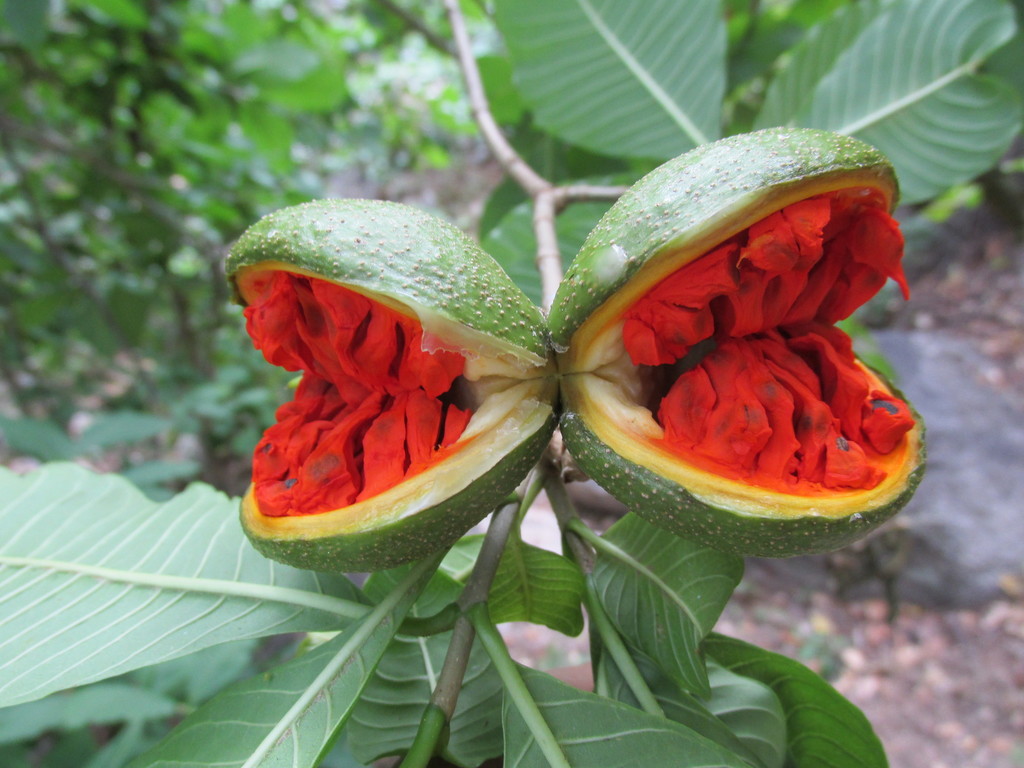
horse balls
Tabernaemontana donnell-smithii
Tabernaemontana donnell-smithii is an evergreen tree in the dogbane family Apocynaceae commonly known as the horse balls tree. In Spanish, it is huevos de caballo, cojones de burro, cojón de mico, or cojotón. The name huevos de caballo comes from the oval shape of the tree's hanging fruit. It is native to Mexico and Central America. The type locality is San Felipe, Retalhuleu in Guatemala. Tabernaemontana donnell-smithii is similar to Tabernaemontana glabra, except that its leaves and flowers are smaller and its fruit is larger.
Tabernaemontana donnell-smithii lives in a variety of habitats, including various types of forest, the forest edge, and pastures. It grows up to 20 metres (66 ft) tall, although the height is partially dependent on the habitat. Trees living in secondary growth areas, forest edges and pastures are generally shorter but broader than those in forests. The flowers are yellow, and may appear at different times of the year depending on the location. Foster and McDiarmid found that the slow growing fruit is about 7 to 10 centimetres (2.8 to 3.9 in) long and weighs an average of about 143 grams (5.0 oz). The fruit is enclosed in a woody husk which represents more than three-quarters of the fruit's weight. When the fruit is open, a slit forms in the husk permitting access to the arils, each of which covers a seed.
Where it lives
Recorded sightings
—
geo-referenced records in GBIF, from museums, herbaria and field observers.
Drag the globe to turn it. Dots are where records exist, not a range map; darker means more records.
In the stacks
This page is assembled live from iNaturalist, GBIF, Wikipedia, the Source Library and the Internet Archive. It is not yet part of the hand-edited codex. iNaturalist taxon 291209.