- Plants
- ›Vascular Plants
- ›flowering plants
- ›monocots
- ›gingers, bananas, and allies
- ›Banana Family
- ›Musa
- ›Musa
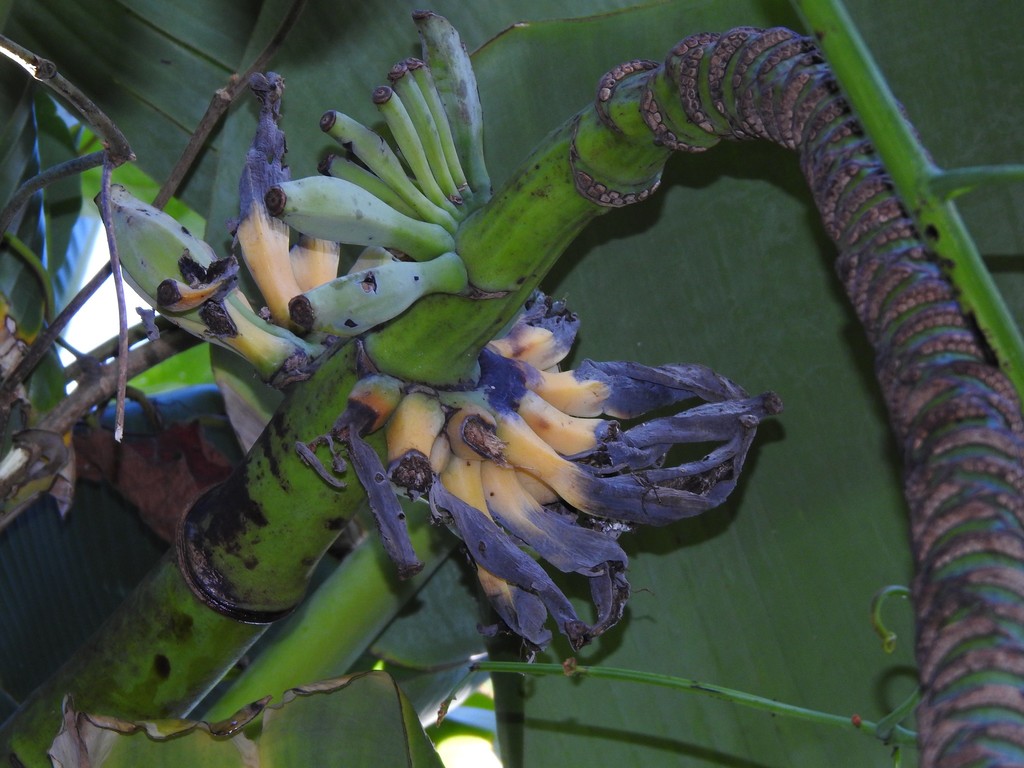
sweet wild banana
Musa balbisiana
Musa balbisiana is a species of wild banana native to eastern South Asia, northern Southeast Asia, and southern China. It is one of the ancestors of modern cultivated bananas, along with Musa acuminata. It was first scientifically described in 1820 by the Italian botanist Luigi Aloysius Colla. It grows lush leaves in clumps with a more upright habit than most cultivated bananas. Flowers grow in inflorescences coloured red to maroon. The fruit are between blue and...
From the article Musa balbisiana on Wikipedia (CC BY-SA), quoted section by section
Description
It grows lush leaves in clumps with a more upright habit than most cultivated bananas. Flowers grow in inflorescences coloured red to maroon. The fruit are between blue and green. They are considered inedible because of the seeds they contain.
Range & habitat
It is native to eastern South Asia, the eastern regions of the Indian subcontinent, northern Southeast Asia, and southern China. Introduced populations exist in the wild, far outside its native range.
Wikipedia: “Distribution”
At the table
It is assumed that wild bananas were cooked and eaten, as farmers would not have developed the cultivated banana otherwise. Seeded Musa balbisiana fruit are called pisang batu (rock banana) in Indonesia and Malaysia, butuhan ('with seeds') in the Philippines, and kluai tani (กล้วยตานี) in Thailand, where its leaves are used for packaging and crafts. Natural parthenocarpic clones occur through polyploidy and produce edible bananas, examples of which are wild saba bananas.. In Indonesia, these bananas can be made into rujak.
Wikipedia: “Uses”
Where it lives
Recorded sightings
—
geo-referenced records in GBIF, from museums, herbaria and field observers.
Drag the globe to turn it. Dots are where records exist, not a range map; darker means more records.
In the stacks
Searching the stacks…
Every page naming Musa balbisiana in the Biodiversity Heritage Library →
This page is assembled live from iNaturalist, GBIF, Wikipedia, the Source Library and the Internet Archive. It is not yet part of the hand-edited codex. iNaturalist taxon 292142.