- Animals
- ›Molluscs
- ›Gastropods
- ›Heterobranchs
- ›Euthyneura
- ›Tectipleura
- ›Sea Butterflies
- ›Pseudothecosomata
- ›Cymbulioidea
- ›Cymbuliidae
- ›Cymbuliinae
- ›Cymbulia
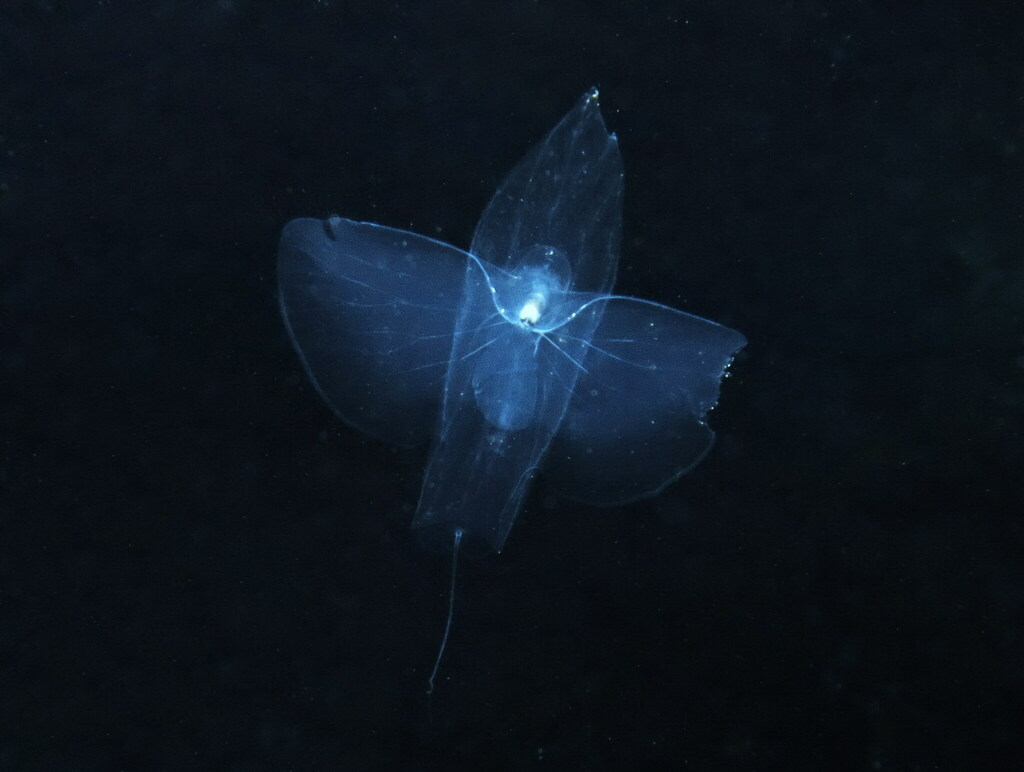
Sword of Venus
Cymbulia peronii
Cymbulia peronii is a species of pteropod. It is a pellagic gastropod mollusk. Specifically, it is a sea butterfly part of the Cymbulioidea superfamily....
From the article Cymbulia peronii on Wikipedia (CC BY-SA), quoted section by section
Description
It reaches about 60–65 mm (2.4–2.6 in) in length and has a translucent, bluish body with two wing-like parapods used for slow movement. During development it retains a transparent, cartilaginous internal shell (pseudoconch) with five dentate ridges that resembles a “glass slipper” or gelatinous crystal-like structure often found washed up on beaches after the animal’s death, sometimes called a "venus' hoof".
Wikipedia: “Anatomy”
Range & habitat
The species inhabits waters concentrating around the extreme south-east United States, the Balearic Islands of Spain, Svalbard, and the offshores of Namibia, sometimes down to about 2,000 m (6,560 ft) depth, carried by currents. It can withstand temperatures of 13–27 °C (55–81 °F).
Wikipedia: “Distribution”
What it does
Reproduction and breeding takes place temporally from June to August. The animals are protandrous hermaphrodites, meaning male characteristics develop first, with individuals becoming female as they age; this is known as successive hermaphroditism. Reproduction takes place in the planktonic environment through the release of gametes and the development of veliger larvae (gastropod larvae).
== References ==
Wikipedia: “Reproduction”
At the table
Cymbulia peronii often captures prey by having its oral organs open while drifting, and feeds on phytoplankton, mucus, diatoms and other chromists. It is a passive predator, and utilizes hair-like tentacles to sense and detect nearby prey.
Wikipedia: “Alimentation”
Where it lives
Recorded sightings
—
geo-referenced records in GBIF, from museums, herbaria and field observers.
Drag the globe to turn it. Dots are where records exist, not a range map; darker means more records.
In the stacks
Searching the stacks…
Every page naming Cymbulia peronii in the Biodiversity Heritage Library →
This page is assembled live from iNaturalist, GBIF, Wikipedia, the Source Library and the Internet Archive. It is not yet part of the hand-edited codex. iNaturalist taxon 292951.