- Animals
- ›Arthropods
- ›Crustaceans
- ›Typical Crustaceans
- ›Malacostracans
- ›Decapods, Isopods, and allies
- ›Decapods and Krill
- ›Decapods
- ›Crabs, Lobsters, Shrimps, and Allies
- ›True Crabs
- ›Eubrachyuran Crabs
- ›Heterotrematan Crabs
- ›Swimming Crabs and Allies
- ›Swimming Crabs
- ›Portuninae
- ›Callinectes
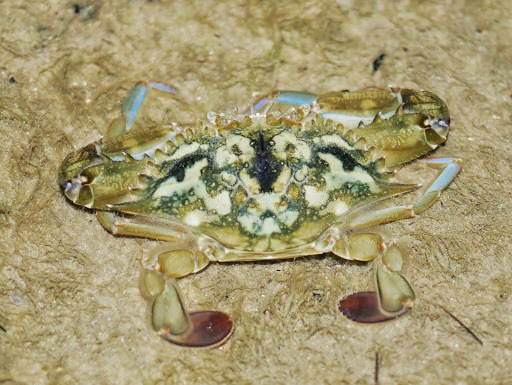
Marbled Swimming Crab
Callinectes marginatus
Callinectes marginatus, commonly known as the sharptooth swimcrab or marbled swimcrab, is a species of swimming crab in the family Portunidae.
From the article Callinectes marginatus on Wikipedia (CC BY-SA), quoted section by section
Description
Its carapace bears nine spines behind each eye, the last of which is around twice the length of the previous one, making the whole carapace around 10 centimetres (3.9 in) wide.
Range & habitat
Although the name Callinectes marginatus was used by Mary J. Rathbun and others to also cover animals now referred to the species C. larvatus and C. diacanthus, C. marginatus is now used only for a species found from the Cape Verde Islands and Nouadhibou, Mauritania to Angola. C. marginatus appears to be entirely marine, unlike some of its congeners, although there are records from the estuaries of the Congo River and the Hwini River. The crabs dig holes around 30 cm (12 in) wide in mudflats.
== References ==
Wikipedia: “Distribution and ecology”
Where it lives
Recorded sightings
—
geo-referenced records in GBIF, from museums, herbaria and field observers.
Drag the globe to turn it. Dots are where records exist, not a range map; darker means more records.
In the stacks
Searching the stacks…
Every page naming Callinectes marginatus in the Biodiversity Heritage Library →
This page is assembled live from iNaturalist, GBIF, Wikipedia, the Source Library and the Internet Archive. It is not yet part of the hand-edited codex. iNaturalist taxon 295303.