- Animals
- ›Arthropods
- ›Crustaceans
- ›Typical Crustaceans
- ›Malacostracans
- ›Decapods, Isopods, and allies
- ›Decapods and Krill
- ›Decapods
- ›Crabs, Lobsters, Shrimps, and Allies
- ›True Crabs
- ›Eubrachyuran Crabs
- ›Thoracotrematan Crabs
- ›Ghost, Fiddler, Sand Bubbler Crabs and Allies
- ›Ghost and Fiddler Crabs
- ›Ghost Crabs
- ›Ocypode
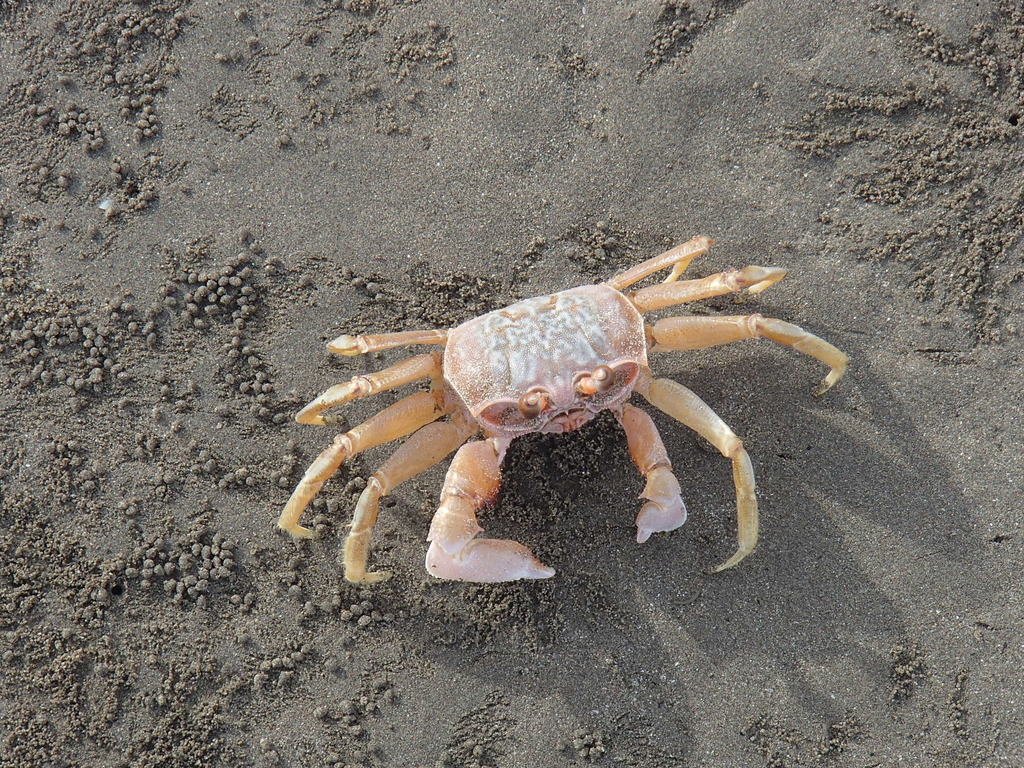
Gulf Ghost Crab
Ocypode occidentalis
The gulf ghost crab, Hoplocypode occidentalis, is a species of ghost crabs native to the Pacific coast of the Americas, from the Gulf of California to Colombia. It is the only species in the genus Hoplocypode. Gulf ghost crabs are medium-sized, reaching a maximum overall body diameter of 6 in (15 cm). They are one of only two ghost crab species found in the eastern Pacific (the other being the painted ghost crabs). However, gulf ghost crabs can easily be distinguished from painted ghost crabs by the absence of "horns" on their eyes.
From the article Gulf ghost crab on Wikipedia (CC BY-SA), quoted section by section
Description
Gulf ghost crabs are medium-sized ghost crabs with deep bodies, reaching a maximum overall body diameter of 6 in (15 cm). The upper surface of the body is generally dark gray with lighter colored marbling. The underside of the body, the tips of the walking legs, and the claws are creamy white. Their coloration varies, usually matching the color of the sand surrounding them, but they are easier to see on black volcanic sand and on light-colored dry sand.
The carapace is squarish in shape and wider than it is long, with a length around 43 mm (1.7 in) and a width of 50 mm (2.0 in). It is thickly covered with rough, small bumps (tubercles). Their eyestalks are large and elongated, but do not possess "horns" as in some other ghost crab species. The outer half of margins of the eye sockets curve distinctly inwards, with the outer edges (exorbital angles) triangular in shape with a sharp, forward-facing, pointed end. Like other ghost crabs, one of the claw appendages (chelipeds, the first pereiopod pair) of gulf ghost crabs is much bigger than the other. The palm of the larger cheliped is elongated with a serrated lower edge and covered with tubercles on the upper surface. It features stridulating (sound-producing) ridges on the inner surface of the palm, which is important for identifying different species within the subfamily Ocypodinae. …
Range & habitat
Gulf ghost crabs are native to the eastern Pacific coast of the Americas, from the Gulf of California to Colombia. They are sympatric with the painted ghost crab (Ocypode gaudichaudii), and juvenile specimens of the two smaller than 5 by 6 mm (0.20 by 0.24 in) are very difficult to tell apart. However, the adults are readily distinguishable, as painted ghost crabs are brightly colored and possess "horns" (styles) on their eyestalks which are absent in gulf ghost crabs. Painted ghost crabs also prefer sheltered rocky beaches, while gulf coast crabs are found on open sandy beaches. Gulf ghost crabs also superficially resemble the Atlantic ghost crab (Ocypode quadrata), but the two species do not occur in the same areas, with the latter being only found in the western Atlantic coast of the Americas.
Wikipedia: “Distribution”
What it does
Gulf ghost crabs live in burrows near the intertidal zone of open sandy beaches and on sand and silt banks near where river mouths empty into the sea. Larger individuals usually have burrows further up the shore, while smaller individuals are closer to the waves. They are nocturnal, emerging from their burrows just after sunset. They are fast-moving generalist scavengers and predators, usually feeding on decaying bodies of fish and other crustaceans. They are also devastating predators of eggs and hatchlings of sea turtles, including the olive Ridley sea turtle (Lepidochelys olivacea) and the leatherback sea turtle (Dermochelys coriacea). In Playa Grande, Costa Rica, they've been observed to be responsible for as much as 48% of the total number of deaths in freshly hatched sea turtles crossing the beaches towards the water.
Wikipedia: “Ecology”
Where it lives
Recorded sightings
—
geo-referenced records in GBIF, from museums, herbaria and field observers.
Drag the globe to turn it. Dots are where records exist, not a range map; darker means more records.
In the stacks
Searching the stacks…
Every page naming Ocypode occidentalis in the Biodiversity Heritage Library →
This page is assembled live from iNaturalist, GBIF, Wikipedia, the Source Library and the Internet Archive. It is not yet part of the hand-edited codex. iNaturalist taxon 295361.