- Animals
- ›Arthropods
- ›Crustaceans
- ›Typical Crustaceans
- ›Malacostracans
- ›Decapods, Isopods, and allies
- ›Amphipods, Isopods, and Allies
- ›Isopods
- ›Woodlice, Pillbugs, and Rock Slaters
- ›Woodlice and Pillbugs
- ›Crinocheta
- ›Porcellionid Woodlice
- ›Porcellio
- ›Porcellio laevis group
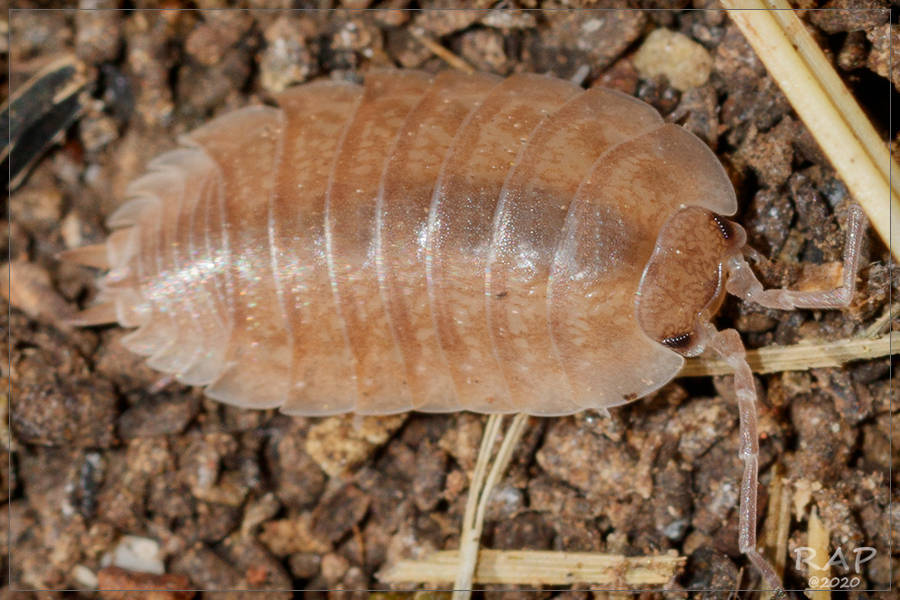
Swift Woodlouse
Porcellio laevis
Porcellio laevis (commonly called the swift woodlouse, or smooth slater in Australia) is a species of woodlouse in the genus Porcellio. As the species epithet laevis as well as the vernacular name "swift woodlouse" suggests, the species is capable of quick bursts of speed when provoked.
This species of woodlouse is distinctively large, appearing up to 20 millimetres (0.79 in) long with a smooth dorsal surface. The males can be identified by their long, spear-shaped uropods. The smooth dorsal surface of Porcellio laevis separates it visually from many other species in the same genus.
From the article Porcellio laevis on Wikipedia (CC BY-SA), quoted section by section
Range & habitat
P. laevis was first recorded in Britain in the 13th century but it likely originated in North Africa. It has a cosmopolitan distribution, and has been introduced to Australia, including Norfolk Island and Lord Howe Island. The species is also found in North and South America, Western Asia, Japan and some Pacific islands. This species is found under rocks and fallen logs in damp areas, and is otherwise rarely encountered. Records from Ireland and Britain also place them in agricultural areas like gardens, farms, and stables where they can be found in dung and compost piles.
Wikipedia: “Distribution and habitat”
What it does
Porcellio laevis is one of several species of isopods known to use "alternating turns" as a defense mechanism, running in a mazelike pattern to confuse or avoid perceived threats. Studies suggest that this behavior, also observed in Armadillidium vulgare, can be reinforced as a learned response, with more "alternating turns" produced by longer and more frequent exposure to predators.
Wikipedia: “Behavior”
Where it lives
Recorded sightings
—
geo-referenced records in GBIF, from museums, herbaria and field observers.
Drag the globe to turn it. Dots are where records exist, not a range map; darker means more records.
In the stacks
Searching the stacks…
Every page naming Porcellio laevis in the Biodiversity Heritage Library →
This page is assembled live from iNaturalist, GBIF, Wikipedia, the Source Library and the Internet Archive. It is not yet part of the hand-edited codex. iNaturalist taxon 296087.