- Animals
- ›Arthropods
- ›Hexapods
- ›Insects
- ›Winged and Once-winged Insects
- ›Ants, Bees, Wasps, and Sawflies
- ›Narrow-waisted Wasps, Ants, and Bees
- ›Ants, Bees, and Stinging Wasps
- ›Vespoid Wasps
- ›Hornets, Paper Wasps, Potter Wasps, and Allies
- ›Paper Wasps
- ›Polistini
- ›Polistes
- ›Aphanilopterus
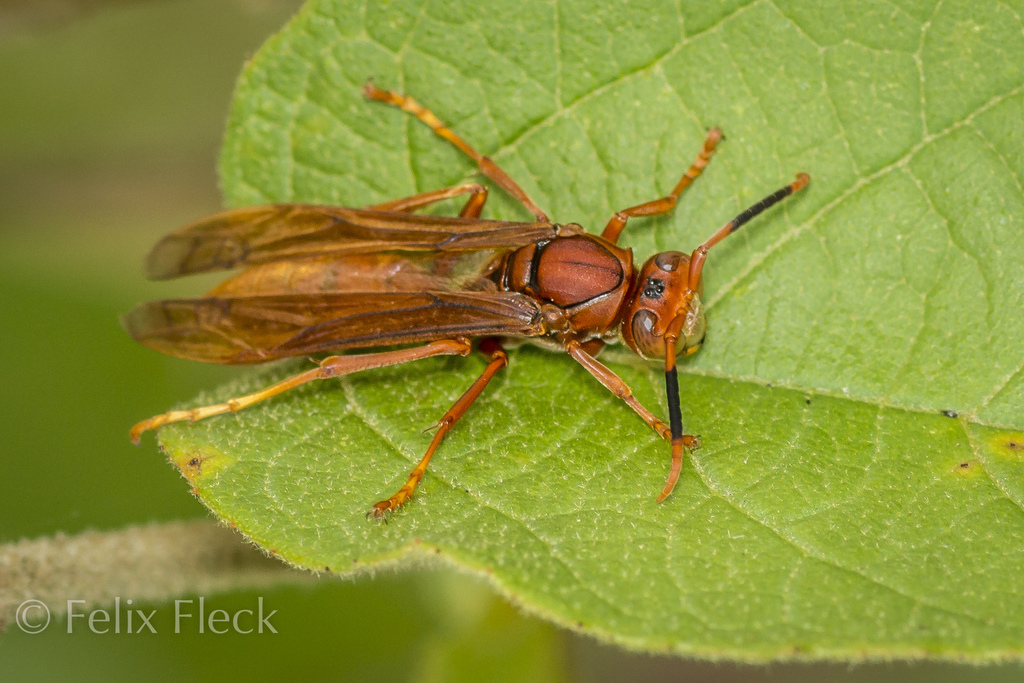
Neotropical Red Paper Wasp
Polistes canadensis
Polistes canadensis is a species of red paper wasp found in the Neotropical realm. It is a primitively eusocial wasp as a member of the subfamily Polistinae. A largely predatory species, it hunts for caterpillar meat to supply its colony, often supplementing its developing larvae with nectar. The most widely distributed American species of the genus Polistes, it colonizes multiple combs, which it rears year-round.
Emerging from hibernation in the spring, the females found nests built from plant material such as dry grass and dead wood. These nests are not covered with an envelope and feature hexagonal cells in which eggs are laid and larvae develop. The Polistes canadensis colony divides its colony among several combs and does not reuse these combs as a defense mechanism against parasites such as the tineid moth. On average, a single female queen with 9.1 foundresses usually initiates the construction of new combs and cells to form nests. The more foundresses in a colony, the more combs produced. On average, combs grow for 15.4 days and achieve a size of 30.8 cells. One female queen exercises absolute dominance over all other females, often using lateral abdominal vibrations and stroking to suppress the aggressive behavior of her nestmates.
From the article Polistes canadensis on Wikipedia (CC BY-SA), quoted section by section
Description
Both male and female Polistes canadensis have a uniformly light to dark mahogany-brown body, sometimes with the head and thorax of a lighter shade. Some feature a yellow apical margin of the first tergum as well. The wings are purplish black, and the veins and stigma are either black or reddish brown. Polistes canadensis is a large-bodied wasp with a wing length ranging from 17.0 to 24.5 mm. Nests are constructed from plant fibers such as dry grass and dead wood, which, as with other paper wasps, are mixed with saliva to create water-resistant nests made out of papery material. These nests are not covered with an outer envelope and feature hexagonal cells in which eggs are laid and larvae develop. A growing Polistes canadensis colony often engages in fission into several combs, with an average size of 30.8 cells per comb. A large, mature but still growing colony may have over 800 cells distributed among over 30 combs. Combs on vertical (walls and tree trunks) and sloping surfaces (tree limbs) hang with the petiole at the upper end. Colonies on tree trunks tend to add secondary combs above or below the first comb resulting in a linear arrangement. In contrast, nests on horizontal surfaces away from edges (i.e. ceilings) feature eccentric petioles with secondary combs bordering the central primary comb in a semicircular perimeter. No comb has more than one petiole. …
Wikipedia: “Description and identification”
Range & habitat
Polistes canadensis is widely distributed over most of the Neotropical region, ranging from Arizona to Argentina. Some locations include, but are not limited to, Mexico, Guatemala, Honduras, Colombia, Ecuador, Venezuela, British Guiana, Trinidad, Brazil, Peru, Bolivia and Paraguay. Nests can often be found on human constructions such as buildings, in open habitats on trunks and large limbs of trees, and in sheltered sites such as in caves, sheds, or under peeling bark.
Wikipedia: “Distribution and habitat”
What it does
Male Polistes canadensis engage in two alternative mating tactics: the role of the territorial male (who chases away intruding patrollers) and the role of the patroller (who flies from tree to tree and does not chase other males). Patrollers have a smaller body size than territorial males. Because of their inability to successfully compete against the larger territorial males for territories, these smaller males resort to patrolling. While physical altercations between territorial males and intruding patrollers are rare (<5% of the time) as the intruders typically quickly depart, there is still significant competition over the possession of territories. Owning a territory tends to lead to more copulations, although the territory itself does not hold any resources or nests. The defense of these territories represents a lek polygyny mating system that is not based on resources. But rather, females perhaps incentivize males to compete for territories by restricting mating to these territories; this way, females know that the territorial males they choose to mate with are strong, healthy males. To attract females to the territories, males can rub their abdomens across the territories to apply pheromones. …
Wikipedia: “Mating behavior”
Listen
Looking for field recordings…
Where it lives
Recorded sightings
—
geo-referenced records in GBIF, from museums, herbaria and field observers.
Drag the globe to turn it. Dots are where records exist, not a range map; darker means more records.
In the stacks
Searching the stacks…
Every page naming Polistes canadensis in the Biodiversity Heritage Library →
This page is assembled live from iNaturalist, GBIF, Wikipedia, the Source Library and the Internet Archive. It is not yet part of the hand-edited codex. iNaturalist taxon 300636.