- Animals
- ›Arthropods
- ›Hexapods
- ›Insects
- ›Winged and Once-winged Insects
- ›Beetles
- ›Water, Rove, Scarab, Long-horned, Leaf, and Snout Beetles
- ›Scarabaeiform Beetles
- ›Scarabs, Stag Beetles, and Allies
- ›Scarabs
- ›Rhinoceros Beetles
- ›Masked Chafers and Rice Beetles
- ›Cyclocephala
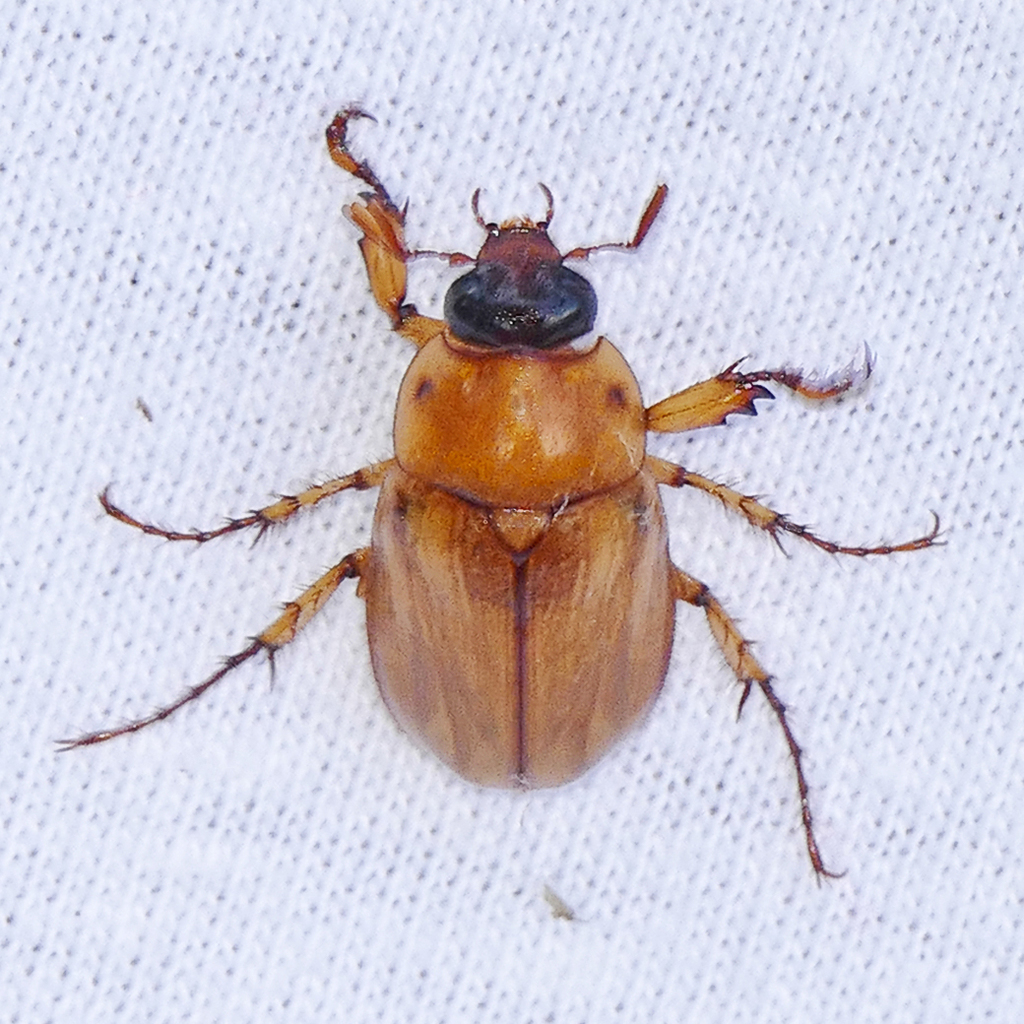
Southern Masked Chafer
Cyclocephala lurida
Cyclocephala lurida, the southern masked chafer, is a species of beetle in the family Scarabaeidae which is native to the southeastern United States. It is a brown beetle with a black head, with an adult length of 10 to 14 mm (0.4 to 0.6 in). The adult beetles cause no harm, but the eggs are laid underground and the developing larvae feed on grass roots and can kill turf under dry conditions.
From the article Cyclocephala lurida on Wikipedia (CC BY-SA), quoted section by section
What it does
Female southern masked chafer beetles emerge from the soil soon after sunset in June and July, remaining on the surface of the ground or climbing up grasses. At much the same time, males emerge and make zig-zag flights low over the ground. The females emit a pheromone, a volatile substance that acts as an attractant to males. When a male has homed in on a female, mating takes place after which the female burrows back into the soil. Mated females lay their eggs underground. The growing larvae feed on grass roots until late spring the following year when they pupate, the adults emerging about a fortnight later. There is a single generation each year, the adults being active for a few weeks. By 11pm during the breeding season, unmated females and all males move underground, and it has been found that after this time, unmated females retained in traps above ground start to attract male northern masked chafer (Cyclocephala borealis), a closely related species. This beetle normally mates after midnight and presumably uses the same pheromone for communication. Research shows that the larvae of the southern masked chafer also release pheromone, and if they happen to be on the surface, the adult males may attempt to mate with them. Adult males and larvae do not normally come in contact because the larvae remain entirely below ground and will usually have pupated before the adults emerge. …
Wikipedia: “Life cycle”
Listen
Looking for field recordings…
Where it lives
Recorded sightings
—
geo-referenced records in GBIF, from museums, herbaria and field observers.
Drag the globe to turn it. Dots are where records exist, not a range map; darker means more records.
In the stacks
Searching the stacks…
Every page naming Cyclocephala lurida in the Biodiversity Heritage Library →
This page is assembled live from iNaturalist, GBIF, Wikipedia, the Source Library and the Internet Archive. It is not yet part of the hand-edited codex. iNaturalist taxon 301456.