- Animals
- ›Arthropods
- ›Hexapods
- ›Insects
- ›Winged and Once-winged Insects
- ›Beetles
- ›Water, Rove, Scarab, Long-horned, Leaf, and Snout Beetles
- ›Cucujiform Beetles
- ›Snout and Bark Beetles
- ›Straight-snouted Weevils
- ›Brentinae
- ›Brentini
- ›Brentus
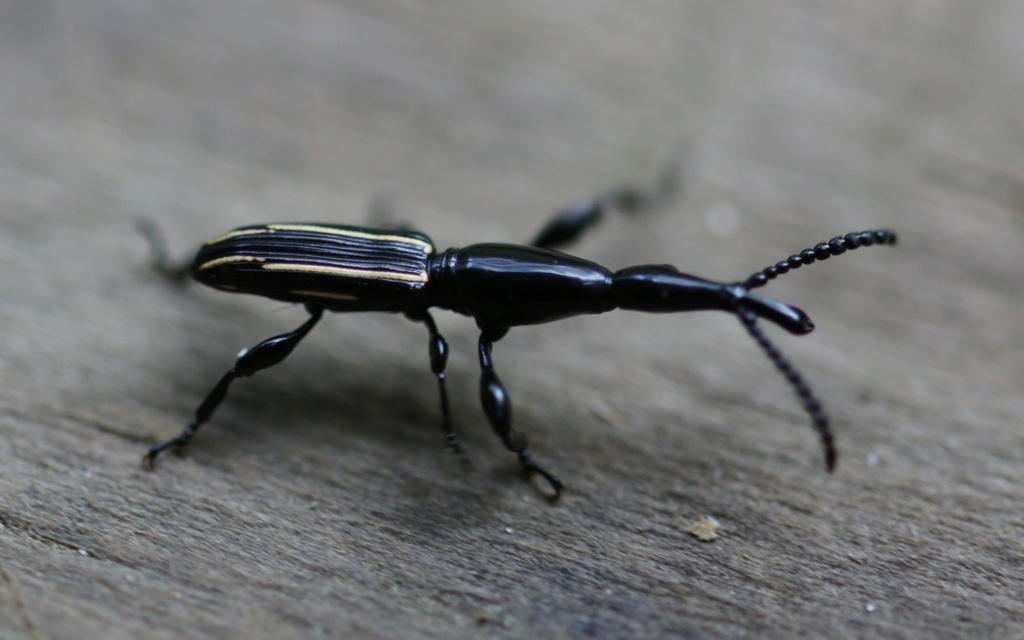
Brentus anchorago
Brentus anchorago is a long-snouted weevil, from the family Brentidae It is found from southern Florida to South America.
From the article Brentus anchorago on Wikipedia (CC BY-SA), quoted section by section
Description
Brentus anchorago is 15 to 52 mm in length. The adult is black in color, with longitudinal yellow marking on the elytra. It has serrate, non-geniculate (elbowed) antennae. The species exhibits significant sexual dimorphism; the males are much thinner than the females.
Range & habitat
This widespread neotropical species is known from Mexico, the West Indies and South America. In the U.S. it occurs in Dade and Monroe counties in Florida. It seems to be associated with the gumbo-limbo tree (Bursera simaruba), throughout its distribution. Larvae bore in dead trees, and the adults can sometimes be found in large numbers under the bark of dead logs.
== References ==
Wikipedia: “Distribution and habitat”
Listen
Looking for field recordings…
Where it lives
Recorded sightings
—
geo-referenced records in GBIF, from museums, herbaria and field observers.
Drag the globe to turn it. Dots are where records exist, not a range map; darker means more records.
In the stacks
Searching the stacks…
Every page naming Brentus anchorago in the Biodiversity Heritage Library →
This page is assembled live from iNaturalist, GBIF, Wikipedia, the Source Library and the Internet Archive. It is not yet part of the hand-edited codex. iNaturalist taxon 304203.