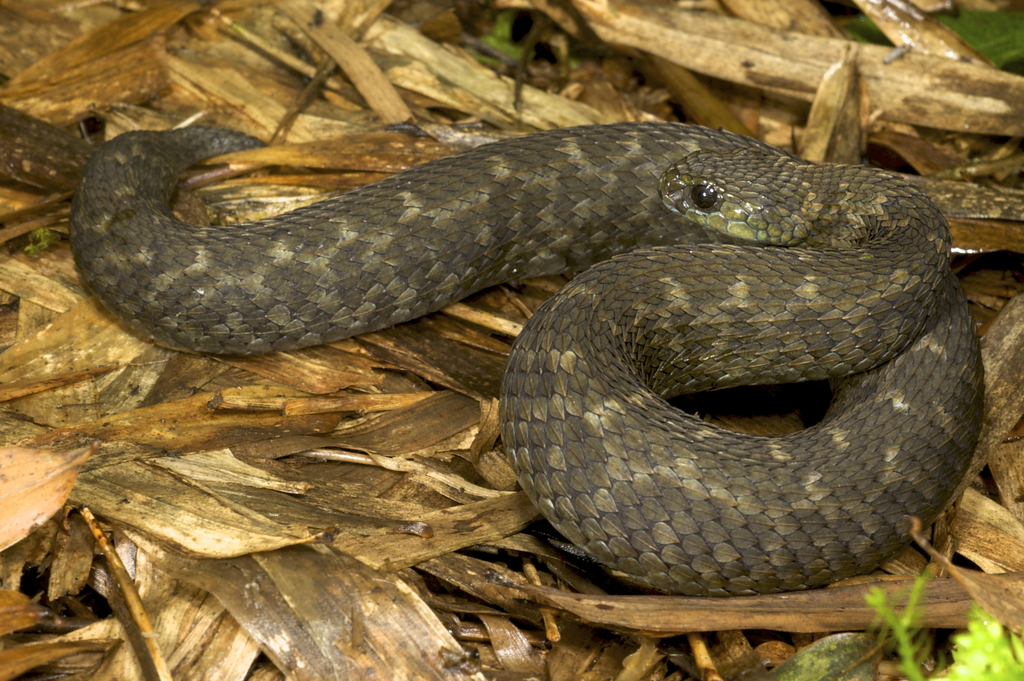
Uzungwe Mountain Bush Viper
Atheris barbouri
Adenorhinos is a monotypic genus created for the venomous viper species, Adenorhinos barbouri, which is a small and exceptionally rare terrestrial species endemic to the Uzungwe and Ukinga mountains of south-central Tanzania in Africa. No subspecies are recognized.
From the article Atheris barbouri on Wikipedia (CC BY-SA), quoted section by section
Description
Atheris barbouri is a small species reaching only 40 cm (16 in) in total length (including tail). The head is broad, triangular and distinct from the neck. The snout is short and rounded. The head is covered with small, strongly keeled, imbricate scales. The eyes are prominent, about 1.5 times larger than the distance to the mouth. The nostril is in an extreme forward position and is part of a single nasal scale that touches the preocular scale. The body is moderately slender, while the tail is relatively short, shorter than other species in the genus Atheris, and not prehensile. The dorsal scales are arranged in 20-23 rows at midbody, and are strongly keeled, except for those in the outermost rows, which are smooth. Ventral scales number 116-122 and are rounded. Subcaudals are 19-23 and are single (undivided). The anal plate is single. The color pattern consists of a brown to blackish brown ground color with a pair of zigzag stripes that run dorsolaterally from the back of the head to the end of the tail. These stripes may form an irregular chain of darker rhombic blotches down the back. The tail may have a faint, black checkering. The belly color is greenish white to olive.
Range & habitat
The range of A. barbouri is extremely limited. It is known only from the Uzungwe and Ukinga mountains of south-central Tanzania. The type locality is "Dabaga, Uzungwe Mountains, southeast of Iringa, Tanganyika Territory, altitude 6,000 feet (1,800 m)" (= Udzungwe Mountains, Tanzania). A terrestrial species, A. barbouri is found in bushes and bamboo undergrowth on mountain slopes at 1,800 m (5,900 ft). It would seem that moist forest habitats are preferred, but it has also been found in gardens of tea farms.
Wikipedia: “Distribution and habitat”
What it does
Little is known about the behavior of A. barbouri. It was first thought to be a burrowing species, but this is not likely as it has no obvious morphological adaptations for even a semifossorial life.
Feeding. It is believed that A. barbouri specializes in eating slugs, earthworms, and other soft-bodied invertebrates, and possibly also frogs.
Reproduction. Atheris barbouri is apparently oviparous. In February 1930, three females were collected that each contained 10 eggs. The largest egg measured 1.0 cm × 0.6 cm (0.39 in × 0.24 in).
Venom. No information is available regarding the venom of A. barbouri, its composition, its toxicity, or the effects of a bite. No cases of envenomation have been recorded. However, because of the very limited distribution, bites are unlikely to occur.
Wikipedia: “Behavior and ecology”
Where it lives
Recorded sightings
—
geo-referenced records in GBIF, from museums, herbaria and field observers.
Drag the globe to turn it. Dots are where records exist, not a range map; darker means more records.
In the stacks
Searching the stacks…
Every page naming Atheris barbouri in the Biodiversity Heritage Library →
This page is assembled live from iNaturalist, GBIF, Wikipedia, the Source Library and the Internet Archive. It is not yet part of the hand-edited codex. iNaturalist taxon 30817.