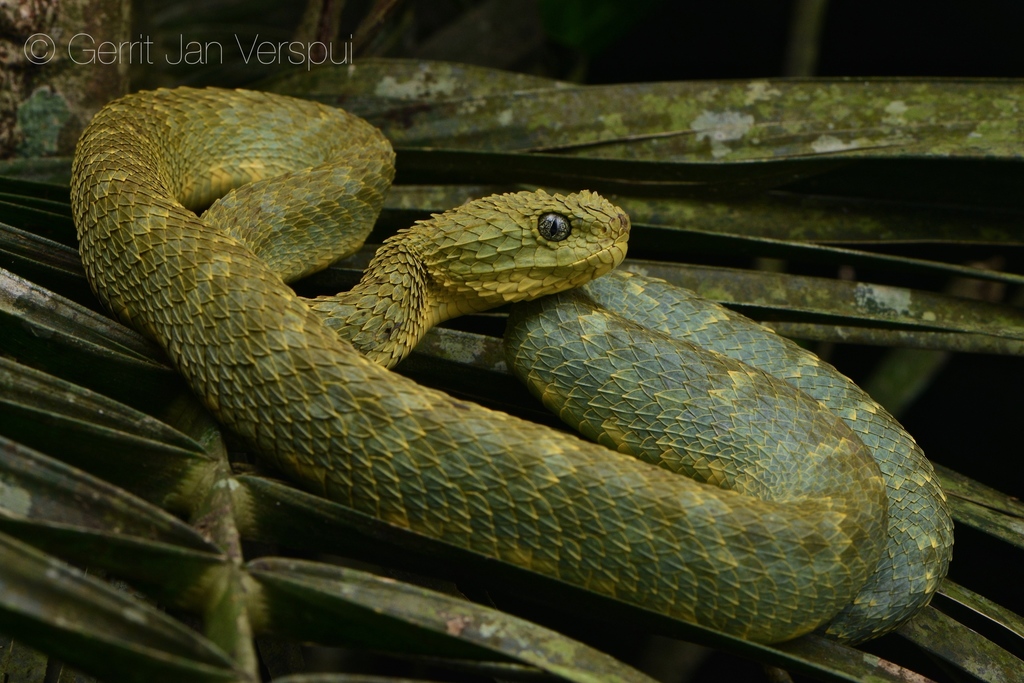
African Bush Viper
Atheris squamigera
Atheris squamigera (common names: green bush viper, variable bush viper, leaf viper, Hallowell's green tree viper, and others) is a venomous viper species endemic to west and central Africa. No subspecies are currently recognized.
From the article Atheris squamigera on Wikipedia (CC BY-SA), quoted section by section
Description
Atheris squamigera grows to an average total length (body + tail) of 46 to 60 cm (18 to 24 in), with a maximum total length that sometimes exceeds 78 cm (31 in). Females are usually larger than males. The head is broad and flat, distinct from the neck. The mouth has a very large gape. The head is thickly covered with keeled, imbricate scales. The rostral scale is not visible from above. A very small scale just above the rostral is flanked by very large scales on either side. The nostrils are lateral. The eye and the nasal are separated by 2 scales. Across the top of the head, there are 7 to 9 interorbital scales. There are 10 to 18 circumorbital scales. There are 2 (rarely 1 or more than 2) rows of scales that separate the eyes from the labials. There are 9 to 12 supralabials and 9 to 12 sublabials. Of the latter, the anterior 2 or 3 touch the chin shields, of which there is only one small pair. The gular scales are keeled. Midbody there are 15 to 23 rows of dorsal scales, 11 to 17 posteriorly. There are 152 to 175 ventral scales and 45 to 67 undivided subcaudals. It is possible that there is a variation in morphometric characters related to habitat:
The coloration is the same in some populations, but variable in others. The dorsal color varies from sage green or light green to green, dark green, bluish, olive or dark olive brown. …
Range & habitat
Atheris squamigera is found in the forest habitats of West and central Africa: from Ghana eastward to western Kenya and Tanzania, south to northern Angola and Bioko Island. The type locality is given as "Near the river Gaboon, Guinea" [Gabon]. A. squamigera is the most well distributed species of the Atheris genus. Scientists believe that the current pattern of dispersal of the Atheris species, including that of the A. squamigera, may have been influenced by a combination of past climatic events, geological activities, the shifting of tectonic plates over millions of years, as well as stochastic dispersal.
Wikipedia: “Geographic range”
What it does
In the wild Atheris squamigeras begin reproducing once they reach sexual maturity at 42 months for females, and at 24 months for males respectively. Reproduction takes place once annually, most often during the wet season. A. squamigera is viviparous, and a single successful pairing can produce up to 19 neonates, although the average is 7–9. The female A. squamigera carries her young internally during a gestation period of two months. Following birth, the neonates are abandoned by the mother as they are born venomous and entirely self sufficient.
Wikipedia: “Reproduction in the wild”
Toxicity
Bites from Atheris squamigera have resulted in at least one report of severe hematological complications as well as two deaths. Although no specific antivenom is made for the genus Atheris, antivenom for the genus Echis has been shown to be partially effective in neutralizing Atheris venom.
Wikipedia: “Venom”
Where it lives
Recorded sightings
—
geo-referenced records in GBIF, from museums, herbaria and field observers.
Drag the globe to turn it. Dots are where records exist, not a range map; darker means more records.
In the stacks
Searching the stacks…
Every page naming Atheris squamigera in the Biodiversity Heritage Library →
This page is assembled live from iNaturalist, GBIF, Wikipedia, the Source Library and the Internet Archive. It is not yet part of the hand-edited codex. iNaturalist taxon 30877.