- Fungi Including Lichens
- ›Basidiomycete Fungi
- ›Higher Basidiomycetes
- ›Mushrooms, Bracket Fungi, Puffballs, and Allies
- ›Gloeophyllales
- ›Gloeophyllaceae
- ›Neolentinus
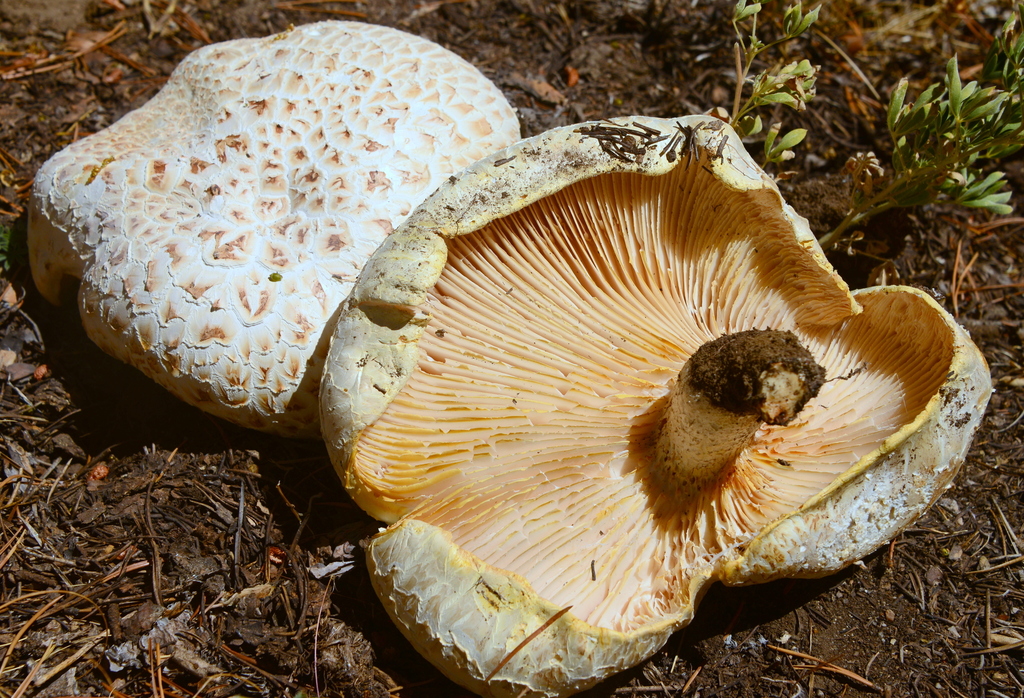
Giant Sawgill
Neolentinus ponderosus
Neolentinus ponderosus, commonly known as the giant sawgill, or ponderous lentinus, is a species of fungus in the family Gloeophyllaceae. It was originally described in 1965 as a species of Lentinus by American mycologist Orson K. Miller. It is found in western North America.
From the article Neolentinus ponderosus on Wikipedia (CC BY-SA), quoted section by section
Description
The fruit bodies have convex to flattened caps ranging from 5–50 centimetres (2–19+1⁄2 in) in diameter. The caps have small cinnamon-brown scales (squamules) on the surface and a margin that is usually curved inward initially. The narrow gills are adnate to decurrent and closely spaced, with intervening lamellulae (short gills) that extend about two-thirds of the distance to the stipe. The gill edges are serrated (notched like a saw, hence the common name). The gills are initially whitish before aging to light buff to light orange. The stipe is 2.5–20 cm (1–7+3⁄4 in) long and 2–10 cm (3⁄4–4 in) thick. Its reddish-brown surface is made of small scales that are less dense in the upper half, where it has a more whitish or buff color. The fruit bodies produce a white to buff spore print. Microscopically, the spores are somewhat spindle-shaped when viewed from the side, and elliptical viewed from the front; they measure 8–10.5 by 3–5.5 μm and are inamyloid. The basidia (spore-bearing cells) are thin-walled, club-shaped and four-spored, measuring 26–36 by 5–8.8 μm. The cystidia on both the faces and edges of the gills are thin-walled, hyaline (translucent), narrowly club-shaped, and measure 26–36 by 5–8.8 μm. The cap cuticle comprises threadlike hyphae with a diameter of 4.4–8 μm, while the cap flesh is made of interwoven hyphae (both thick- and thin-walled) measuring 2.5–6 μm. …
Range & habitat
Neolentinus ponderosus is a saprophytic species, and grows on the stumps and logs of conifers, particularly ponderosa pine. It causes a brown rot in wood, whereby it breaks down the hemicellulose and cellulose to cause a brown discoloration, and the subsequent cracking of the wood into roughly cubical pieces. Fruit bodies grow singly or in small clusters, and usually prefer open spots with direct sunlight. The range of the fungus is restricted to the Pacific Northwest region of western North America. Fruiting occurs in late spring, or later (summer) in mountainous locales.
Wikipedia: “Habitat and distribution”
At the table
The young mushrooms are edible, but tend to become tough when mature. It can then be cooked longer or parboiled. The flesh has a fruit or indistinct odor and a mild taste. They are prized by the Rarámuri Indians of Mexico.
== References ==
Wikipedia: “Uses”
Where it lives
Recorded sightings
—
geo-referenced records in GBIF, from museums, herbaria and field observers.
Drag the globe to turn it. Dots are where records exist, not a range map; darker means more records.
In the stacks
Searching the stacks…
Every page naming Neolentinus ponderosus in the Biodiversity Heritage Library →
This page is assembled live from iNaturalist, GBIF, Wikipedia, the Source Library and the Internet Archive. It is not yet part of the hand-edited codex. iNaturalist taxon 311292.