- Plants
- ›Vascular Plants
- ›flowering plants
- ›Dicots
- ›Mallows, Rock Roses, and Allies
- ›Mallow and Hibiscus Family
- ›Malvoideae
- ›Malveae
- ›Iliamna
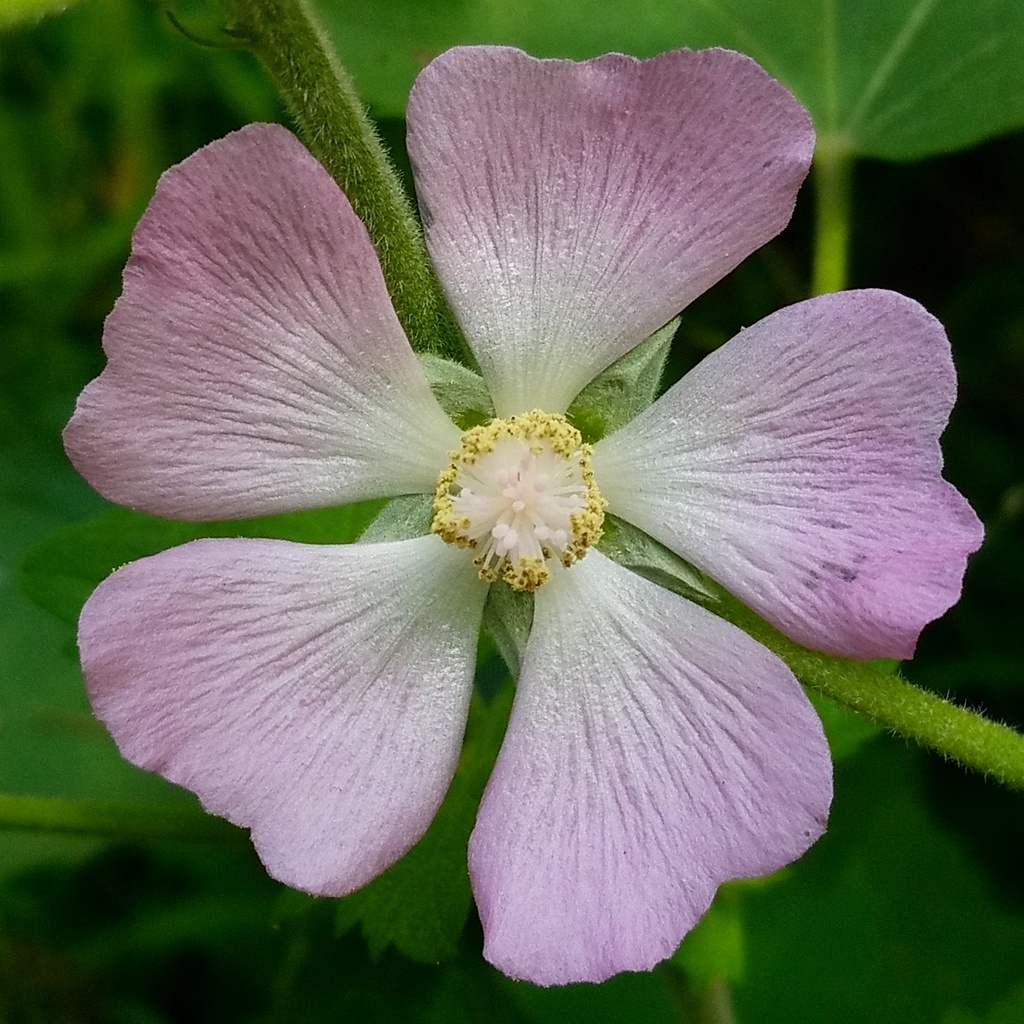
Kankakee mallow
Iliamna remota
Iliamna remota, commonly known as the Kankakee mallow, is an endangered species of flowering plant in the mallow family. It is endemic to a single location, the 700-metre-long (2,300 ft) Langham Island in Kankakee River State Park, in the US state of Illinois.
From the article Iliamna remota on Wikipedia (CC BY-SA), quoted section by section
Description
Iliamna remota is a herbaceous, perennial flowering plant growing from 1 m (3 ft 3 in) to 2.5 m (8 ft 2 in) tall. It has a greyish-green, densely hairy stem and alternate, palmately-lobed leaves. These have medium green, smooth upper surfaces and greyish-green pubescent undersides. The large flowers develop in the axils of the leaves, either singly or in groups of up to three, ranging in color from white to lavender. Anywhere from two to eight stems may grow from a single root crown and the roots themselves are generally shallow in depth while growing lengthy, dense, and fibrous tangles. Growth usually begins in the month of March, with flowering happening anywhere in July or August and eventual seed dispersal in September. New colonies sometimes develop from rhizomes.
In human culture
The first official documentation of the species was by Ellsworth Jerome Hill on June 29, 1872, while he was visiting the Langham Island that was then named Altorf Island after the nearby town of Altorf. The habitat of the species, Langham Island, was turned into an official nature preserve in 1966 for the Kankakee River area. Due to its small population and the fact that the range of the species was limited only to a single island, the species was placed onto the endangered species list for the state of Illinois in 1980. Botanist John Schwegman noted in a 1984 report that a 1973 survey by students at Westview High School in Illinois of the range of I. remota found that the population covered almost the entire northwestern part of the island. A 1981 survey found that a single colony of the species on the island contained around 109 flowering stems. Similar reports two years later found that this same colony had declined to just 49 stems and the overall species was made up of only 180 stems in five colonies. John Schwegman devised a plan to help the population recover and flourish again on the island. This plan included wiping out other plant species on the island that reduced the sunlight reaching the low-lying I. remota stems by using both chemical methods and controlled burns. Regular surveys of the population were also to be conducted annually. …
Wikipedia: “History”
Where it lives
Recorded sightings
—
geo-referenced records in GBIF, from museums, herbaria and field observers.
Drag the globe to turn it. Dots are where records exist, not a range map; darker means more records.
In the stacks
Searching the stacks…
Every page naming Iliamna remota in the Biodiversity Heritage Library →
This page is assembled live from iNaturalist, GBIF, Wikipedia, the Source Library and the Internet Archive. It is not yet part of the hand-edited codex. iNaturalist taxon 319412.