- Plants
- ›Vascular Plants
- ›flowering plants
- ›Dicots
- ›proteas, lotuses, planes, and allies
- ›Protea family
- ›Singlet Proteas
- ›Nutseed Proteoid Clade
- ›Cape Nutseed Proteoids
- ›Leucospermum
- ›Tumiditubus
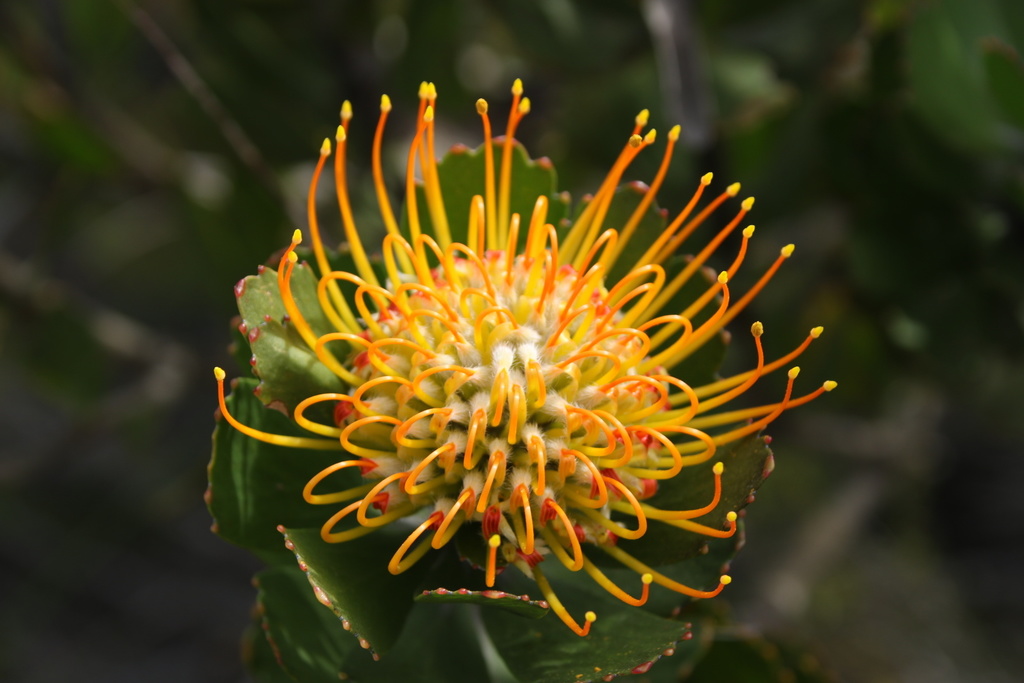
Mossel Bay Pincushion
Leucospermum praecox
Leucospermum praecox is an evergreen, rounded, upright shrub of up to 3 m (9 ft) high, and 4 m (12 ft) in diameter that is assigned to the family Proteaceae. It has hairless, inverted egg-shaped to broadly wedge-shaped leaves of about 5 cm (2 in) long with six to eleven teeth near the tip, globe-shaped flower head with initially yellow flowers, later orange or scarlet, with styles sticking far out, giving the head the appearance of a pincushion. It is called Mossel Bay pincushion or large-tufted pincushion in English. It flowers between April and September. It is an endemic species that is restricted to the very south of the Western Cape province of South Africa.
From the article Leucospermum praecox on Wikipedia (CC BY-SA), quoted section by section
Description
The Mossel Bay pincushion is an upright, rounded shrub of 2–3 m (6–9 ft) high and up to 4 m (12 ft) in diameter that has a stout main stem of up to 8 cm (3.2 in) in diameter. The branches are covered by a smooth, grey bark. The flowering branches are round in cross-section, ½–1 cm (0.2–0.4 in) in diameter and covered in a dense, greyish layer of felty, cringy hairs pressed to the surface, with some long silky hairs. The leaves are hairless, inverted egg-shaped or broadly wedge-shaped, 3½–7 cm (1.4–2.8 in) long and 1½–3 cm (0.6–1.2 in) wide, with between six and eleven teeth near the tip, oriented slightly pointing upwards and somewhat overlapping. The flower heads are seated in the axil of a leaf, globe-shaped, 6 cm (2.4 in) in diameter, with up to four head per flowering stem. The common base of the flowers in the same head is broadly cone-shaped, about 2 cm (0.8 in) high and 1½ cm (0.6 in) wide. It is subtended by an involucre consisting of oval bracts with a pointy tip of about 0.8 cm (0.32 in) long and ½ cm (0.2 in) wide, that are rubbery in consistency, and densely set with soft grey hairs. …
Range & habitat
L. praecox can be found in a relatively small area between Mossel Bay in the east to the mouth of the Gouritz River a little west of Albertinia and from the line between these locations southwards to the coast. Within this area it is locally common and there are several very dense stands, although an alien Hakea species is encroaching. At Mossel Bay L. praecox grows on weathered Table Mountain Sandstone, but elsewhere the species can only be found on deep stabilised white Tertiary to recently deposited, acidulous sands on the fore coast. L. praecox has an unusual flowering period, that begins in April, the southern hemisphere fall, until the early spring in September.
Wikipedia: “Distribution, habitat and ecology”
Where it lives
Recorded sightings
—
geo-referenced records in GBIF, from museums, herbaria and field observers.
Drag the globe to turn it. Dots are where records exist, not a range map; darker means more records.
In the stacks
Searching the stacks…
Every page naming Leucospermum praecox in the Biodiversity Heritage Library →
This page is assembled live from iNaturalist, GBIF, Wikipedia, the Source Library and the Internet Archive. It is not yet part of the hand-edited codex. iNaturalist taxon 320038.