- Plants
- ›Vascular Plants
- ›flowering plants
- ›Dicots
- ›proteas, lotuses, planes, and allies
- ›Protea family
- ›Paired Proteas
- ›Embothrieae
- ›Hakeinae
- ›Hakea
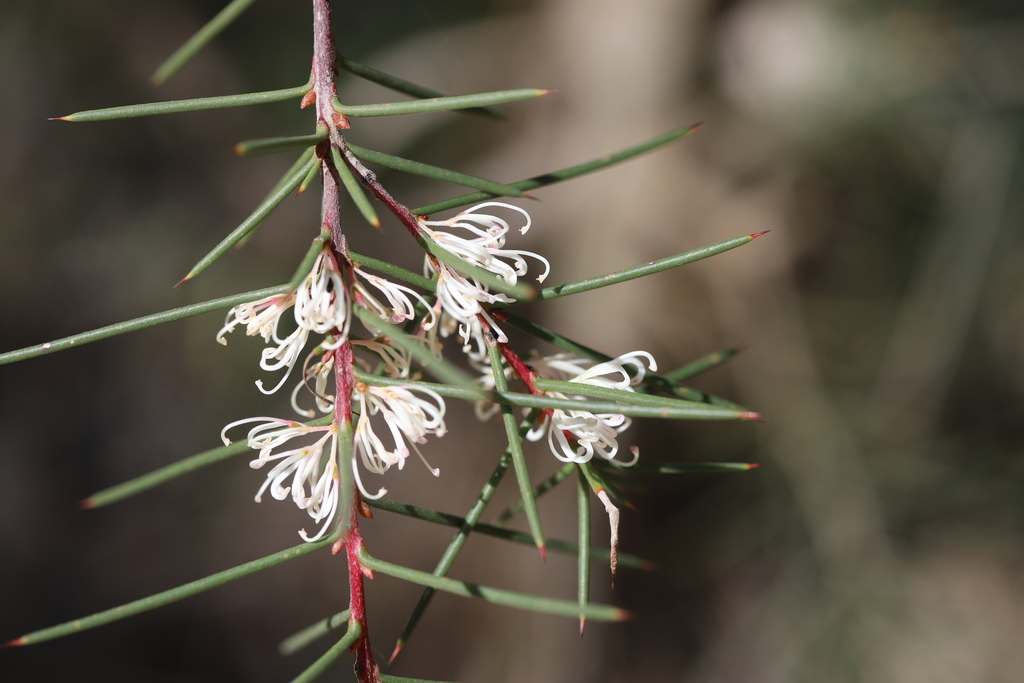
Bushy Needlewood
Hakea decurrens
Hakea decurrens, commonly known as bushy needlewood, is a species of shrub or small tree in the family Proteaceae. It is erect in habit, growing to between 0.3 and 5 metres tall. The leaves are 1.5 to 8 cm long and 0.7 to 1.6 mm wide. The species is native and widespread in New South Wales, Victoria and Tasmania in Australia. Additionally it is naturalised in South Australia and Portugal.
From the article Hakea decurrens on Wikipedia (CC BY-SA), quoted section by section
Description
Hakea decurrens is a semi-prostrate to erect scrambling bush or small tree 0.4–5 m (1–20 ft) tall. Smaller branches have short densely matted silky hairs, occasionally some quickly becoming smooth. Leaves are needle-shaped, widely spreading horizontally, are 1.5–8 cm (0.6–3 in) long and 0.7–1.6 mm (0.03–0.06 in) wide. The smooth leaves are grooved on the underside ending with a sharp point 1–3.5 mm (0.04–0.1 in) long. The inflorescence consists in 1–6 white or pink flowers on a short white or rusty slightly hairy or densely matted hairy short stalk. The hairs extending onto a 1.2–4.8 mm (0.047–0.19 in) long pedicel. The smooth perianth is 4.2–7.2 mm (0.17–0.28 in) long. The style is 8.5–12.2 mm (0.33–0.48 in) long. A profusion of flowers appear in leaf axils from May to September. The grey woody fruit are broadly egg-shaped, 1.8–3.5 cm (0.7–1 in) long and 1–3 cm (0.39–1.2 in) wide, covered in distinct warts ending in a prominent beak with two small horns.
Range & habitat
The species is native and widespread in New South Wales, Victoria and Tasmania in Australia. Additionally, it is naturalised in South Australia and Portugal. The distribution of the three subspecies is as follows:
H. decurrens subsp. decurrens, occurs on the western slopes and plains of the Great Dividing Range of New South Wales; H. decurrens subsp. platytaenia, occurs in exposed coastal heaths in southeastern New South Wales, eastern Victoria and the Bass Strait Islands. H. decurrens subsp. physocarpa, occurs in New South Wales, Victoria and the Bass Strait Islands. In Tasmania it is thought to be native to the north and naturalised in the south. It is also naturalised in the Mount Lofty Ranges in South Australia and Portugal.
== References ==
Wikipedia: “Distribution and habitat”
Where it lives
Recorded sightings
—
geo-referenced records in GBIF, from museums, herbaria and field observers.
Drag the globe to turn it. Dots are where records exist, not a range map; darker means more records.
In the stacks
Searching the stacks…
Every page naming Hakea decurrens in the Biodiversity Heritage Library →
This page is assembled live from iNaturalist, GBIF, Wikipedia, the Source Library and the Internet Archive. It is not yet part of the hand-edited codex. iNaturalist taxon 320929.