- Plants
- ›Vascular Plants
- ›flowering plants
- ›Dicots
- ›proteas, lotuses, planes, and allies
- ›Protea family
- ›Paired Proteas
- ›Banksieae
- ›Banksiinae
- ›Banksia
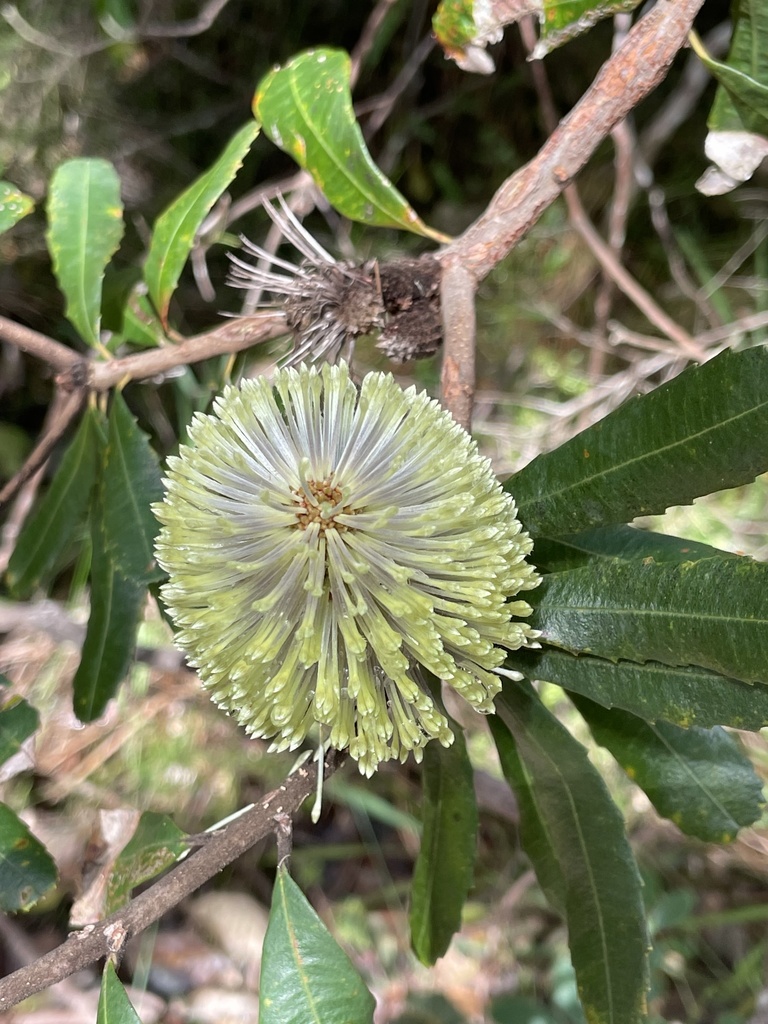
Rusty Banksia
Banksia oblongifolia
Banksia oblongifolia, commonly known as the fern-leaved, dwarf or rusty banksia, is a species in the plant genus Banksia. Found along the eastern coast of Australia from Wollongong, New South Wales, in the south to Rockhampton, Queensland, in the north, it generally grows in sandy soils in heath, open forest or swamp margins and wet areas. A many-stemmed shrub up to 3 m (9.8 ft) high, it has leathery serrated leaves and rusty-coloured new growth. The yellow flower spikes, known as inflorescences, most commonly appear in autumn and early winter. Up to 80 follicles, or seed pods, develop on the spikes after flowering. Banksia oblongifolia resprouts from its woody lignotuber after bushfires, and the seed pods open and release seed when burnt, the seed germinating and growing on burnt ground. Some plants grow between fires from seed shed spontaneously.
Spanish botanist Antonio José Cavanilles described B. oblongifolia in 1800, though it was known as Banksia aspleniifolia in New South Wales for many years. However, the latter name, originally coined by Richard Anthony Salisbury, proved invalid, and Banksia oblongifolia has been universally adopted as the correct scientific name since 1981. Two varieties were recognised in 1987, but these have not been generally accepted. A wide array of mammals, birds, and invertebrates visit the inflorescences. Though easily grown as a garden plant, it is not commonly seen in horticulture.
From the article Banksia oblongifolia on Wikipedia (CC BY-SA), quoted section by section
Description
Banksia oblongifolia is a shrub that can reach 3 m (9.8 ft) high, though is generally less than 2 m (6.6 ft) high, with several stems growing out of a woody base known as a lignotuber. The smooth bark is marked with horizontal lenticels, and is reddish-brown fading to greyish-brown with age. New leaves and branchlets are covered with a rusty fur. The leaves lose their fur and become smooth with maturity, and are alternately arranged along the stem. Measuring 5–11 cm (2.0–4.3 in) in length and 1.5–2 cm (0.59–0.79 in) in width, the leathery green leaves are oblong to obovate (egg-shaped) or truncate with a recessed midvein and mildly recurved margins, which are entire at the base and serrate towards the ends of the leaves. The sinuses (spaces between the teeth) are U-shaped and teeth are 1–2 mm long. The leaf underside is whitish with a reticulated vein pattern and a raised central midrib. The leaves sit on 2–5 mm long petioles. Flowering has been recorded between January and October, with a peak in autumn and early winter (April to June). The inflorescences, or flower spikes, arise from the end of 1 to 5 year old branchlets, and often have a whorl of branchlets arising from the node or base. Measuring 5–15 cm (2.0–5.9 in) high and 4 cm (1.6 in) wide, the yellow spikes often have blue-grey tinged limbs in bud, though occasionally pinkish, mauve or mauve-blue limbs are seen. …
Range & habitat
Banksia oblongifolia occurs along the eastern coast of Australia from Wollongong, New South Wales, in the south to Rockhampton, Queensland, in the north. There are isolated populations offshore on Fraser Island, and inland at Blackdown Tableland National Park and Crows Nest in Queensland, and also inland incursions at the base of the Glasshouse Mountains in southern Queensland, at Grafton in northern New South Wales, and Bilpin and Lawson in the Blue Mountains west of Sydney. B. oblongifolia grows in a range of habitats—in damp areas with poor drainage, along the edges of swamps and flats, as well as wallum shrubland, or coastal plateaux. It is also found in open forest or woodland, where it grows on ridges or slopes, or heath. Soils are predominantly sandy or sandstone-based, though granite-based and clay-loams are sometimes present. Associated species in the Sydney region include heathland species such as heath banksia (Banksia ericifolia), coral heath (Epacris microphylla) and mountain devil (Lambertia formosa), and tick bush (Kunzea ambigua) and prickly-leaved paperbark (Melaleuca nodosa) in taller scrub, and under trees such as scribbly gum (Eucalyptus sclerophylla) and narrow-leaved apple (Angophora bakeri) in woodland. The Agnes Banks Woodland in western Sydney has been recognised by the New South Wales Government as an Endangered Ecological Community. Here, B. …
Wikipedia: “Distribution and habitat”
What it does
Banksia oblongifolia plants can live for more than 60 years. They respond to bushfire by resprouting from buds located on the large woody lignotuber. Larger lignotubers have the greatest number of buds, although buds are more densely spaced on smaller lignotubers. A 1988 field study in Ku-ring-gai Chase National Park found that shoots grow longer after fire, particularly one within the previous four years, and that new buds grow within six months after a fire. These shoots are able to grow, flower and set seed two to three years after a fire. The woody infructescences also release seeds as their follicles are opened with heat, although a proportion do open spontaneously at other times. One field study in Ku-ring-gai Chase National Park found 10% opened in the absence of bushfire, and that seeds germinated, and young plants do grow. Older plants are serotinous, that is, they store large numbers of seed in an aerial seed bank in their canopy that are released after fire. Being relatively heavy, the seeds do not disperse far from the parent plant. Bird species that have been observed foraging and feeding at the flowers include the red wattlebird (Anthochaera carunculata), Lewin's honeyeater (Meliphaga lewinii), brown honeyeater (Lichmera indistincta), tawny-crowned honeyeater (Gliciphila melanops), yellow-faced honeyeater (Lichenostomus chrysops), white-plumed honeyeater (L. …
Wikipedia: “Ecology”
How it is grown
Conrad Loddiges and his sons wrote of Banksia oblongifolia in volume 3 of their work The Botanical Cabinet in 1818, reporting it had been brought into cultivation in 1792, though had been initially and incorrectly called Banksia dentata. It flowered in November in the United Kingdom, and was grown in a greenhouse over winter. Not commonly cultivated, it adapts readily to garden conditions and tolerates most soils in part-shade or full sun. The colours of the inflorescences in bud, and timing of flowers into winter give it horticultural value, as does its reddish new growth. Larger plants have taller flower spikes. It is propagated readily from seed, with young plants taking five to seven years to flower from seed. Pruning can improve the shrub's appearance, and it is a potential bonsai subject.
Wikipedia: “Cultivation”
Where it lives
Recorded sightings
—
geo-referenced records in GBIF, from museums, herbaria and field observers.
Drag the globe to turn it. Dots are where records exist, not a range map; darker means more records.
In the stacks
Searching the stacks…
Every page naming Banksia oblongifolia in the Biodiversity Heritage Library →
This page is assembled live from iNaturalist, GBIF, Wikipedia, the Source Library and the Internet Archive. It is not yet part of the hand-edited codex. iNaturalist taxon 321080.