- Animals
- ›Arthropods
- ›Hexapods
- ›Insects
- ›Winged and Once-winged Insects
- ›True Bugs, Hoppers, Aphids, and allies
- ›True Bugs
- ›Cimicomorph Bugs
- ›Miroidea
- ›Plant Bugs
- ›Mirinae
- ›Mirini
- ›Stenotus
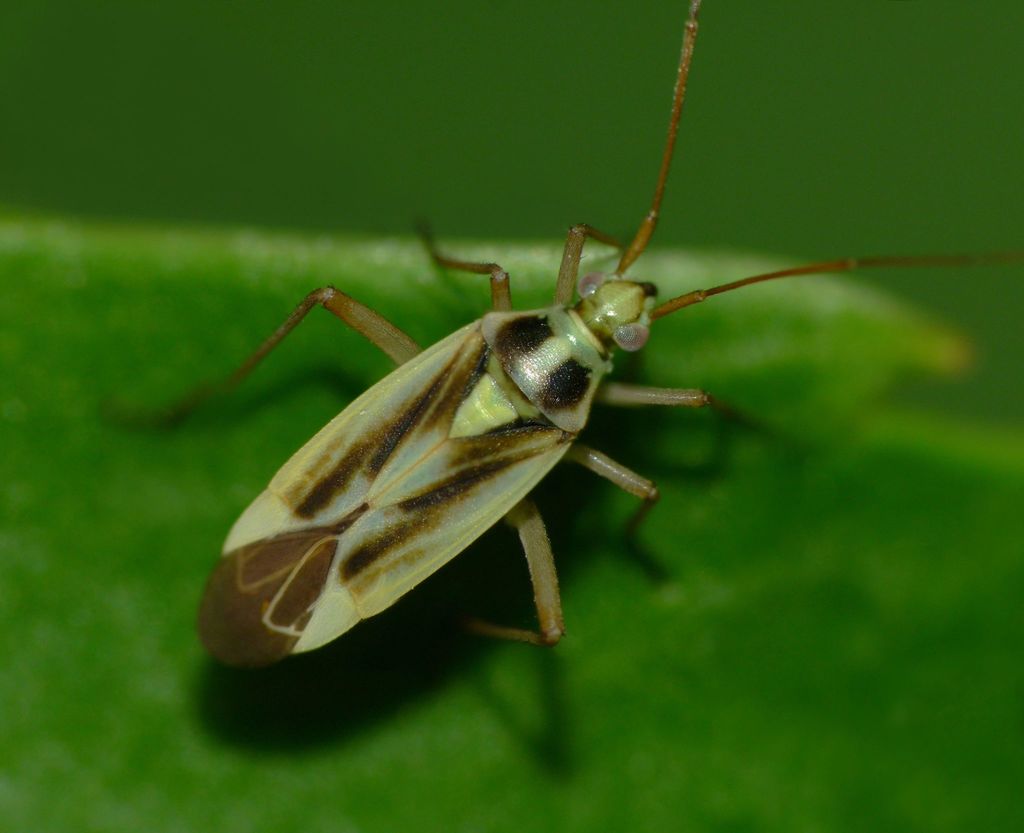
Two-spotted Grass Bug
Stenotus binotatus
Stenotus binotatus is a species of plant bug, originally from Europe, but now also established across North America and New Zealand. It is 6–7 mm (0.24–0.28 in) long, yellowish, with darker markings on the pronotum and forewings. It feeds on various grasses, and can be a pest of crops such as wheat.
From the article Stenotus binotatus on Wikipedia (CC BY-SA), quoted section by section
Description
Stenotus binotatus is a fairly large plant bug (6–7 millimetres or 0.24–0.28 inches long), which is somewhat variable in appearance. The insect's sides are roughly parallel, and the colours depend on both the animal's sex and its age, the markings becoming darker and stronger with increasing age. Males are mostly yellow, with darker markings on the pronotum and forewings, which females are greenish-yellow with paler markings.
Range & habitat
S. binotatus is native to most of the Palearctic but has been introduced to temperate regions around the world. It is common "throughout the northern and central U.S. and southern Canada", and it has been introduced to New Zealand, where it is now found almost throughout the country.
Wikipedia: “Distribution”
What it does
Both the nymphs and adults feed on the inflorescences of grasses, especially timothy-grass (Phleum pratense). In New Zealand, S. binotatus has been collected from a large variety of plants, including the grasses brown top, Yorkshire fog, cocksfoot, wheat, barley and maize, and many other plants (including rushes, Hypericum, Leptospermum scoparium, Metrosideros, Nothofagus, Coriaria, Olearia, Muehlenbeckia, Carmichaelia, Larix decidua, Eucalyptus, Melicytus ramiflorus, Coprosma robusta, hemlock and nettles). Adults are active from June to September in the United Kingdom, and in December and January in New Zealand.
Wikipedia: “Ecology”
In human culture
Stenotus binotatus was originally described under the name Lygaeus binotatus by Johan Christian Fabricius in 1794. The genus Stenotus was erected by Wassily Ewgrafowitsch Jakowlew (also transcribed as "Jakovlev") in 1877, and S. binotatus was designated its type species. Stenotus binotatus is known by various common names, including two-spotted plant bug, timothy plant bug, and slender crop mirid.
Wikipedia: “Taxonomic history”
Listen
Looking for field recordings…
Where it lives
Recorded sightings
—
geo-referenced records in GBIF, from museums, herbaria and field observers.
Drag the globe to turn it. Dots are where records exist, not a range map; darker means more records.
In the stacks
Searching the stacks…
Every page naming Stenotus binotatus in the Biodiversity Heritage Library →
This page is assembled live from iNaturalist, GBIF, Wikipedia, the Source Library and the Internet Archive. It is not yet part of the hand-edited codex. iNaturalist taxon 321690.