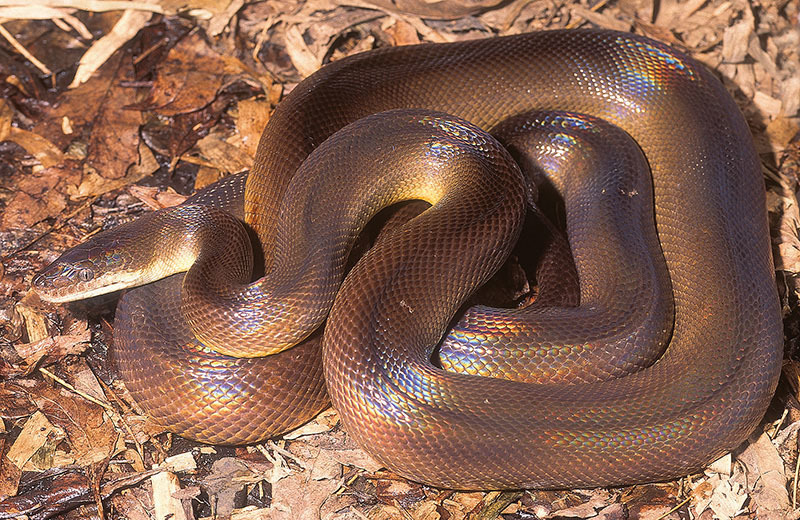
Water Python
Liasis fuscus
The water python (Liasis fuscus) is a python species found in Australia and Papua New Guinea. No subspecies are currently recognized. Like all other pythons, it is not venomous.
From the article Water python on Wikipedia (CC BY-SA), quoted section by section
Description
Adults average about 6–8 feet (2+ meters) in length, but may reach 10 feet (3.0 meters). Robustly built, it has a long head that is slightly distinct from the neck. The anterior supralabials have thermosensitive pits. Scalation includes a pair of undivided parietal scales and a single loreal scale on either side of the head. On the body, the dorsal scales number 45-55 at midbody, the ventral scales 270-300, the anal scale is single, with 60-90 paired subcaudal scales. The color pattern consists of a uniform, iridescent dark blackish brown dorsal color. The belly is a dull to bright yellow that includes the first few rows of dorsal scales. The throat is cream colored, while the upper labials are light gray-brown with dark brown or black spots.
Range & habitat
They are found in Australia in the Kimberley district of northern Western Australia from around Broome east through Northern Territory at least as far south as Mataranka to the coast of central Queensland to near Mackay. Also found in the Sir Charles Hardy Islands, on Cornwallis Island in the Torres Strait, and in Papua New Guinea, Western District, in the lower Fly River region at least as far inland as Lake Daviumbo. It can also be found in the southern part of Papuan province of Indonesia. The type locality given is "Port Bowen" (Port Clinton, Queensland, Australia). The highest population density is reached on the Adelaide River floodplains in the Northern Territory.
Wikipedia: “Distribution and habitat”
What it does
Despite its common name, many individuals are found far from water for most of the year. They are usually nocturnal, seeking shelter during the day in hollow logs, in riverbank dens, and in vegetation. When surprised, most attempt to flee into any available water.
Wikipedia: “Behavior”
Where it lives
Recorded sightings
—
geo-referenced records in GBIF, from museums, herbaria and field observers.
Drag the globe to turn it. Dots are where records exist, not a range map; darker means more records.
In the stacks
Searching the stacks…
Every page naming Liasis fuscus in the Biodiversity Heritage Library →
This page is assembled live from iNaturalist, GBIF, Wikipedia, the Source Library and the Internet Archive. It is not yet part of the hand-edited codex. iNaturalist taxon 32191.