- Plants
- ›Vascular Plants
- ›flowering plants
- ›Dicots
- ›Roses, Elms, Figs, and Allies
- ›buckthorn family
- ›Paliureae
- ›Ziziphus
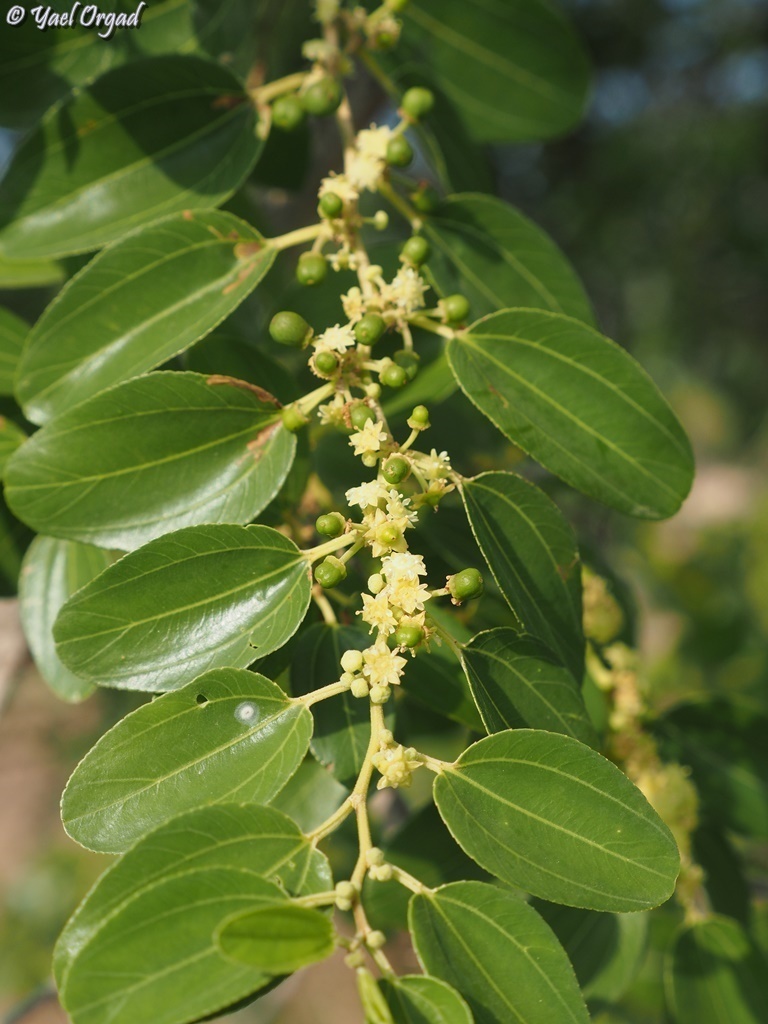
Christ's thorn jujube
Ziziphus spina-christi
Ziziphus spina-christi, known as the Christ's thorn jujube, is an evergreen tree or plant native to northern and tropical Africa, Southern and Western Asia. It is native to the countries Chad, Djibouti, Eritrea, Ethiopia, Kenya, Libya, Mali, Mauritania, Nigeria, Pakistan, Senegal, Somalia, Tunisia, Turkey and Zimbabwe.
From the article Ziziphus spina-christi on Wikipedia (CC BY-SA), quoted section by section
Range & habitat
It is native to the Western Asia from the Levant and Sinai to Pakistan, the Arabian Peninsula, and northeastern, eastern, and western Africa from Senegal to Somalia, Egypt, and Tanzania. It grows in deserts, semi-deserts, and savannas, often in wadis and washes, on stream and river banks, and wadis and washes where groundwater is available.
Wikipedia: “Distribution and habitat”
What it does
In the Levant, it grows in valleys up to an elevation of 500 metres (1,600 ft), and is drought tolerant and heat-resistant. The seed, contained within a small, oblong woody pit, is opened and eaten by local fauna, including the rock hyrax.
Wikipedia: “Ecology”
At the table
The ripe fruits are edible. Historically, it was utilized in ancient Egyptian medicine for its supposed anti-inflammatory properties, specifically in treating pain, swelling, and heat. An in vitro study has suggested that the plant might have anti-inflammatory properties, identifying active compounds such as epigallocatechin and gallocatechin that inhibit inflammatory pathways like NF-κB.
Wikipedia: “Uses”
In human culture
In the Levant and wider Middle East, it is called sidr (associated with the lote tree of the Quran), and is common in the Jordan Valley and around Jerusalem, as well as in the Hajar Mountains of the United Arab Emirates. By some traditions, it was the tree from which the crown of thorns of Jesus was made. Matthew George Easton argues that Z. spina-christi is too brittle to be bent into a crown, and suggests another local plant, Ziziphus lotus. The oldest known Z. spina-christi is located in Ir Ovot southern Israel. It is estimated to be between 1500 and 2000 years old. It is believed locally to be the very tree from which Jesus' crown of thorns was made. It is the national tree of Qatar. In the Philippines, the Blaan people called it dadiangas. This was the former name of the city of General Santos.
Wikipedia: “In culture”
Where it lives
Recorded sightings
—
geo-referenced records in GBIF, from museums, herbaria and field observers.
Drag the globe to turn it. Dots are where records exist, not a range map; darker means more records.
In the old herbals & bestiaries

In the stacks
Searching the stacks…
Every page naming Ziziphus spina-christi in the Biodiversity Heritage Library →
This page is assembled live from iNaturalist, GBIF, Wikipedia, the Source Library and the Internet Archive. It is not yet part of the hand-edited codex. iNaturalist taxon 322319.