- Animals
- ›Arthropods
- ›Hexapods
- ›Insects
- ›Winged and Once-winged Insects
- ›Flies
- ›Brachyceran Flies
- ›Cyclorrhaphan Flies
- ›Schizophoran Flies
- ›Calyptrate Flies
- ›Bot Flies, Blow Flies, and Allies
- ›Blow Flies
- ›Calliphorinae
- ›Cynomya
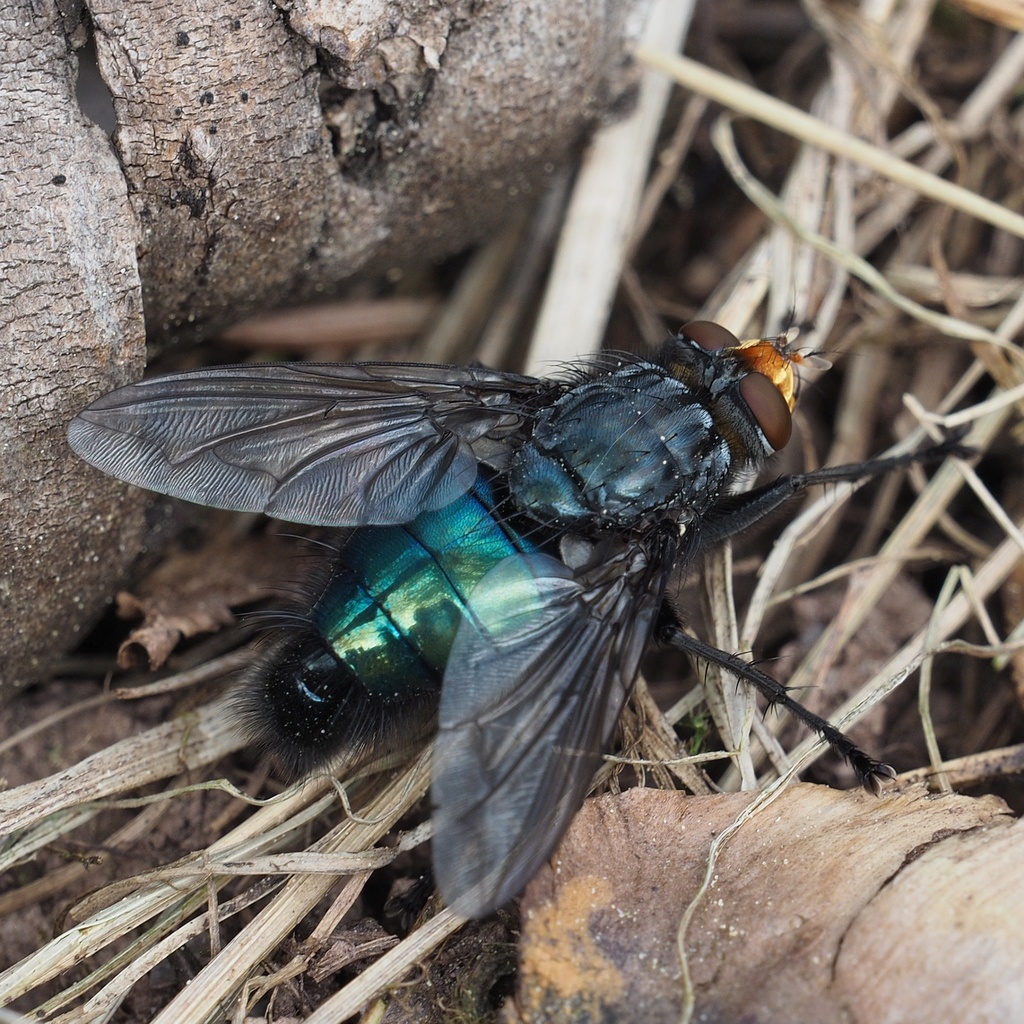
Yellow-faced Blowfly
Cynomya mortuorum
Cynomya mortuorum belongs to the order Diptera, sometimes referred to as "true flies". In English, the only common name occasionally used is "fly of the dead" (Totenfliege in German). It has a bluish-green appearance, similar to other Calliphoridae and is found in multiple geographic locations with a preference for colder regions. Belonging to the family Calliphoridae, it has been shown to have forensically relevant implications due to its appearance on carrion. Current research is being done to determine C. mortuorum's level of importance and usage within forensic entomology.
From the article Cynomya mortuorum on Wikipedia (CC BY-SA), quoted section by section
What it does
C. mortuorum is a deep blue-green shining metallic fly with a yellowish face and jowls, possessing a body length of 8–15 mm. This fly is a cold-adapted blowfly originally named by Carl Linnaeus in 1761. It lays its eggs on carrion, which provides food for the larvae and facilitates the larvae's development. The development lasts approximately 38 days. As do most blow flies, or members of the family Calliphoridae, C. mortuorum has a life cycle that includes an egg stage, three larval instars, and a pupal form before becoming an adult, or imago. Insects with this kind of life cycle have holometabolous development, meaning that the larval stage looks completely different from the adult. Each of these stages has identifying characteristics that are unique to this species.
Egg. As an egg, it has been described as a whitish cylinder with a tapered anterior end and blunt posterior end. The egg is generally 1.62 to 1.75 mm in length and 0.5–0.7 mm in width. These eggs are generally larger than other calliphorid eggs. On the dorsal surface of the egg, there are two hatching pleats on either side of the chorion, which acts as a plastron. Sometimes, the eggs can be difficult to separate from eggs of other species, so great care needs to be taken when using these eggs for forensic studies.
Larvae. The larval stage is broken up into three instars; and, each instar has 12 segments. …
Wikipedia: “General characteristics and life cycle”
At the table
The use of C. mortuorum in the judicial system is most commonly applied to the medicocriminal branch of forensic entomology. It is often useful in estimating the post-mortem interval of a human cadaver. By studying the morphology and stage of development of the C. mortuorum obtained from a body, one can determine an estimate of a time of death for that body. Plenty of variables play into the use of insects in a criminal investigation, including temperature, certain chemicals, or location, but determining an arthropod's stage of development on a corpse proves to be an accurate technique in estimating a time of death. Calliphoridae eggs, like C. mortuorum eggs, usually hatch twenty-four to forty-eight hours after being laid. These specimens, once hatched, undergo three instars in their larval stage, which can take anywhere from four to twenty-one days. Another three to fourteen days account for the blow fly's pre-pupae stage, and, finally, the pupae stage can take an additional three to twenty days. Depending on certain variables, a forensic entomologist can pinpoint which stage of development a C. mortuorum is in, and how long it and the carcass it is feeding on have been there.
Wikipedia: “Uses in forensic entomology”
Listen
Looking for field recordings…
Where it lives
Recorded sightings
—
geo-referenced records in GBIF, from museums, herbaria and field observers.
Drag the globe to turn it. Dots are where records exist, not a range map; darker means more records.
In the stacks
Searching the stacks…
Every page naming Cynomya mortuorum in the Biodiversity Heritage Library →
This page is assembled live from iNaturalist, GBIF, Wikipedia, the Source Library and the Internet Archive. It is not yet part of the hand-edited codex. iNaturalist taxon 322691.