- Plants
- ›Vascular Plants
- ›flowering plants
- ›Dicots
- ›carrots, ivies, and allies
- ›carrot family
- ›Mackinlayoideae
- ›Actinotus
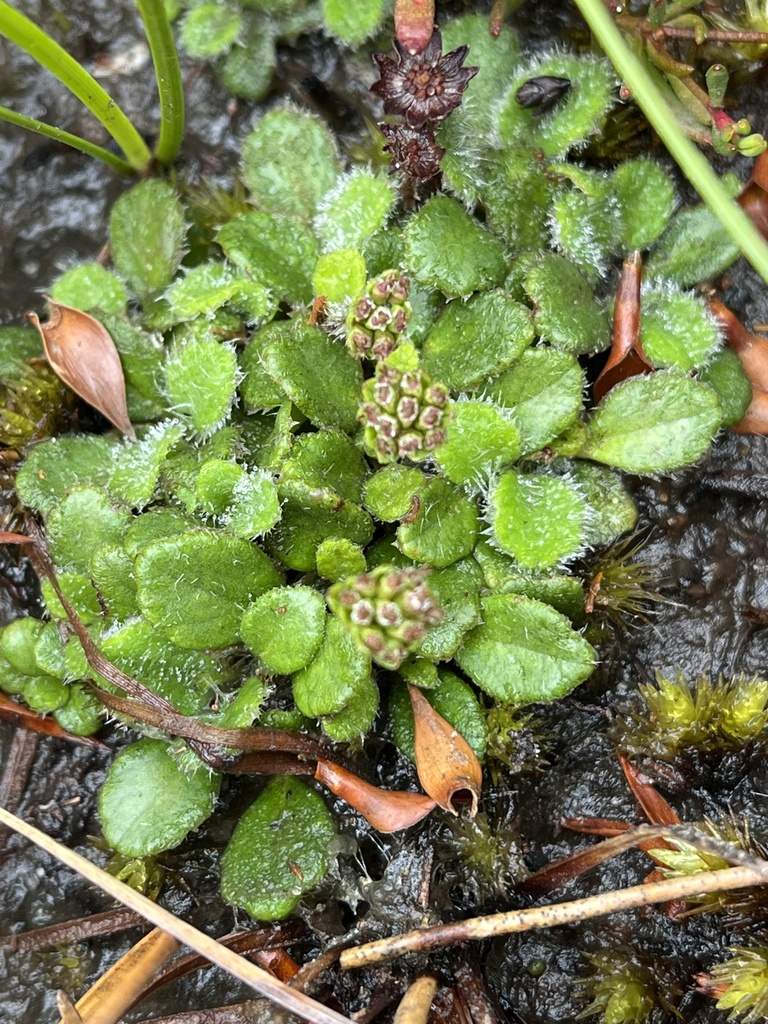
tiny flannel flower
Actinotus bellidioides
Actinotus bellidioides, sometimes known as the tiny flannel-flower, is a rosette-forming herb endemic to Tasmania, Australia. Its name derives from the genus Bellis (family Asteraceae) combined with the Greek -oides (“resembling”), referencing the leaf similarity to Bellis. Although recorded in Western Australia in 1891 and Victoria in 1944, A. bellidioides is now presumed extinct on mainland Australia and persists only in Tasmania.
From the article Actinotus bellidioides on Wikipedia (CC BY-SA), quoted section by section
Description
Actinotus bellidioides is a small perennial herb about 3 cm (1.2 in) wide, forming tufts through branching rootstocks. Its thick, dark green leaves grow in a basal rosette, measuring 0.3 to 1.0 cm long and ranging from spoon-shaped to round, often with small, rounded teeth or shallow lobes. The leaves can be softly hairy or nearly smooth on top, with a rounded tip and a short stalk that tapers at the base.
Flowering from November to January, a single upright stalk, often hairy, reaches up to 3 cm (1.2 in). At its tip, a tightly clustered head of 6–10 flowers are surrounded by 6–10 small bracts fused at the base into a cup about 6 mm wide. Inner flowers are bisexual, while outer ones are typically male or sterile. Tiny green sepals, about 0.5 mm (19.7 Mil) long, may accompany petals or appear alone. The fruit is a flattened, slightly ridged schizocarp about 0.2 mm (7.9 Mil) long and sheds its sepals when mature.
Range & habitat
Actinotus bellidioides typically grows from sea level to 1200 m in moorlands, sedgelands, scrublands, and other waterlogged, peaty habitats in western and southern Tasmania. These ecosystems occupy roughly 17% of the state and lie mostly on metamorphosed Precambrian bedrock with low mineral content and hardened structure, providing few nutrients. Moreover, wet and cold conditions restrict organic matter decomposition, further limiting nutrient availability. As a result, rainfall is the primary nutrient source. These plant communities often feature Gymnoschnoenus spaerocephalus or Lepidosperma filorme and include various Epacridaceae shrubs that compete with A. bellidioides for nutrients. As well as nutrient-poor conditions, A.bellidioides is adapted to tolerate the constant waterlogging, frost, and the high soil acidity that is also limiting vegetation composition in these peaty habitats. Even in subalpine and alpine regions, herbs in Tasmania’s wet, peaty soils, such as A. bellidioides, are typically perennial, largely because the maritime climate moderates temperature extremes (preventing permanent snow cover) and the low nutrient availability discourages rapid growth. Consequently, A. bellidioides persists through harsh winter conditions rather than adopting a short-lived annual or biennial growth strategy. …
Wikipedia: “Distribution and habitat”
Where it lives
Recorded sightings
—
geo-referenced records in GBIF, from museums, herbaria and field observers.
Drag the globe to turn it. Dots are where records exist, not a range map; darker means more records.
In the stacks
Searching the stacks…
Every page naming Actinotus bellidioides in the Biodiversity Heritage Library →
This page is assembled live from iNaturalist, GBIF, Wikipedia, the Source Library and the Internet Archive. It is not yet part of the hand-edited codex. iNaturalist taxon 323098.