- Plants
- ›Vascular Plants
- ›flowering plants
- ›Dicots
- ›Sunflowers, Bellflowers, Fanflowers, and Allies
- ›Sunflowers, Daisies, Asters, and Allies
- ›Asteroideae
- ›asters and allies
- ›Celmisiinae
- ›Olearia
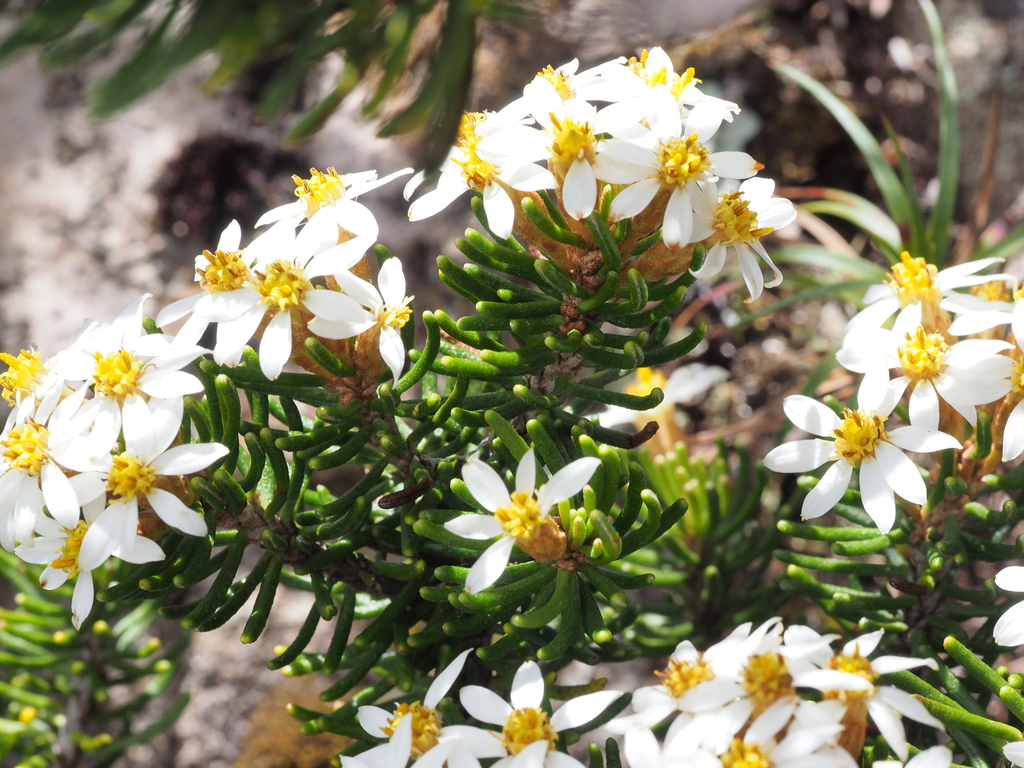
rock daisy bush
Olearia ledifolia
Olearia ledifolia, commonly known as rock daisy bush, is a species of flowering plant of the family Asteraceae. It is endemic to Tasmania and found at higher altitudes where it grows as a low, compact bush with tough, leathery leaves and small white and yellow daisy-like "flowers" in summer.
From the article Shawia ledifolia on Wikipedia (CC BY-SA), quoted section by section
Description
Shawia ledifolia typically forms a compact, low lying and rigid shrub about 0.5 m (1 ft 8 in) tall. The branches are numerous and densely packed with young growth covered in fine rust-coloured hairs. The lower sections of the branches may have raised scars from leaves that fall off after one or two years. The dark green leaves are tough and leathery, oblong, approximately 12–14 mm (0.47–0.55 in) long and arranged alternately along the stems. The upper surface of the leaf is usually glabrous, with the margins of the leaf rolled down and inwards. The lower leaf surface is covered in fine hairs that may appear rusty brown to silver. The heads or daisy-like "flowers" contain numerous florets, with involucral bracts at the base. The heads are daisy-like in appearance with 10 – 12 white ray florets, the ligule approximately 10 mm (0.39 in) long, surrounding deep yellow disc florets. The heads are borne singly on short peduncles in the leaf axils near the tips of branches. The fruit is a shiny, glabrous achene with seed dispersal being assisted by dry, wind borne pappus. Flowering occurs in the southern hemisphere summer months of January and February.
Range & habitat
Shawia ledifolia is endemic to the island state of Tasmania and has been recorded on King Island. It is a common species in alpine heath, bolster heath, deciduous heath, fjaeldmark, alpine sedgeland and coniferous heath at elevations above 1000m. Its common name, the rock daisy bush, refers to its preference for sheltered rocky slopes and scree fields amongst mountain plateaus.
Wikipedia: “Distribution and habitat”
What it does
Shawia ledifolia may become a co-dominant species at higher elevations where the growth of trees is limited by climatic factors. These environments are subject to snow and ice, low temperatures, strong winds and high UV levels. The primary threat to the plant communities where S. ledifolia grows is fire, with frequent burning greatly decreasing the likelihood of recovery and leading to species impoverishment. However, it is unclear what the response of S. ledifolia is to fire at the species level. Other threats include trampling, grazing pressures from livestock and climate change. Strongly revolute leaf margins are a frequently recorded xeromorphic adaptions for plants that are subject to water stress, especially when coupled with growths of hair like trichomes. The morphology of the leaf serves to increase the boundary layer between the stomata positioned on the underside of the leaf and the external desiccating environment, thus preventing water loss during gas exchange. The classically thin skeletal soils of alpine Tasmania where S. ledifolia occurs have limited water holding capacity and are often subject to summer drought conditions.
Wikipedia: “Ecology”
How it is grown
Shawia ledifolia is rarely cultivated because of its restrictive habitat requirements. However, surface sowing of freshly collected seed that has been allowed to dry has yielded some success, with germination occurring in 2 – 5 weeks. It prefers well-drained, moist, acidic soil in full sun and is frost and wind tolerant. It has proven resistant to the soil-borne disease Phytophthora cinnamomi, but it is intolerant to phosphorus.
== References ==
Wikipedia: “Cultivation”
Where it lives
Recorded sightings
—
geo-referenced records in GBIF, from museums, herbaria and field observers.
Drag the globe to turn it. Dots are where records exist, not a range map; darker means more records.
In the stacks
Searching the stacks…
Every page naming Olearia ledifolia in the Biodiversity Heritage Library →
This page is assembled live from iNaturalist, GBIF, Wikipedia, the Source Library and the Internet Archive. It is not yet part of the hand-edited codex. iNaturalist taxon 323145.