- Plants
- ›Vascular Plants
- ›flowering plants
- ›Dicots
- ›Sunflowers, Bellflowers, Fanflowers, and Allies
- ›triggerplant family
- ›Donatia
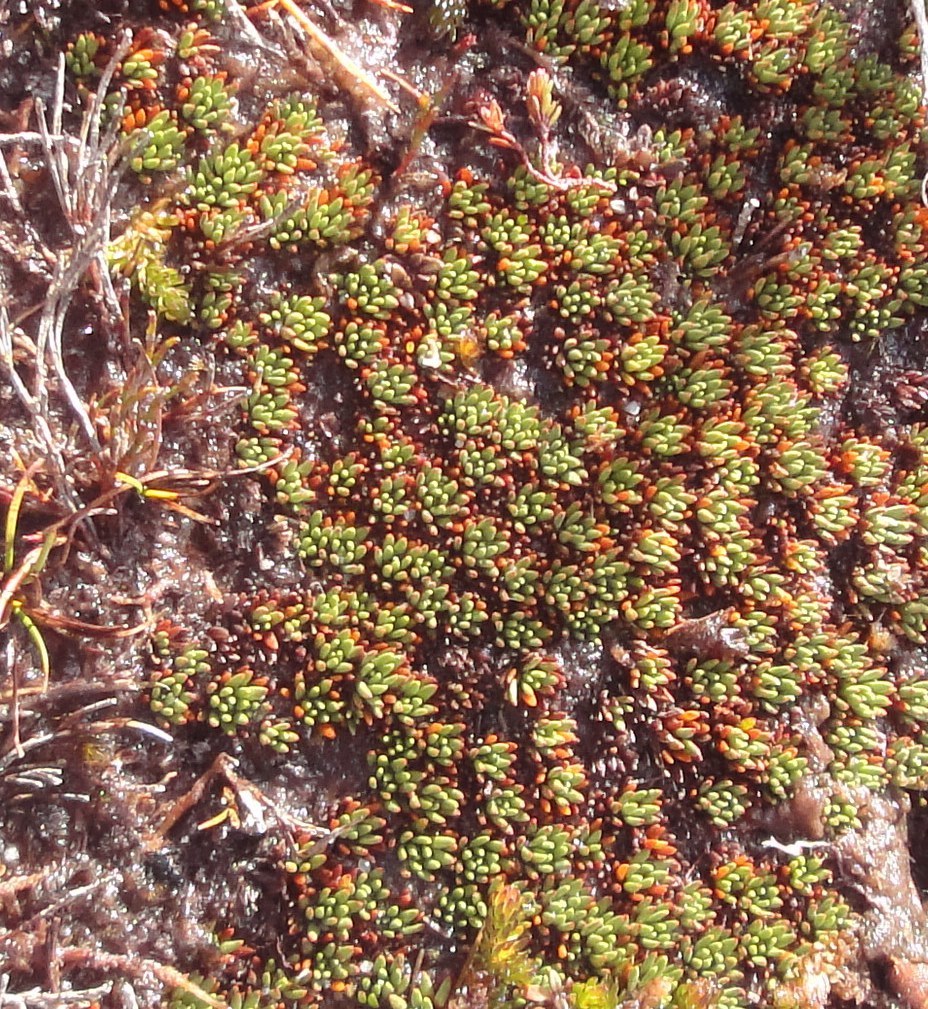
New Zealand Cushion
Donatia novae-zelandiae
Donatia novae-zelandiae is a species of mat-forming cushion plant, found only in New Zealand and Tasmania. Common names can include New Zealand cushion or snow cushion, however snow cushion also refers to Iberis sempervirens. Donatia novae-zelandiae forms dense spirals of thick, leathery leaves, creating a hardy plant that typically exists in alpine and subalpine bioclimatic zones.
Donatia novae-zelandiae is one of two species in the genus Donatia, which is the only genus in the family Donatiaceae.
From the article Donatia novae-zelandiae on Wikipedia (CC BY-SA), quoted section by section
Description
Donatia novae-zelandiae is a perennial plant that forms a mat capable of reaching over a meter in diameter, made up of densely packed tufts tipped with imbricated spirals of leaves, all connected by one root system. Leaves are sessile, base widened, 5-6mm long and erect. Upper leaves are bright green, while lower leaves are brown, but still long persisting. In the leaf axils are 2-3mm long, tufts of dense white hairs. Stomata are apparent, running parallel along the main axis on both leaf surfaces, with their guard cells being surrounded by a distinctive circular ridge. Flowers are white, 5-6mm wide, solitary and scattered across the surface of the mat. Flowers feature 5 triangular sepals, 2 stamens and 5 pointed, oblong, 5mm long petals. Flowering occurs from January to March. Fruit are turbinate shaped, with fruiting occurring from February to March.
Range & habitat
The species likely originated in Tasmania during the Pliocene and Pleistocene eras, when major Australian and New Zealand mountain ranges formed. This created subsequent glaciation and cooling temperatures, leading to the creation of modern alpine and sub-alpine environments. A long-distance dispersal event, likely aided by Antarctica brought Donatia novae-zelandiae, along with Stylidiaceae species to New Zealand, where they were pre-adapted for alpine and sub-alpine growth. Donatia novae-zelandiae is most prevalent in cushion moorland, which generally form in areas of high-rainfall with poor drainage, above 800m. The water logging, peat substrate and harsh conditions prevent trees from growing, so these areas become entirely dominated by cushion plants. Donatia novae-zelandiae can be found solitary, or in a mosaic of other cushions and micro shrubbery. The dense interlocking tufts of cushion plants allow them to survive harsh winds and resist freezing temperatures. In a mosaic, cushion plants are known to facilitate other species through this added protection. When tested on Donatia novae-zelandiae though, a 2012 study by Brittany Cranston found that they were poor facilitators. When added to an open alpine area, species richness of the site was decreased. In contrast, another cushion species, Silene acaulis increased the species richness. …
Wikipedia: “Distribution and ecology”
Where it lives
Recorded sightings
—
geo-referenced records in GBIF, from museums, herbaria and field observers.
Drag the globe to turn it. Dots are where records exist, not a range map; darker means more records.
In the stacks
Searching the stacks…
Every page naming Donatia novae-zelandiae in the Biodiversity Heritage Library →
This page is assembled live from iNaturalist, GBIF, Wikipedia, the Source Library and the Internet Archive. It is not yet part of the hand-edited codex. iNaturalist taxon 323166.