- Plants
- ›Vascular Plants
- ›flowering plants
- ›Dicots
- ›Heathers, Balsams, Primroses, and Allies
- ›heath family
- ›Epacrids, Styphelias and Allies
- ›Styphelieae
- ›Cyathodes
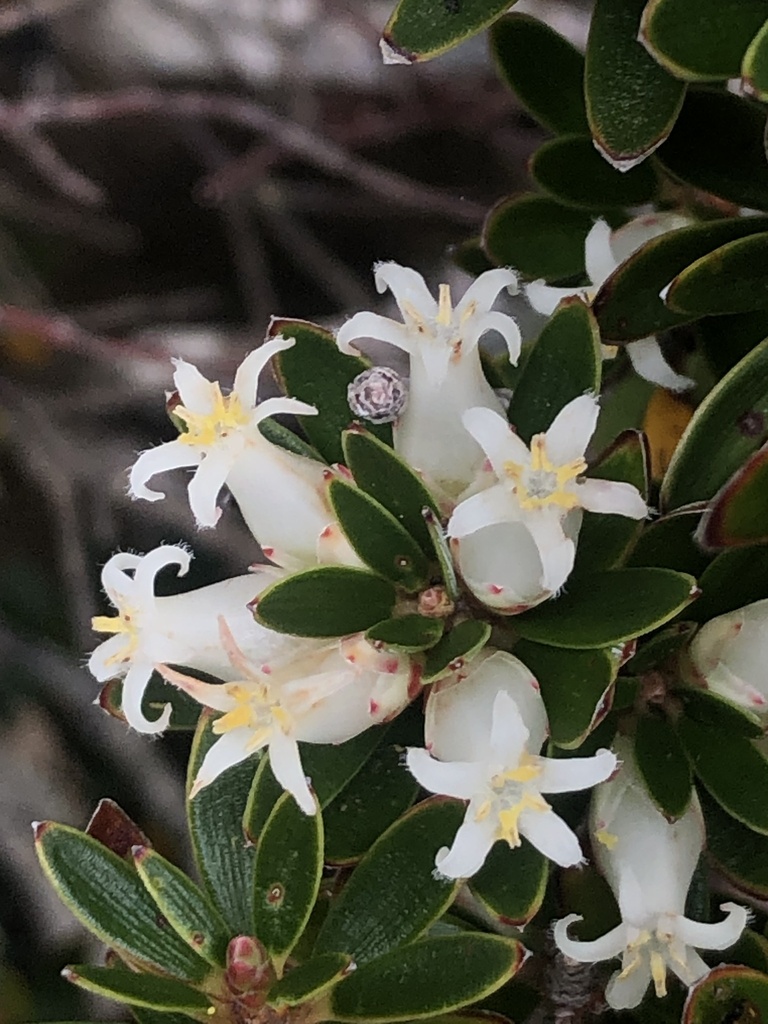
Cyathodes straminea
Cyathodes straminea, also known as false-whorled cheeseberry, is a species of flowering plant in the family Ericaceae endemic to Tasmania, where it grows as an alpine to subalpine shrub (15–60 cm in height) with a spreading habit. The generic name Cyathodes was derived from Greek "Cyath" = cup and "odes" = like, referring to the ovary encircled by cup-shaped nectary.
From the article Cyathodes straminea on Wikipedia (CC BY-SA), quoted section by section
Description
Cyathodes straminea is a shrub with leaves arranged in pseudowhorls. Leaves are obovate-elliptic 7–16 mm long, 3-4.5 mm wide, often with a membranous margin, and a soft, blunt point. The upper surface is glabrous, but the lower surface is covered in white wax (glaucous) with prominent parallel veins (Fig.1). Petiole 1.6-2.4 mm long. The flowers occur in summer in upper leaf axils (Fig.2) and have a strong cheesy smell, are white, bell-shaped and hermaphrodite (both male and female) with long corolla lobes and anthers exserted on thick filaments. They have 5-10 locules in the ovary, developing into red, rounded, flattened fruits to 8mm wide, reputed to be edible (raw or cooked) (Fig.3).
Range & habitat
Cyathodes straminea grows frequently in open shrubby subalpine heathland and woodlands on the Dolerite mountains of the northern, central and eastern parts of Tasmania above 1000m. Usually found on medium and heavy (clay) soils in moist, rocky and windy sites, with well-drained conditions and is frost tolerant. Commonly associated with Eucalyptus coccifera, Orites revoluta, Helichrysum and Richea species.
Wikipedia: “Habitat”
How it is grown
It requires a well-drained moist soil in a sheltered site. These plans are very susceptible to drought but can grow even in -7 °C. The seeds should be surface sown in ericaceous soil. It germinates within 1–2 months at 18 °C. Scarification will reduce the germination time and 2 or 3 periods of 4 – 6 weeks cold stratification, alternated with 4 weeks warm stratification can also help.
Wikipedia: “Cultivation”
Where it lives
Recorded sightings
—
geo-referenced records in GBIF, from museums, herbaria and field observers.
Drag the globe to turn it. Dots are where records exist, not a range map; darker means more records.
In the stacks
Searching the stacks…
Every page naming Cyathodes straminea in the Biodiversity Heritage Library →
This page is assembled live from iNaturalist, GBIF, Wikipedia, the Source Library and the Internet Archive. It is not yet part of the hand-edited codex. iNaturalist taxon 323182.