- Plants
- ›Vascular Plants
- ›flowering plants
- ›Dicots
- ›Legumes, Milkworts, and Allies
- ›Legumes
- ›Faboideae
- ›Mirbelieae
- ›Daviesia
hop bitter-pea
Daviesia latifolia
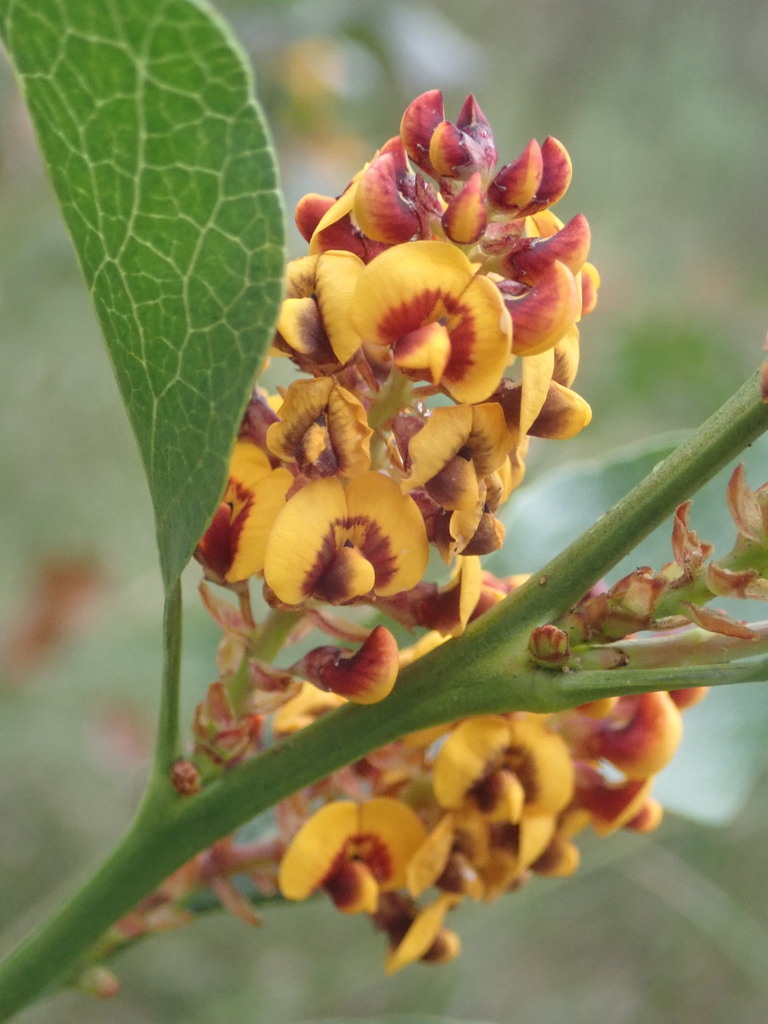
Daviesia latifolia, commonly known as hop bitter-pea, is a shrub in the family Fabaceae. It usually grows to between 1 and 3 metres high and has large leaves with a prominent network of veins. Clusters of yellow and brown pea flowers are produced between September and December in the species native range. The species was first formally described by botanist Robert Brown, his description published in Hortus Kewensis in 1811. It is endemic to eastern Australia.
From the article Daviesia latifolia on Wikipedia (CC BY-SA), quoted section by section
Description
Daviesia latifolia is a slender, erect shrub that typically grows to 1–5 m (3 ft 3 in – 16 ft 5 in) high and 1.0–1.5 m (3 ft 3 in – 4 ft 11 in) wide and has arching, glabrous branches. Adult phyllodes are elliptic to egg-shaped or lance-shaped, 20–150 mm (0.79–5.91 in) long and 5–70 mm (0.20–2.76 in) wide on a petiole-like base 3–20 mm (0.12–0.79 in) long. The phyllodes are wavy with scalloped edges and have prominent veins. Juvenile phyllodes are slightly broader. The flowers are borne in leaf axils along up to three racemes, the peduncle 10–20 mm (0.39–0.79 in) long, the rachis 25–80 mm (0.98–3.15 in) long, each flower on a pedicel 1.5–4 mm (0.059–0.157 in) long. The sepals are 3–5 mm (0.12–0.20 in) long and joined at the base, the upper two joined for most of their length and the lower three triangular and 0.5–1 mm (0.020–0.039 in) long. The standard petal is broadly egg-shaped, 6–9 mm (0.24–0.35 in) long and orange-yellow and maroon with a yellow centre, the wings 5.5–8 mm (0.22–0.31 in) long and yellow and maroon, and the keel 4.5–5.5 mm (0.18–0.22 in) long and maroon. Flowering occurs from September to December and the fruit is triangular pod 6.5–11 mm (0.26–0.43 in) long.
Range & habitat
Hop bitter-pea grows in forest, often as an understorey plant and occurs at altitudes up to 1,800 m (5,900 ft), from the Granite Belt of south-eastern Queensland, through the tablelands, western slopes and south coast of New South Wales, to most of Victoria apart, from the north west of the state. It is also common in dry woodlands in Tasmania.
Wikipedia: “Distribution and habitat”
At the table
The stems and phyllodes can be used with alum to produce a fawn dye used as a mordant. The phyllodes also have reputed medicinal properties, and were also substituted as hops to flavour beer. Early European settlers used the leaves as a drug to expel intestinal worms, including hydatid cysts, and also as tonic.
== References ==
Wikipedia: “Other uses”
How it is grown
The species is useful as an ornamental, as a windbreak and in nitrogen-fixing. It prefers well-drained soil in full sun and is frost tolerant.
Wikipedia: “Use in horticulture”
Where it lives
Recorded sightings
—
geo-referenced records in GBIF, from museums, herbaria and field observers.
Drag the globe to turn it. Dots are where records exist, not a range map; darker means more records.
In the stacks
Searching the stacks…
Every page naming Daviesia latifolia in the Biodiversity Heritage Library →
This page is assembled live from iNaturalist, GBIF, Wikipedia, the Source Library and the Internet Archive. It is not yet part of the hand-edited codex. iNaturalist taxon 323230.