- Plants
- ›Vascular Plants
- ›flowering plants
- ›Dicots
- ›myrtles, evening primroses, and allies
- ›myrtle family
- ›Myrtoideae
- ›gum trees
- ›Eucalyptus
- ›Eucalyptus
- ›Eucalyptus
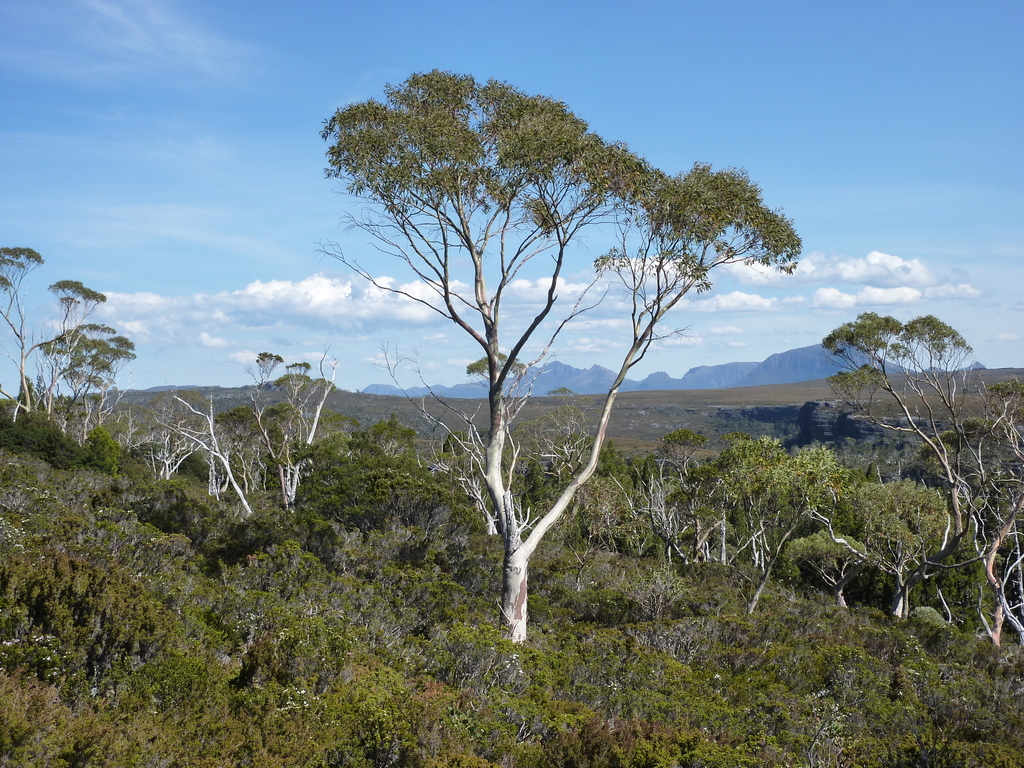
Tasmanian Snow Gum
Eucalyptus coccifera
Eucalyptus coccifera, commonly known as the Tasmanian snow gum, is a small to medium-sized tree in the Eucalyptus genus, endemic to Tasmania. It has smooth, grey and cream-coloured bark, elliptic to lance-shaped adult leaves, flower buds in groups of between three and nine, usually white flowers and conical, hemispherical or cup-shaped fruit.
From the article Eucalyptus coccifera on Wikipedia (CC BY-SA), quoted section by section
Description
Eucalyptus coccifera is a tree that typically grows to a height of 15 metres (49 ft) but is sometimes a mallee to 5 m (16 ft). The bark is smooth and light grey to white, with streaks of tan. Young plants and coppice regrowth have sessile, blue-green, elliptic to heart-shaped leaves 15–45 mm (0.59–1.77 in) long and 7–23 mm (0.28–0.91 in) wide. Adult leaves are arranged alternately, elliptic to lance-shaped, the same glossy green to bluish on both sides, 50–100 mm (2.0–3.9 in) long and 10–20 mm (0.39–0.79 in) wide on a petiole 8–22 mm (0.31–0.87 in) long. The flowers are borne in groups of three, seven or nine in leaf axils on a peduncle 4–12 mm (0.16–0.47 in) long, the individual buds on a pedicel 1–7 mm (0.039–0.276 in) long. Mature buds are oval, glaucous, 5–8 mm (0.20–0.31 in) long and 4–7 mm (0.16–0.28 in) wide with a warty, hemispherical to more less flattened operculum. Flowering occurs between December and February and the flower are white, or rarely, pink. The fruit is a woody conical, hemispherical or cup-shaped capsule 6–12 mm (0.24–0.47 in) long and 8–13 mm (0.31–0.51 in) wide.
Range & habitat
Eucalyptus coccifera is endemic to Tasmania, and is the dominant species of many exposed, rocky, dolerite rich sub-alpine regions in Tasmania's south and Central Plateau.
Wikipedia: “Distribution and habitat”
What it does
Eucalyptus flower buds generally take around a year to fully develop, however development takes longer in E. coccifera and other high altitude species. Insects and birds pollinate the emergent flowers, and fertilization can take up to 20 days after pollination. E. coccifera flowering typically occurs between November and February. After fertilization, the hard woody capsule develops. Seeds are released through the capsule valves, which open when the capsule dries. This drying out is either caused by extreme heat and drought, or by fire. Dispersal of seed relies partially on wind, but mostly on gravity: the seeds will usually fall within a couple of metres of the parent tree. E. coccifera is also known to regenerate from underground lignotubers after fire.
Clinal variation. The distribution of E. coccifera is limited by altitude: rarely will it be found lower than 800 metres (2,600 ft), or higher than 1,300 metres (4,300 ft) above sea level. Around 1,300 metres (4,300 ft) the tree line is often unclear, and E. coccifera can be found in small stands or even as solitary trees. At these altitudes, E. coccifera generally grows to heights below 10 metres (33 ft), often blending into the alpine shrubbery at the highest reaches of its distribution. A strong correlation has been found between increasing altitude and declining stem growth rate in E. …
Wikipedia: “Reproduction and propagation”
Where it lives
Recorded sightings
—
geo-referenced records in GBIF, from museums, herbaria and field observers.
Drag the globe to turn it. Dots are where records exist, not a range map; darker means more records.
In the stacks
Searching the stacks…
Every page naming Eucalyptus coccifera in the Biodiversity Heritage Library →
This page is assembled live from iNaturalist, GBIF, Wikipedia, the Source Library and the Internet Archive. It is not yet part of the hand-edited codex. iNaturalist taxon 323285.