- Plants
- ›Vascular Plants
- ›flowering plants
- ›Dicots
- ›proteas, lotuses, planes, and allies
- ›Protea family
- ›Singlet Proteas
- ›Cenarrhenes
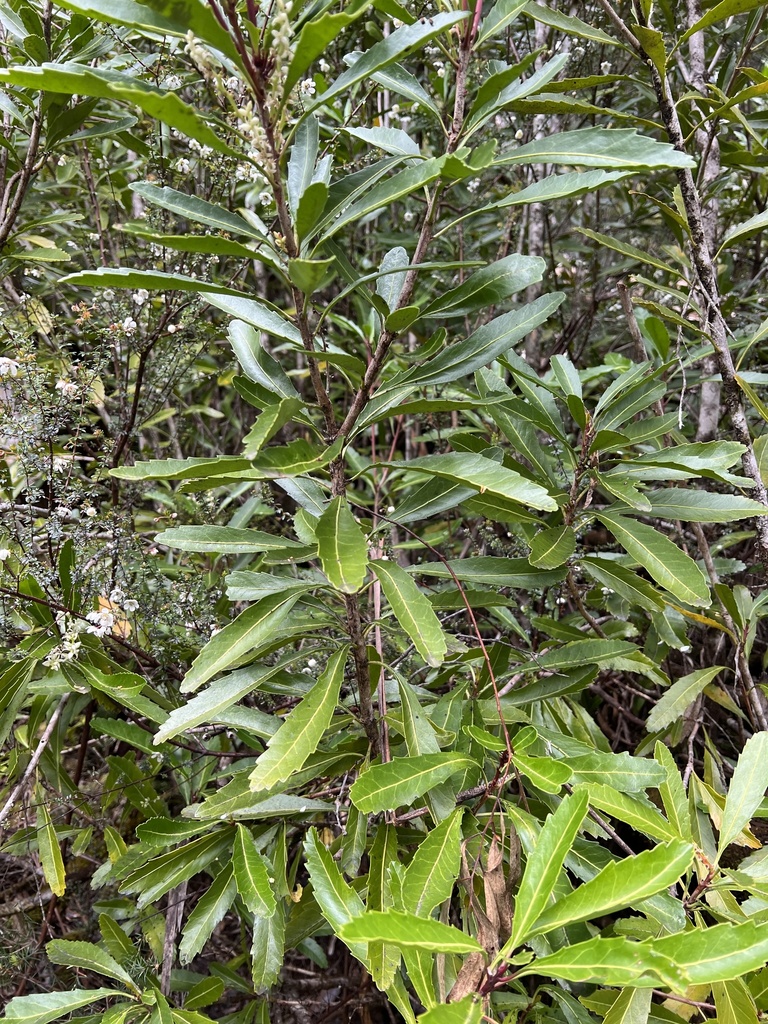
Port Arthur Plum
Cenarrhenes nitida
Cenarrhenes is a monytypic genus in the family Proteaceae containing the single species Cenarrhenes nitida, known as the Port Arthur plum or native plum. Cenarrhenes nitida is an evergreen shrub to small tree endemic to the rainforests and scrublands of western Tasmania. It bears white flowers in late spring followed by the development of fleshy fruit.
From the article Cenarrhenes on Wikipedia (CC BY-SA), quoted section by section
Description
Cenarrhenes nitida forms an erect shrub to small tree ranging in height from 10 m (33 ft) in sheltered sites such as rainforests to 2 m (6.6 ft) in exposed sites. Its leaves, which are roughly 8 to 12 cm (3.1 to 4.7 in) long, are thick, dull and hairless with a cleanly serrated edge and rounded tip. These are attached to the stem via a short stalk. The leaves are spread along the branches and have a nauseating stale-cabbage smell when crushed which helps distinguish it from Anopterus glandulosus (Escalloniaceae), which looks similar but lacks the smell and the leaves are often longer and arranged in false whorls. The leaves turn black when dried. The flowers are produced in early summer from November to December and are small, symmetrical, and unscented. Each flower has four, pointed, fleshy petals, which curl backward when open. Closed flowers have pink tips but turn all white when open. The flowers are stalkless and arranged on woody spikes, which are shorter than the leaves. The flowers are insect-pollinated and have four, thick, cream-yellow stamens. The pollination is spring-loaded and is triggered by a touch sensitive hair on one of the four anthers. Often, only one to three flowers per stalk will develop into mature fruit with the remainder forming stunted woody balls. The fruit of C. …
Range & habitat
Cenarrhenes nitida is endemic to southern and western Tasmania and some of its islands, growing to an altitude of 800 m (2,600 ft), and reaching the margins of the alpine zone. It occurs most often as an understory tree to small shrub in wet sclerophyll forests and rainforest with poor soils and occasionally in heath, button grass sedgeland and scrub. Offshore populations occur inland on South Bruny Island and in forested areas of the De Witt Islands, which closely resemble environments on mainland Tasmania.
Wikipedia: “Distribution and habitat”
How it is grown
Cenarrhenes nitida is a slow growing plant which requires a cool, moist, shady site with well composted soils and preferably good drainage. The seeds mature after the flesh has been removed and the stone allowed to dry. The seeds can be stored this way so long as they are kept in a well ventilated place. Germination is triggered by temperatures of roughly 20 °C (68 °F) after at least two months of cold stratification. C. nitida is often difficult to propagate and can be very slow growing if conditions are not right. They are best grown from seed as cuttings will remain green for considerable lengths of time without developing roots before turning brown.
== References ==
Wikipedia: “Cultivation”
Where it lives
Recorded sightings
—
geo-referenced records in GBIF, from museums, herbaria and field observers.
Drag the globe to turn it. Dots are where records exist, not a range map; darker means more records.
In the stacks
Searching the stacks…
Every page naming Cenarrhenes nitida in the Biodiversity Heritage Library →
This page is assembled live from iNaturalist, GBIF, Wikipedia, the Source Library and the Internet Archive. It is not yet part of the hand-edited codex. iNaturalist taxon 323298.