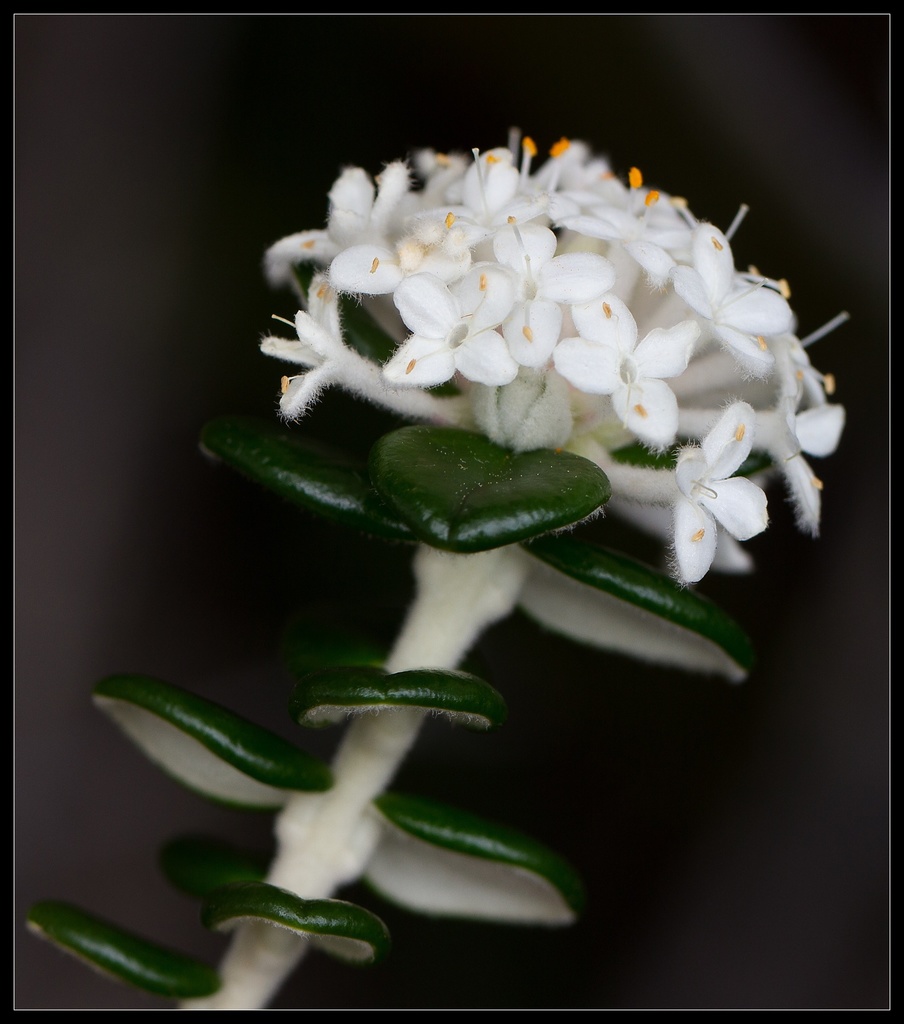
Round-leaf rice flower
Pimelea nivea
Pimelea nivea is a species of flowering plant in the family Thymelaeaceae and is endemic to Tasmania. It is an erect shrub with densely hairy young stems, elliptic to round leaves arranged in opposite pairs, and compact clusters of white or cream-coloured flowers.
From the article Pimelea nivea on Wikipedia (CC BY-SA), quoted section by section
Description
Pimelea nivea is an erect shrub that typically grows to a height of 0.3–3.5 m (1 ft 0 in – 11 ft 6 in), its young stems densely covered with white hairs. The leaves are arranged in opposite pairs, elliptic to round, 2–16 mm (0.079–0.630 in) long and 2.5–12 mm (0.098–0.472 in) wide on a short petiole. The upper surface of the leaves is glabrous and the lower surface is densely covered with white hairs. The flowers are arranged in large numbers on the ends of the branches in compact clusters. The flowers are usually white or cream-coloured, rarely pale pink, the sepals 2.0–4.5 mm (0.079–0.177 in) long, the floral tube 6–10 mm (0.24–0.39 in) long. Flowering occurs from September to February.
Range & habitat
This pimelea mainly grows on rocky hillslopes and is found in the Devonport-Waterhouse and between Hobart and South West Cape, where it is common and widespread.
== References ==
Wikipedia: “Distribution and habitat”
Where it lives
Recorded sightings
—
geo-referenced records in GBIF, from museums, herbaria and field observers.
Drag the globe to turn it. Dots are where records exist, not a range map; darker means more records.
In the stacks
Searching the stacks…
Every page naming Pimelea nivea in the Biodiversity Heritage Library →
This page is assembled live from iNaturalist, GBIF, Wikipedia, the Source Library and the Internet Archive. It is not yet part of the hand-edited codex. iNaturalist taxon 323364.