- Plants
- ›Vascular Plants
- ›flowering plants
- ›monocots
- ›Agaves, Orchids, Irises, and Allies
- ›iris family
- ›Isophysidoideae
- ›Isophysis
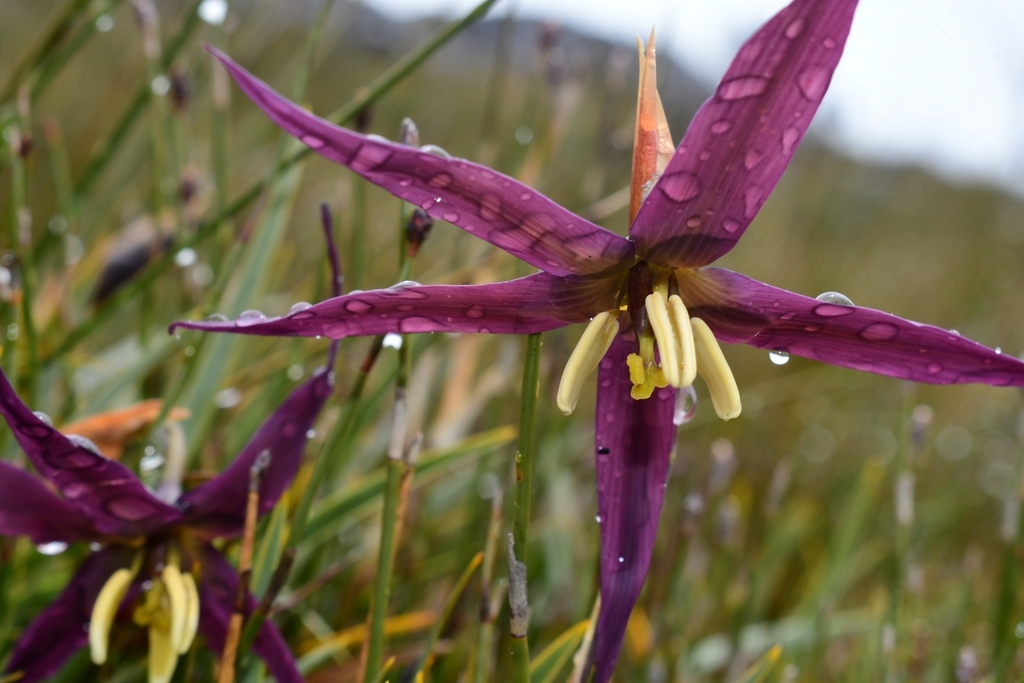
Tasmanian purple-star
Isophysis tasmanica
Isophysis is a genus of herbaceous, perennial and rhizomatous plants in the Iris family (Iridaceae). A monotypic genus formerly known as Hewardia, it contains a single species, Isophysis tasmanica, endemic to the mountains of Western Tasmania growing in heathland on sandy soils. It has grass-like foliage and star-like dark red-purple or yellow flowers with reflexed tepals. A characteristic feature of this species is its superior ovary, which distinguishes it from any other member of Iridaceae. The...
From the article Isophysis on Wikipedia (CC BY-SA), quoted section by section
Description
Isophysis tasmanica is a tufted plant with smooth leaves that come from a woody underground rhizome. The leaves are 5–30 cm long and 3–5 mm wide. The leaves are linear and persist in fans. The scape is erect, terete and unbranched, the scrape can be 40 cm high. Up the scape there are one to three smaller leaves that wrap around the stem. Below the flower, a pair of spath-bracts (modified leaves) that enclose the solitary terminal flower are brown or purple. The flower is purple and can be almost black but they are sometimes yellow. The petals are equal and 2.5–6 cm long 3–9 mm wide. These petals come together in a tube. It has a superior ovary with three flattened stamens. This superior ovary, distinguishes it from any other member of the Iridaceae. Plants in the Iridaceae family are usually distinguished by the "septal nectaries" this is tissue in an ovary that produces nectar, but these are not present within Isophyis tasmanica. This suggests that Isophyis tasmanica does not use nectar to attract pollinators. The former genus name Hewardia is used as a landmark name in Tasmania's southwest wilderness such as Hewardia Ridge on Mt. Picton located near Pineapple flats, named after the Pineapple Grass.
Range & habitat
Isophysis tasmanica is a dominant species within alpine sedge land. It is also found in coniferous, alpine, bolster and deciduous heathlands. It occurs from sea level to 1300m. The vegetation that it resides in is open in structure. It grows on highly siliceous rocks. It is often found on gravel slopes or rock crevices.
Wikipedia: “Habitat”
Where it lives
Recorded sightings
—
geo-referenced records in GBIF, from museums, herbaria and field observers.
Drag the globe to turn it. Dots are where records exist, not a range map; darker means more records.
In the stacks
Searching the stacks…
Every page naming Isophysis tasmanica in the Biodiversity Heritage Library →
This page is assembled live from iNaturalist, GBIF, Wikipedia, the Source Library and the Internet Archive. It is not yet part of the hand-edited codex. iNaturalist taxon 323422.