- Plants
- ›Vascular Plants
- ›flowering plants
- ›monocots
- ›grasses, sedges, cattails, and allies
- ›Restiads
- ›Eurychorda
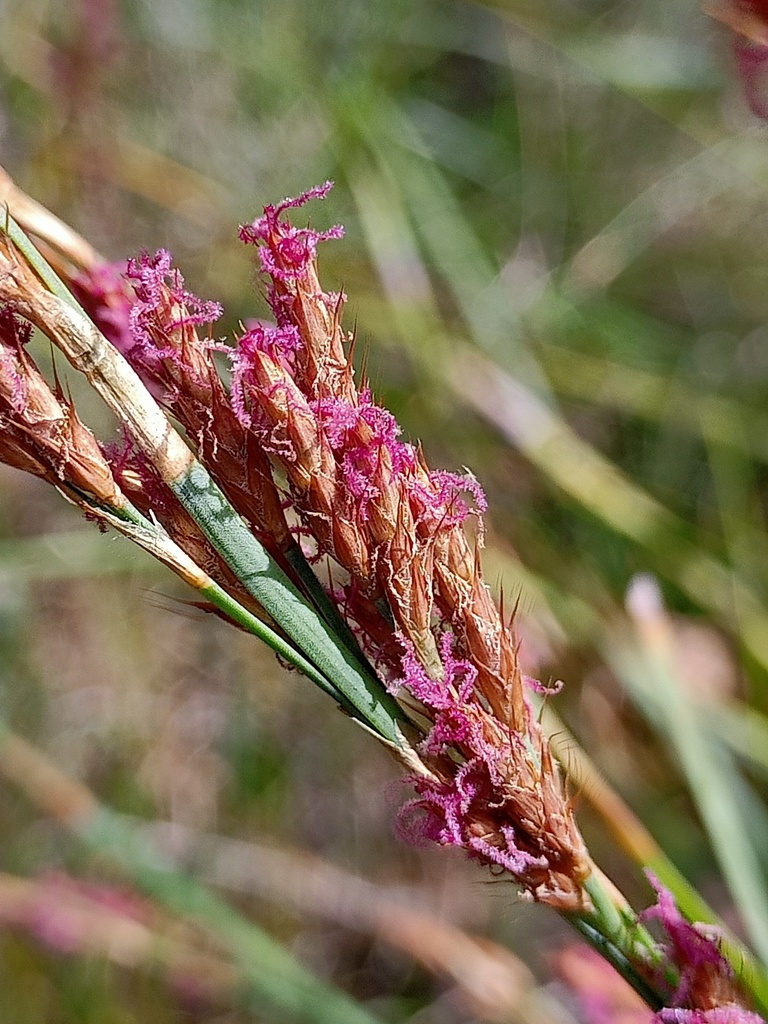
Eurychorda complanata
Eurychorda is a monotypic genus of flowering plants in the family Restionaceae formally described in 1998. The only known species, Eurychorda complanata, commonly known as the flat cord-rush, is endemic to Australia. It is characterised by flattened stems and reduced, sheathing leaves.
From the article Eurychorda on Wikipedia (CC BY-SA), quoted section by section
Description
A perennial or rhizomatous geophyte herb, Eurychorda complanata exhibits a graminoid growth form with tufted or shortly creeping rhizomes, and erect culms ranging from 20–120 cm (7.9–47.2 in) in height and 0.8–3.5 mm (0.031–0.138 in) in diameter. Leaves are reduced pale, glabrous sheaths along the stem with acute apices, approximately 10–25 mm (0.39–0.98 in) long. It has terminal inflorescences of spikelets, typically 5-20, arranged in a narrow panicle with shorter bracts. E. complanata is dioecious. Male spikelets are ovate to globose, about 6–9 mm (0.24–0.35 in) long, with many flowers, while female spikelets are elliptic, approximately 6.5–9 mm (0.26–0.35 in) long, usually pedicellate, and have fewer flowers. Both male and female flowers possess four tepals. It flowers in summer (November, December, January, February) and has dry dehiscent capsule fruit.
Range & habitat
Eurychorda complanata thrives in waterlogged peaty vegetation from sea level to sub-alpine areas and is a common species in button grass sedgeland communities. It is common in Tasmania but its distribution extends across south-eastern Australia (Tasmania, Victoria, New South Wales, Queensland, South Australia).
Wikipedia: “Habitat and distribution”
Where it lives
Recorded sightings
—
geo-referenced records in GBIF, from museums, herbaria and field observers.
Drag the globe to turn it. Dots are where records exist, not a range map; darker means more records.
In the stacks
Searching the stacks…
Every page naming Eurychorda complanata in the Biodiversity Heritage Library →
This page is assembled live from iNaturalist, GBIF, Wikipedia, the Source Library and the Internet Archive. It is not yet part of the hand-edited codex. iNaturalist taxon 323475.