- Animals
- ›Arthropods
- ›Hexapods
- ›Insects
- ›Winged and Once-winged Insects
- ›Dragonflies and Damselflies
- ›Dragonflies
- ›Aeshnoidea
- ›Darners
- ›Anax
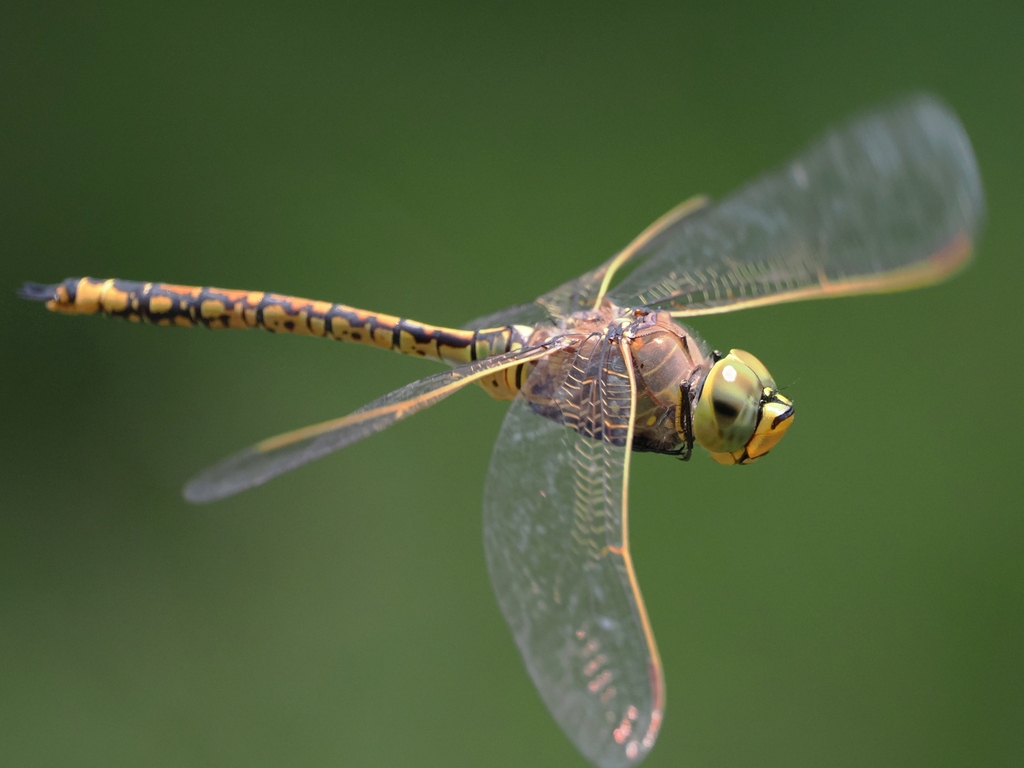
Australian Emperor
Anax papuensis
The Australian emperor dragonfly, also known as the yellow emperor dragonfly, scientific name Anax papuensis, is a species of dragonfly in the Aeshnidae family. It is black with yellow dots along its tail.
From the article Australian emperor on Wikipedia (CC BY-SA), quoted section by section
Description
The Australian emperor is a very large dragonfly, up to 70 mm long. Its abdomen is marked boldly in black and yellow. The thorax is greenish-grey. The head is yellow with a T-shaped mark on the forehead (frons). The eyes are yellow-green. The leading edges of the wings are yellow. The insect habitually hunts fairly slowly, patrolling up and down like other hawkers, with short bursts at high speed. Their wingspan is 11 centimetres (4.3 in). Males and females are similar.
Range & habitat
The Australian emperor is found throughout Australia. In the state of Victoria, it has a split distribution: below about 600 metres in altitude, and above about 1200 metres, apparently because it avoids forested areas. It is also found in New Zealand, New Guinea, the Cocos-Keeling Islands, Java, Sumba and New Caledonia. The Australian emperor is widespread and common on larger bodies of water with tall vegetation on the banks. Like other hawkers, it may hunt far from water. It flies throughout the summer from September to May.
Wikipedia: “Distribution and habitat”
What it does
The Australian emperor is notable as the dragonfly in which motion camouflage was studied by Mizutani et al.: males of Anax papuensis are fiercely territorial, and approach and attack rivals, the males choose a flight path that keeps their image as seen by the target still with respect to a landmark point. The attacking dragonfly thus looms larger in the target's eyes, but otherwise does not seem to move until it is very close. The males are very protective of their females. In case of intrusion of another individual, he will drive it away by engaging in a series of noisy air battles. Females lay their eggs under water.
Wikipedia: “Behaviour”
In human culture
The genus name Anax is derived from the Greek ἄναξ (anax, "king" or "sovereign"), likely referring to the dominant behaviour of Anax imperator. The species name papuensis is derived from Papua and the Latin suffix -ensis ("originating from" or "inhabiting"), although the name may be misleading, as the species had not been recorded from Papua New Guinea at the time it was described.
Wikipedia: “Etymology”
Listen
Looking for field recordings…
Where it lives
Recorded sightings
—
geo-referenced records in GBIF, from museums, herbaria and field observers.
Drag the globe to turn it. Dots are where records exist, not a range map; darker means more records.
In the stacks
Searching the stacks…
Every page naming Anax papuensis in the Biodiversity Heritage Library →
This page is assembled live from iNaturalist, GBIF, Wikipedia, the Source Library and the Internet Archive. It is not yet part of the hand-edited codex. iNaturalist taxon 323553.